AQA · GCSE · Business
Course version: 8132 · Version from Sept 2017
Price, product, promotion and place (4Ps): degree of competition
Full specification wording
The elements of the marketing mix: price, product, promotion and place (4Ps): degree of competition
The degree of competition measures how many rivals a business faces and how strongly they compete.
Checked against the AQA 8132 specification (opens in a new tab) on .
- Point 12 of 80
- 4 key terms
Study notes
From the checked teaching notes for this specification point.
The idea
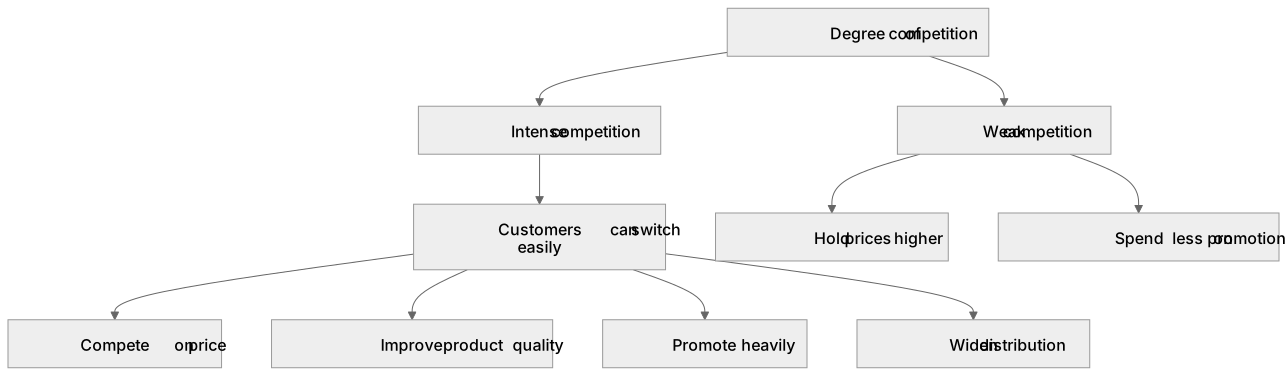
The degree of competition measures how many rivals a business faces and how strongly they compete. It ranges from a market with one dominant seller to one with many similar firms. Where competition is intense, customers can switch easily, so businesses often compete on price, improve product quality, promote heavily or widen distribution. Where competition is weak, a business may hold prices higher and spend less on promotion. For example, a town with several supermarkets may see price wars and loyalty schemes, while a sole pharmacy in a village faces little direct competition. Assessing the degree of competition helps a business decide how aggressively to use each element of the marketing mix.
What earns the marks
- Defines the degree of competition as the number and strength of rival businesses in a market.
- Explains how intense competition affects pricing, such as pressure to lower prices or offer discounts.
- Explains how competition affects product, promotion and place decisions, for example greater differentiation, heavier promotion or wider distribution.
- Applies the degree of competition to a given context, comparing a crowded market with one where a business has few rivals.
- Evaluates how far the degree of competition should drive marketing mix decisions compared with other factors such as costs or brand strength.
Common mistakes and how to put them right
Confusing the degree of competition with the nature of the market.
Put it right: Competition is one feature of the market, not the whole concept.
Assuming more competition always means lower prices.
Put it right: Firms may compete on quality, service or promotion instead of price.
Ignoring the effect of competition on non-price elements.
Put it right: Competition also shapes product features, promotional spend and place choices.
Exam tips
- State how many rivals exist and how similar their products are before explaining the effect on the 4Ps.
- Use comparative language such as more competitive or less competitive to show the strength of competition.
- Support evaluation by weighing competition against other influences, such as production costs or brand loyalty.
Try the lesson
The start of the The elements of the marketing mix: price, product, promotion and place (4Ps): degree of competition lesson, made from checked teaching notes for this specification point.
Have a go first
Which phrase best describes the degree of competition in a market where a large number of businesses sell similar products to the same group of customers?
Listen
The degree of competition measures how many rivals a business faces and how strongly they compete. It ranges from a market with one dominant seller to one with many similar firms. Where competition is intense, customers can switch easily, so businesses often compete on price, improve product quality, promote heavily or widen distribution. Where competition is weak, a business may hold prices higher and spend less on promotion. For example, a town with several supermarkets may see price wars and loyalty schemes, while a sole pharmacy in a village faces little direct competition. Assessing the degree of competition helps a business decide how aggressively to use each element of the marketing mix. A strong answer earns marks for these points. Defines the degree of competition as the number and strength of rival businesses in a market. Explains how intense competition affects pricing, such as pressure to lower prices or offer discounts. Explains how competition affects product, promotion and place decisions, for example greater differentiation, heavier promotion or wider distribution. Applies the degree of competition to a given context, comparing a crowded market with one where a business has few rivals. A common slip: Confusing the degree of competition with the nature of the market. Instead, competition is one feature of the market, not the whole concept. Exam tip: State how many rivals exist and how similar their products are before explaining the effect on the 4Ps.
See it
Key words
Say what each word means before you turn the card.
Degree of competition
Try answering aloud or in your head before turning the card.
Price competition
Try answering aloud or in your head before turning the card.
Non-price competition
Try answering aloud or in your head before turning the card.
Marketing mix
Try answering aloud or in your head before turning the card.
See every definition
- Degree of competition
- A measure of how many rivals a business faces and how strongly they compete.
- Price competition
- Competing by lowering prices or offering discounts where competition is intense and customers can switch easily.
- Non-price competition
- Competing by improving product quality, promoting heavily or widening distribution instead of competing on price.
- Marketing mix
- The elements of price, product, promotion and place that a business decides how aggressively to use.
Label the diagram
Some boxes have lost their names. Pick the right name for each number.
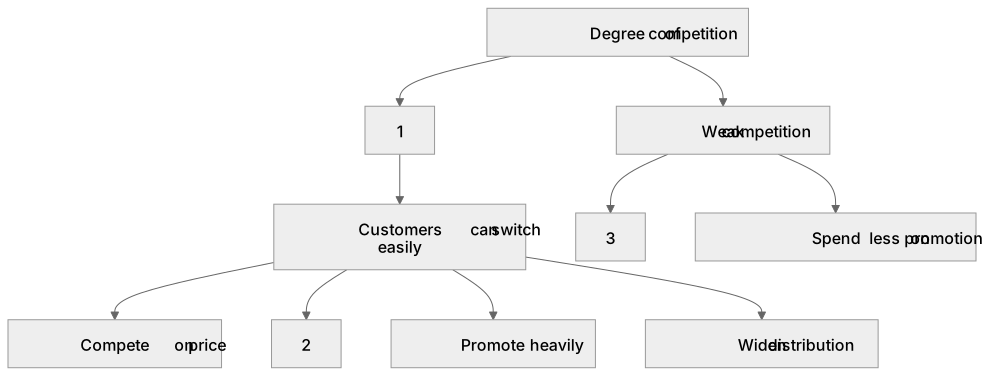
1Box 1
2Box 2
3Box 3
There is more to this lesson
The full lesson goes on to check your understanding and help you earn the marks. Create a free account to carry on, with your progress saved.
A week of Premium from your first lesson · Then the free plan continues · No card, no charge
Test your understanding of The elements of the marketing mix: price, product, promotion and place (4Ps): degree of competition
Active recall beats re-reading. Take an instant quiz now to test what you’ve learned and lock it into long-term memory.
A week of Premium from your first lesson · Then the free plan continues · No card, no charge