AQA · GCSE · Business
Course version: 8132 · Version from Sept 2017
Price, product, promotion and place (4Ps): product life cycle.
Full specification wording
The elements of the marketing mix: price, product, promotion and place (4Ps): product life cycle.
The product life cycle describes the stages a product passes through over time: development, introduction, growth, maturity and decline.
Checked against the AQA 8132 specification (opens in a new tab) on .
- Point 13 of 80
- 4 key terms
Study notes
From the checked teaching notes for this specification point.
The idea
The product life cycle describes the stages a product passes through over time: development, introduction, growth, maturity and decline. In development, costs are incurred before any sales revenue arrives. At introduction, sales are low and promotion is heavy, so profit may be negative. During growth, sales rise quickly as customers adopt the product and competitors may enter. At maturity, sales peak and competition is strongest, so the business may extend the cycle through updates, new packaging or new markets. In decline, sales fall as tastes, technology or substitutes change, so the business may withdraw the product. The cycle helps a business plan its marketing mix at each stage, for example charging a higher price at introduction and reviewing price at maturity.
What earns the marks
- Identifies the stages of the product life cycle: development, introduction, growth, maturity and decline.
- Explains that sales and profit behave differently at each stage, for example profit may be negative at introduction because of high launch costs.
- Explains how the marketing mix may change across stages, such as heavy promotion at introduction and price review at maturity.
- Explains extension strategies, such as product updates, new packaging or targeting new markets, used when sales approach maturity.
- Applies the model to a given business or product to explain a decision, for example withdrawing a product in decline.
Common mistakes and how to put them right
Treating the product life cycle as a guarantee that every product follows the same timescale.
Put it right by explaining that stage length varies between products and markets.
Confusing sales with profit at every stage.
Put it right by explaining that profit depends on costs as well as revenue, so a product can have rising sales but falling profit.
Assuming decline always means immediate withdrawal.
Put it right by explaining that extension strategies may be used before withdrawal is considered.
Exam tips
- Link each stage to a specific element of the marketing mix rather than describing the stages in isolation.
- Use the context of the case study product when explaining why a stage matters to the business.
- When recommending an extension strategy, justify it with reference to the product and its customers.
Try the lesson
The start of the The elements of the marketing mix: price, product, promotion and place (4Ps): product life cycle. lesson, made from checked teaching notes for this specification point.
Have a go first
Which stage of the product life cycle comes immediately after the introduction stage?
Listen
The product life cycle describes the stages a product passes through over time: development, introduction, growth, maturity and decline. In development, costs are incurred before any sales revenue arrives. At introduction, sales are low and promotion is heavy, so profit may be negative. During growth, sales rise quickly as customers adopt the product and competitors may enter. At maturity, sales peak and competition is strongest, so the business may extend the cycle through updates, new packaging or new markets. In decline, sales fall as tastes, technology or substitutes change, so the business may withdraw the product. The cycle helps a business plan its marketing mix at each stage, for example charging a higher price at introduction and reviewing price at maturity. A strong answer earns marks for these points. Identifies the stages of the product life cycle: development, introduction, growth, maturity and decline. Explains that sales and profit behave differently at each stage, for example profit may be negative at introduction because of high launch costs. Explains how the marketing mix may change across stages, such as heavy promotion at introduction and price review at maturity. Explains extension strategies, such as product updates, new packaging or targeting new markets, used when sales approach maturity. A common slip: Treating the product life cycle as a guarantee that every product follows the same timescale. Instead, explaining that stage length varies between products and markets. Exam tip: Link each stage to a specific element of the marketing mix rather than describing the stages in isolation.
See it
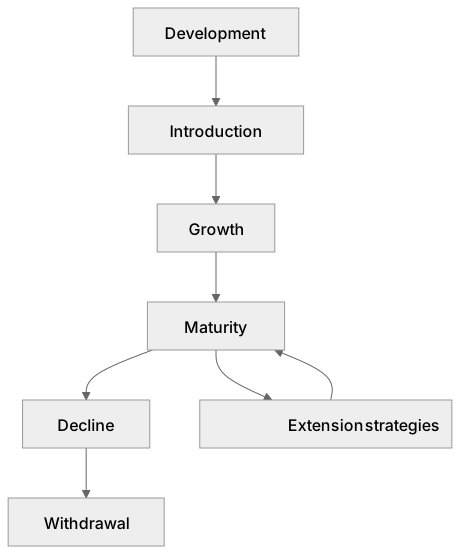
Key words
Say what each word means before you turn the card.
Product life cycle
Try answering aloud or in your head before turning the card.
Extension strategies
Try answering aloud or in your head before turning the card.
Sales, costs and profit
Try answering aloud or in your head before turning the card.
Marketing mix decisions over time
Try answering aloud or in your head before turning the card.
See every definition
- Product life cycle
- The stages a product passes through over time: development, introduction, growth, maturity and decline.
- Extension strategies
- Methods such as product updates, new packaging or targeting new markets, used when sales approach maturity.
- Sales, costs and profit
- Sales and profit behave differently at each stage, for example profit may be negative at introduction because of high launch costs.
- Marketing mix decisions over time
- The marketing mix may change across stages, such as heavy promotion at introduction and price review at maturity.
Label the diagram
Some boxes have lost their names. Pick the right name for each number.
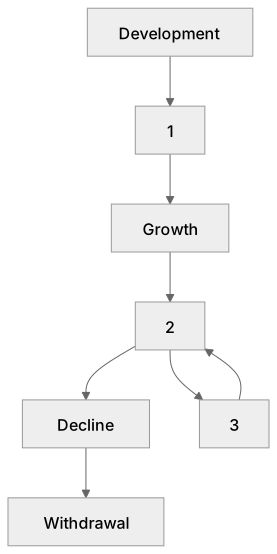
1Box 1
2Box 2
3Box 3
There is more to this lesson
The full lesson goes on to check your understanding and help you earn the marks. Create a free account to carry on, with your progress saved.
A week of Premium from your first lesson · Then the free plan continues · No card, no charge
Test your understanding of The elements of the marketing mix: price, product, promotion and place (4Ps): product life cycle.
Active recall beats re-reading. Take an instant quiz now to test what you’ve learned and lock it into long-term memory.
A week of Premium from your first lesson · Then the free plan continues · No card, no charge