AQA · GCSE · Business
Course version: 8132 · Version from Sept 2017
Price, product, promotion and place (4Ps): E-commerce and m-commerce…
Full specification wording
The elements of the marketing mix: price, product, promotion and place (4Ps): E-commerce and m-commerce Students should be able to analyse the growing importance of e-commerce and m-commerce and how it can extend the reach of businesses to include international markets.
E-commerce is buying and selling online, often through websites or marketplaces.
Checked against the AQA 8132 specification (opens in a new tab) on .
- Point 74 of 80
- 4 key terms
Study notes
From the checked teaching notes for this specification point.
The idea
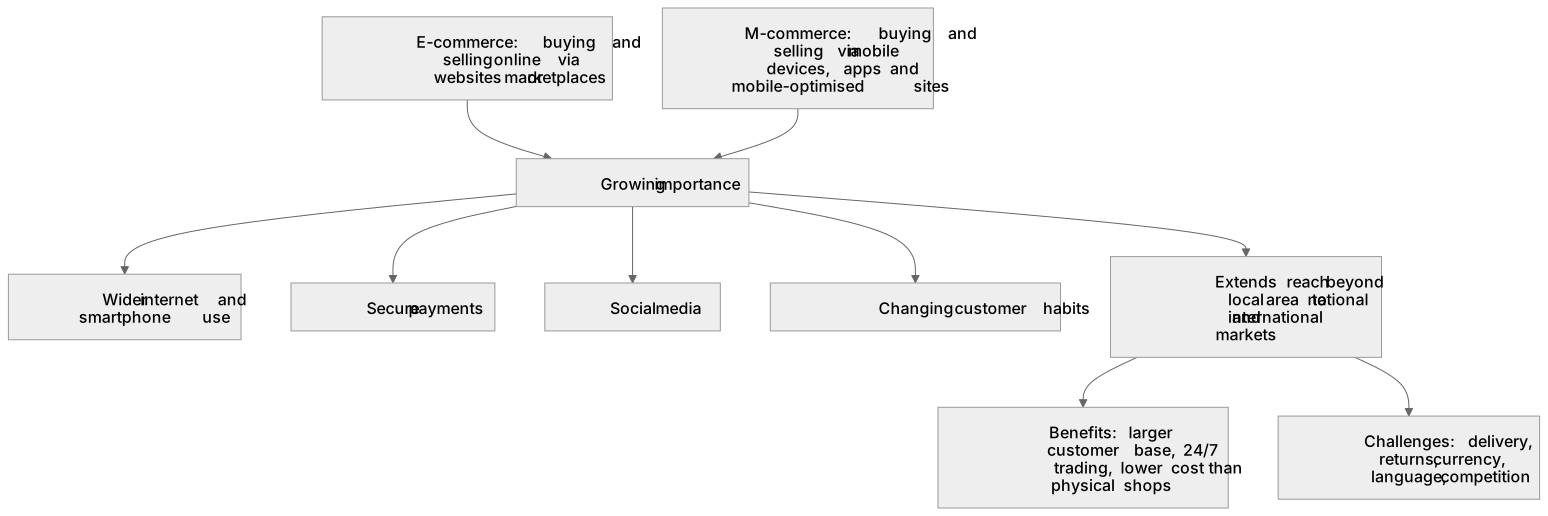
E-commerce is buying and selling online, often through websites or marketplaces. M-commerce is buying and selling through mobile devices, such as apps and mobile-optimised sites. Their growing importance comes from wider internet and smartphone use, secure payments, social media and changing customer habits. For a business, this extends reach beyond a local area to national and international markets, often at lower cost than opening physical shops. Analyse this by weighing benefits, such as a larger customer base and 24/7 trading, against challenges, such as delivery, returns, currency, language and competition.
What earns the marks
- Defines e-commerce and m-commerce and distinguishes between them, for example websites versus mobile apps and mobile-optimised sites.
- Explains reasons for their growing importance, such as increased internet access, smartphone ownership, secure online payment and changing consumer habits.
- Analyses how e-commerce and m-commerce extend reach, for example by removing geographical limits and allowing 24/7 trading.
- Explains how international markets can be reached, considering delivery networks, language, currency and local regulations.
- Weighs benefits against challenges, such as higher sales potential versus delivery costs, returns, cyber security and increased competition.
Common mistakes and how to put them right
Treating e-commerce and m-commerce as the same thing.
Put it right: State that m-commerce specifically uses mobile devices such as smartphones and tablets.
Claiming that going online automatically guarantees international sales.
Put it right: Explain that international reach also needs suitable delivery, payment, language and legal arrangements.
Ignoring the costs and risks of online trading.
Put it right: Consider website development, fulfilment, returns, cyber security and delivery charges.
Exam tips
- Use the scenario's product and market to explain why e-commerce or m-commerce matters for that business.
- Develop each point with a consequence, for example wider reach leads to more potential customers, which may increase sales and allow economies of scale.
- When analysing international markets, refer to at least one practical issue, such as delivery time, currency exchange or local competition.
Try the lesson
The start of the The elements of the marketing mix: price, product, promotion and place (4Ps): E-commerce and m-commerce Students should be able to analyse the growing importance of e-commerce and m-commerce and how it can extend the reach of businesses to include international markets. lesson, made from checked teaching notes for this specification point.
Have a go first
A UK-based manufacturer of specialist sports equipment decides to launch an e-commerce website. How does this decision most effectively extend the business's reach to international markets?
Listen
E-commerce is buying and selling online, often through websites or marketplaces. M-commerce is buying and selling through mobile devices, such as apps and mobile-optimised sites. Their growing importance comes from wider internet and smartphone use, secure payments, social media and changing customer habits. For a business, this extends reach beyond a local area to national and international markets, often at lower cost than opening physical shops. Analyse this by weighing benefits, such as a larger customer base and 24/7 trading, against challenges, such as delivery, returns, currency, language and competition. A strong answer earns marks for these points. Defines e-commerce and m-commerce and distinguishes between them, for example websites versus mobile apps and mobile-optimised sites. Explains reasons for their growing importance, such as increased internet access, smartphone ownership, secure online payment and changing consumer habits. Analyses how e-commerce and m-commerce extend reach, for example by removing geographical limits and allowing 24/7 trading. Explains how international markets can be reached, considering delivery networks, language, currency and local regulations. A common slip: Treating e-commerce and m-commerce as the same thing. Instead, state that m-commerce specifically uses mobile devices such as smartphones and tablets. Exam tip: Use the scenario's product and market to explain why e-commerce or m-commerce matters for that business.
See it
Key words
Say what each word means before you turn the card.
E-commerce
Try answering aloud or in your head before turning the card.
M-commerce
Try answering aloud or in your head before turning the card.
Market reach and internationalisation
Try answering aloud or in your head before turning the card.
Online trading opportunities and challenges
Try answering aloud or in your head before turning the card.
See every definition
- E-commerce
- Buying and selling online, often through websites or marketplaces.
- M-commerce
- Buying and selling through mobile devices, such as apps and mobile-optimised sites.
- Market reach and internationalisation
- Extending reach beyond a local area to national and international markets, often at lower cost than opening physical shops.
- Online trading opportunities and challenges
- Weighing benefits, such as a larger customer base and 24/7 trading, against challenges, such as delivery, returns, currency, language and competition.
Label the diagram
Some boxes have lost their names. Pick the right name for each number.
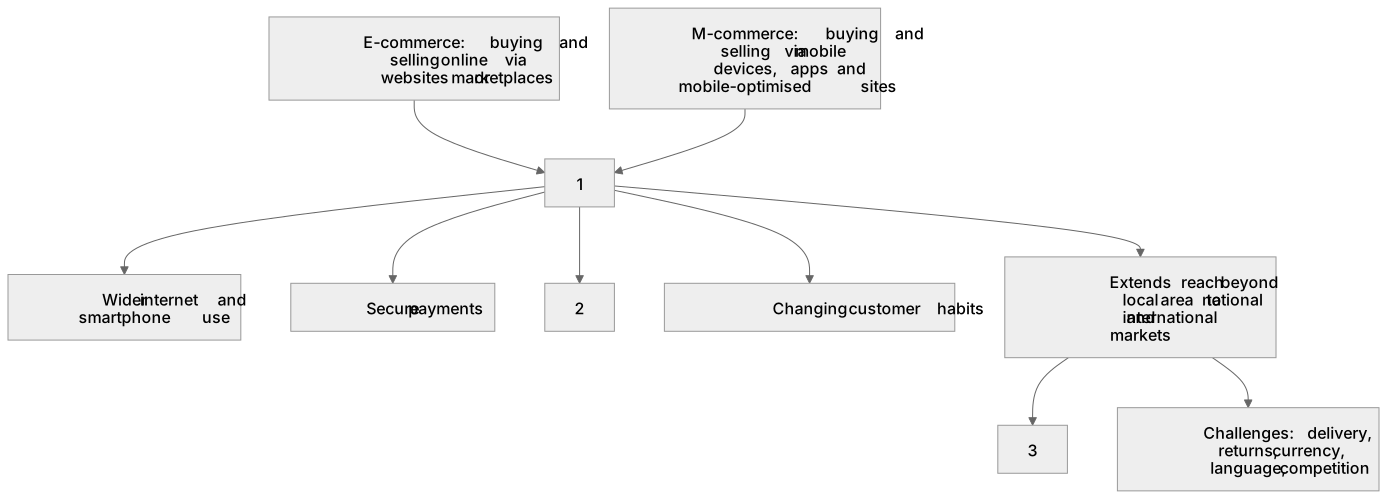
1Box 1
2Box 2
3Box 3
There is more to this lesson
The full lesson goes on to check your understanding and help you earn the marks. Create a free account to carry on, with your progress saved.
A week of Premium from your first lesson · Then the free plan continues · No card, no charge
Test your understanding of The elements of the marketing mix: price, product, promotion and place (4Ps): E-commerce and m-commerce Students should be able to analyse the growing importance of e-commerce and m-commerce and how it can extend the reach of businesses to include international markets.
Active recall beats re-reading. Take an instant quiz now to test what you’ve learned and lock it into long-term memory.
A week of Premium from your first lesson · Then the free plan continues · No card, no charge