AQA · GCSE · Business
Course version: 8132 · Version from Sept 2017
Price, product, promotion and place (4Ps): Reasons for promotion:
Full specification wording
The elements of the marketing mix: price, product, promotion and place (4Ps): Reasons for promotion:
Promotion is the 'P' of the marketing mix concerned with communicating with customers.
Checked against the AQA 8132 specification (opens in a new tab) on .
- Point 63 of 80
- 4 key terms
Study notes
From the checked teaching notes for this specification point.
The idea
Promotion is the 'P' of the marketing mix concerned with communicating with customers. A business promotes for several connected reasons. It may need to make potential customers aware that a product exists, especially for a new product or a new market. It may need to remind existing customers, or persuade them to choose its brand rather than a rival's. Promotion can also inform customers about product features, price changes or where to buy, and it can help build a brand image and customer loyalty. A further reason is to increase sales and market share, perhaps by encouraging repeat purchase or attracting new segments. The reason chosen shapes the method: awareness may suit advertising, while persuasion may suit special offers.
What earns the marks
- Identifies promotion as the communication element of the marketing mix, distinct from price, product and place.
- Explains that promotion raises awareness of a product, particularly for new products or new markets.
- Explains that promotion reminds existing customers and encourages repeat purchase or loyalty.
- Explains that promotion persuades customers to choose one brand over a competitor's.
- Explains that promotion can inform customers about features, price changes or where to buy.
- Explains that promotion supports sales growth and market share, and can build brand image.
Common mistakes and how to put them right
Treating promotion as only advertising.
Put it right: Promotion also includes sales promotions, public relations, sponsorship, direct marketing and personal selling.
Confusing promotion with price.
Put it right: Promotion communicates with customers, while price is the amount charged.
Assuming promotion always increases sales.
Put it right: Promotion may fail if the message, method or budget is unsuitable for the target market.
Exam tips
- Link each reason to a specific method, such as using advertising to build awareness or a special offer to encourage trial.
- Use business context from the case study rather than writing about promotion in general.
- Develop each reason with a consequence, such as increased sales leading to higher market share.
Try the lesson
The start of the The elements of the marketing mix: price, product, promotion and place (4Ps): Reasons for promotion: lesson, made from checked teaching notes for this specification point.
Have a go first
Which one of the following is a reason why a business carries out promotion?
Listen
Promotion is the 'P' of the marketing mix concerned with communicating with customers. A business promotes for several connected reasons. It may need to make potential customers aware that a product exists, especially for a new product or a new market. It may need to remind existing customers, or persuade them to choose its brand rather than a rival's. Promotion can also inform customers about product features, price changes or where to buy, and it can help build a brand image and customer loyalty. A further reason is to increase sales and market share, perhaps by encouraging repeat purchase or attracting new segments. The reason chosen shapes the method: awareness may suit advertising, while persuasion may suit special offers. A strong answer earns marks for these points. Identifies promotion as the communication element of the marketing mix, distinct from price, product and place. Explains that promotion raises awareness of a product, particularly for new products or new markets. Explains that promotion reminds existing customers and encourages repeat purchase or loyalty. Explains that promotion persuades customers to choose one brand over a competitor's. A common slip: Treating promotion as only advertising. Instead, promotion also includes sales promotions, public relations, sponsorship, direct marketing and personal selling. Exam tip: Link each reason to a specific method, such as using advertising to build awareness or a special offer to encourage trial.
See it

Key words
Say what each word means before you turn the card.
Marketing mix
Try answering aloud or in your head before turning the card.
Communication with customers
Try answering aloud or in your head before turning the card.
Customer awareness and persuasion
Try answering aloud or in your head before turning the card.
Sales growth and brand image
Try answering aloud or in your head before turning the card.
See every definition
- Marketing mix
- The combination of price, product, promotion and place, known as the 4Ps, in which promotion is the element concerned with communicating with customers.
- Communication with customers
- The role of promotion within the marketing mix, informing customers about product features, price changes or where to buy.
- Customer awareness and persuasion
- Making potential customers aware that a product exists, especially for a new product or a new market, and persuading them to choose its brand rather than a rival's.
- Sales growth and brand image
- Increasing sales and market share, perhaps by encouraging repeat purchase or attracting new segments, and helping to build a brand image and customer loyalty.
Label the diagram
Some boxes have lost their names. Pick the right name for each number.
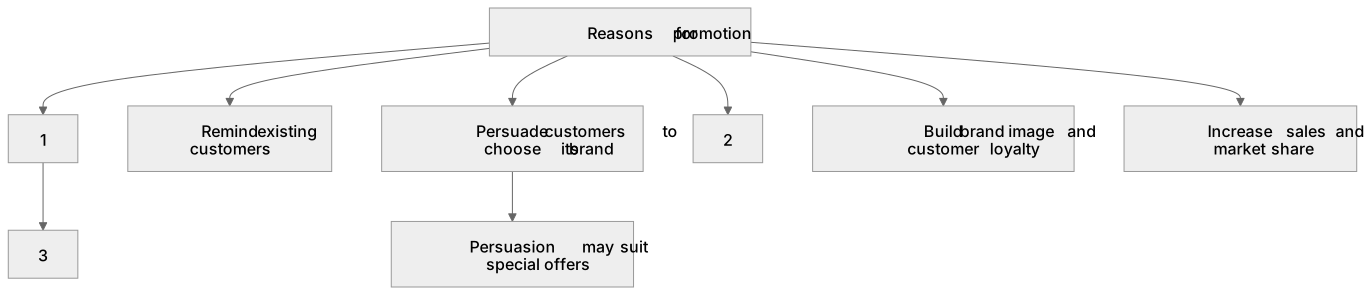
1Box 1
2Box 2
3Box 3
There is more to this lesson
The full lesson goes on to check your understanding and help you earn the marks. Create a free account to carry on, with your progress saved.
A week of Premium from your first lesson · Then the free plan continues · No card, no charge
Test your understanding of The elements of the marketing mix: price, product, promotion and place (4Ps): Reasons for promotion:
Active recall beats re-reading. Take an instant quiz now to test what you’ve learned and lock it into long-term memory.
A week of Premium from your first lesson · Then the free plan continues · No card, no charge