AQA · GCSE · Business
Course version: 8132 · Version from Sept 2017
Price, product, promotion and place (4Ps): target market.
Full specification wording
The elements of the marketing mix: price, product, promotion and place (4Ps): target market.
A target market is the specific group of customers a business aims to attract and satisfy with its marketing mix.
Checked against the AQA 8132 specification (opens in a new tab) on .
- Point 62 of 80
- 3 key terms
Study notes
From the checked teaching notes for this specification point.
The idea
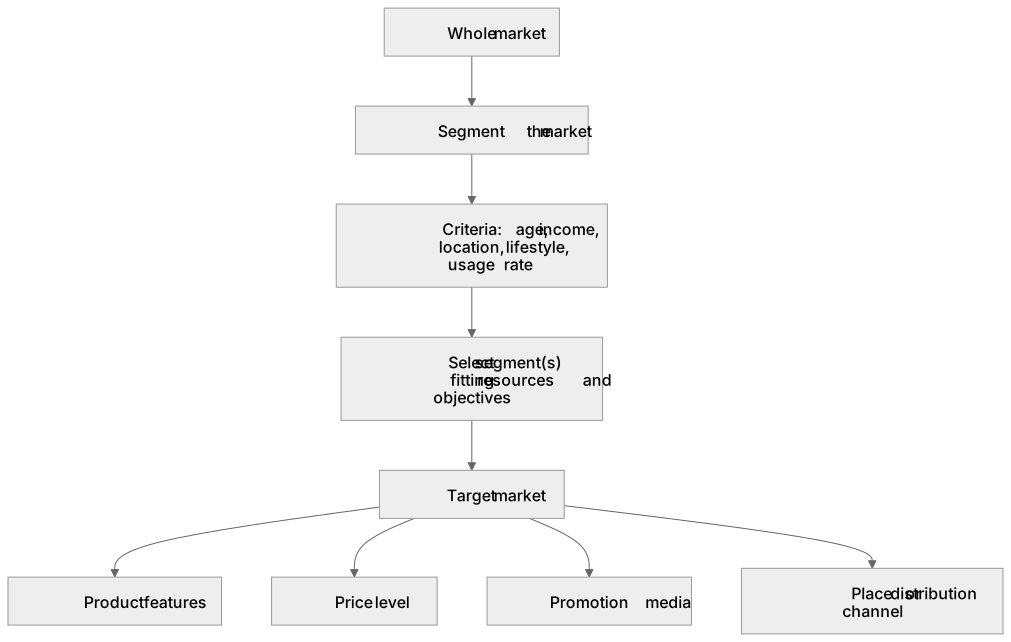
A target market is the specific group of customers a business aims to attract and satisfy with its marketing mix. It is identified by segmenting the whole market using criteria such as age, income, location, lifestyle or usage rate, then selecting the segment or segments that best fit the business's resources and objectives. For example, a business may target 18–25 year old urban students with a low-priced, heavily promoted mobile app, or target affluent professionals with a premium product sold through selected outlets. The target market shapes decisions about price, product features, promotion media and place. A clear target market helps a business focus its limited budget, differentiate from rivals and measure success, but it also means the business may miss sales from other groups.
What earns the marks
- Defines a target market as the specific group of customers a business aims to attract and satisfy, distinguishing it from the whole market.
- Explains that a target market is identified through segmentation using criteria such as age, income, location, lifestyle or usage rate.
- Uses a concrete example, such as a business targeting 18–25 year old urban students with a low-priced app, to show how the target market shapes the marketing mix.
- Explains how the target market influences each element of the marketing mix: product features, price level, promotion media and place or distribution channel.
- Applies the concept to a case study by identifying the target market from the evidence and justifying how the marketing mix should be adapted to meet its needs.
- Evaluates the benefits and drawbacks of targeting a specific market, such as focus and differentiation versus missed sales from other groups.
Common mistakes and how to put them right
Confusing the target market with the whole market.
Put it right by stating that the target market is a selected segment or segments, not all possible buyers.
Believing that a target market must be a single demographic group.
Put it right by recognising that it can be defined by multiple criteria such as income, lifestyle and usage rate combined.
Assuming that a target market never changes.
Put it right by explaining that it can be revised as customer needs, competition or business objectives change.
Exam tips
- When asked about the target market, state the specific group and then link it to at least two elements of the marketing mix to show understanding.
- Use case study evidence to justify why the chosen target market is appropriate, for example by referring to the age, income or location of potential customers.
- Avoid saying 'everyone' is the target market; instead identify a distinct group and explain why focusing on it is sensible for the business.
Try the lesson
The start of the The elements of the marketing mix: price, product, promotion and place (4Ps): target market. lesson, made from checked teaching notes for this specification point.
Have a go first
What is meant by a business's target market?
Listen
A target market is the specific group of customers a business aims to attract and satisfy with its marketing mix. It is identified by segmenting the whole market using criteria such as age, income, location, lifestyle or usage rate, then selecting the segment or segments that best fit the business's resources and objectives. For example, a business may target 18–25 year old urban students with a low-priced, heavily promoted mobile app, or target affluent professionals with a premium product sold through selected outlets. The target market shapes decisions about price, product features, promotion media and place. A clear target market helps a business focus its limited budget, differentiate from rivals and measure success, but it also means the business may miss sales from other groups. A strong answer earns marks for these points. Defines a target market as the specific group of customers a business aims to attract and satisfy, distinguishing it from the whole market. Explains that a target market is identified through segmentation using criteria such as age, income, location, lifestyle or usage rate. Uses a concrete example, such as a business targeting 18–25 year old urban students with a low-priced app, to show how the target market shapes the marketing mix. Explains how the target market influences each element of the marketing mix: product features, price level, promotion media and place or distribution channel. A common slip: Confusing the target market with the whole market. Instead, stating that the target market is a selected segment or segments, not all possible buyers. Exam tip: When asked about the target market, state the specific group and then link it to at least two elements of the marketing mix to show understanding.
See it
Key words
Say what each word means before you turn the card.
Target market
Try answering aloud or in your head before turning the card.
Market segmentation
Try answering aloud or in your head before turning the card.
Marketing mix
Try answering aloud or in your head before turning the card.
See every definition
- Target market
- The specific group of customers a business aims to attract and satisfy with its marketing mix.
- Market segmentation
- Identifying a target market by dividing the whole market using criteria such as age, income, location, lifestyle or usage rate.
- Marketing mix
- Price, product, promotion and place, the decisions shaped by the target market.
Label the diagram
Some boxes have lost their names. Pick the right name for each number.
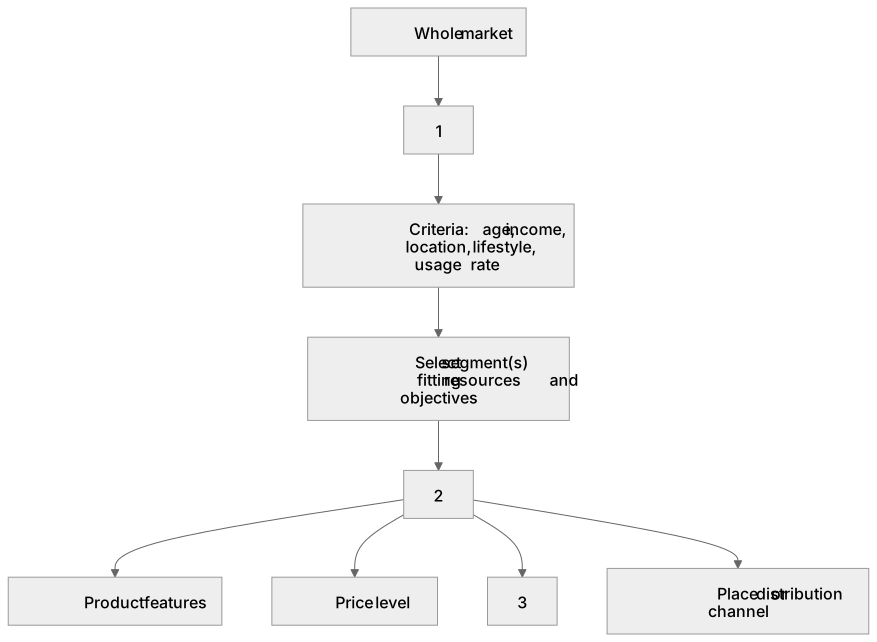
1Box 1
2Box 2
3Box 3
There is more to this lesson
The full lesson goes on to check your understanding and help you earn the marks. Create a free account to carry on, with your progress saved.
A week of Premium from your first lesson · Then the free plan continues · No card, no charge
Test your understanding of The elements of the marketing mix: price, product, promotion and place (4Ps): target market.
Active recall beats re-reading. Take an instant quiz now to test what you’ve learned and lock it into long-term memory.
A week of Premium from your first lesson · Then the free plan continues · No card, no charge