AQA · GCSE · Business
Course version: 8132 · Version from Sept 2017
Price, product, promotion and place (4Ps): research and development
Full specification wording
The elements of the marketing mix: price, product, promotion and place (4Ps): research and development
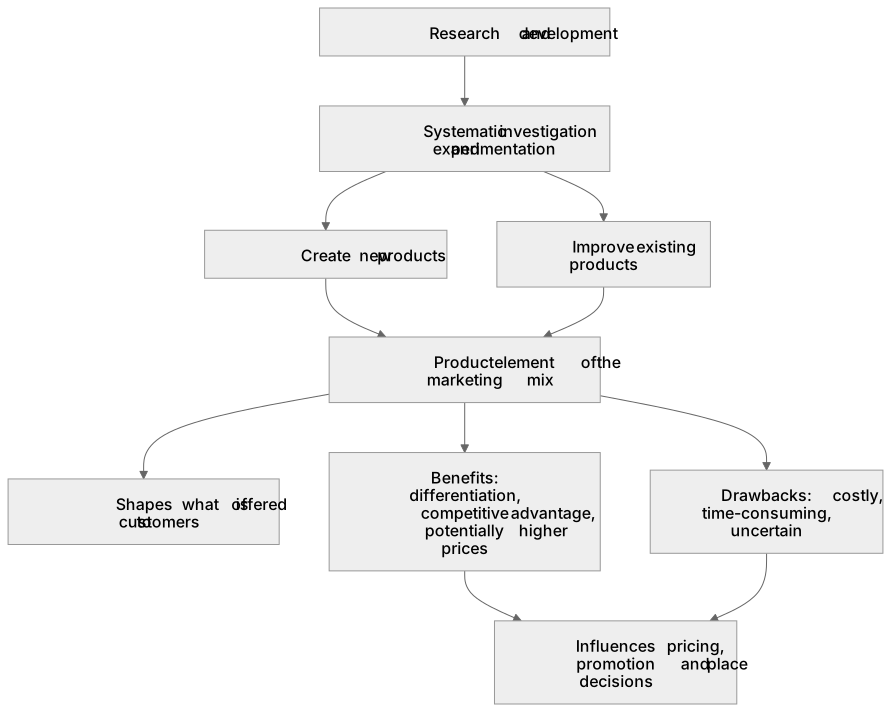
Research and development (R&D) is the systematic investigation and experimentation a business undertakes to create new products or improve existing ones.
Checked against the AQA 8132 specification (opens in a new tab) on .
- Point 23 of 80
- 2 key terms
Study notes
From the checked teaching notes for this specification point.
The idea
Research and development (R&D) is the systematic investigation and experimentation a business undertakes to create new products or improve existing ones. It sits within the product element of the marketing mix because it directly shapes what is offered to customers. For example, a pharmaceutical company may spend years testing a new compound before launch, while a food manufacturer might reformulate a recipe to reduce sugar. R&D can be a source of competitive advantage, enabling differentiation and potentially higher prices, but it is costly, time-consuming and uncertain. Businesses must weigh these risks against the need to keep pace with customer expectations and technological change. Effective R&D supports product design, quality and innovation, which in turn influence pricing, promotion and place decisions.
What earns the marks
- Defines R&D as systematic investigation aimed at creating new products or improving existing ones.
- Explains how R&D links to the product element of the marketing mix and influences what is offered to customers.
- Gives a relevant example of R&D activity, such as developing a new app or reformulating a drink.
- Analyses at least one benefit of R&D, such as differentiation, competitive advantage or ability to charge higher prices.
- Analyses at least one drawback of R&D, such as high cost, long timescales or uncertain commercial success.
- Reaches a judgement about whether R&D is worthwhile for a given business context.
Common mistakes and how to put them right
Confusing R&D with general market research.
Put it right: R&D focuses on creating or improving products and processes, whereas market research gathers information about customers and markets.
Assuming R&D always leads to successful products.
Put it right: Recognise that R&D carries risk and many projects fail or are abandoned.
Treating R&D as only relevant to large technology firms.
Put it right: Many businesses, including small firms, undertake R&D to stay competitive.
Exam tips
- Use a specific business example to illustrate how R&D affects the product element of the marketing mix.
- When evaluating, weigh the potential rewards of R&D against the costs and risks in the context given.
- Link R&D decisions to other parts of the marketing mix, such as how a new product might be priced or promoted.
Try the lesson
The start of the The elements of the marketing mix: price, product, promotion and place (4Ps): research and development lesson, made from checked teaching notes for this specification point.
Have a go first
In the marketing mix, which activity involves creating new products and improving existing ones?
Listen
Research and development (R&D) is the systematic investigation and experimentation a business undertakes to create new products or improve existing ones. It sits within the product element of the marketing mix because it directly shapes what is offered to customers. For example, a pharmaceutical company may spend years testing a new compound before launch, while a food manufacturer might reformulate a recipe to reduce sugar. R&D can be a source of competitive advantage, enabling differentiation and potentially higher prices, but it is costly, time-consuming and uncertain. Businesses must weigh these risks against the need to keep pace with customer expectations and technological change. Effective R&D supports product design, quality and innovation, which in turn influence pricing, promotion and place decisions. A strong answer earns marks for these points. Defines R&D as systematic investigation aimed at creating new products or improving existing ones. Explains how R&D links to the product element of the marketing mix and influences what is offered to customers. Gives a relevant example of R&D activity, such as developing a new app or reformulating a drink. Analyses at least one benefit of R&D, such as differentiation, competitive advantage or ability to charge higher prices. A common slip: Confusing R&D with general market research. Instead, R&D focuses on creating or improving products and processes, whereas market research gathers information about customers and markets. Exam tip: Use a specific business example to illustrate how R&D affects the product element of the marketing mix.
See it
Key words
Say what each word means before you turn the card.
Research and development
Try answering aloud or in your head before turning the card.
Competitive advantage
Try answering aloud or in your head before turning the card.
See every definition
- Research and development
- The systematic investigation and experimentation a business undertakes to create new products or improve existing ones.
- Competitive advantage
- A source of advantage that enables differentiation and potentially higher prices.
Label the diagram
Some boxes have lost their names. Pick the right name for each number.
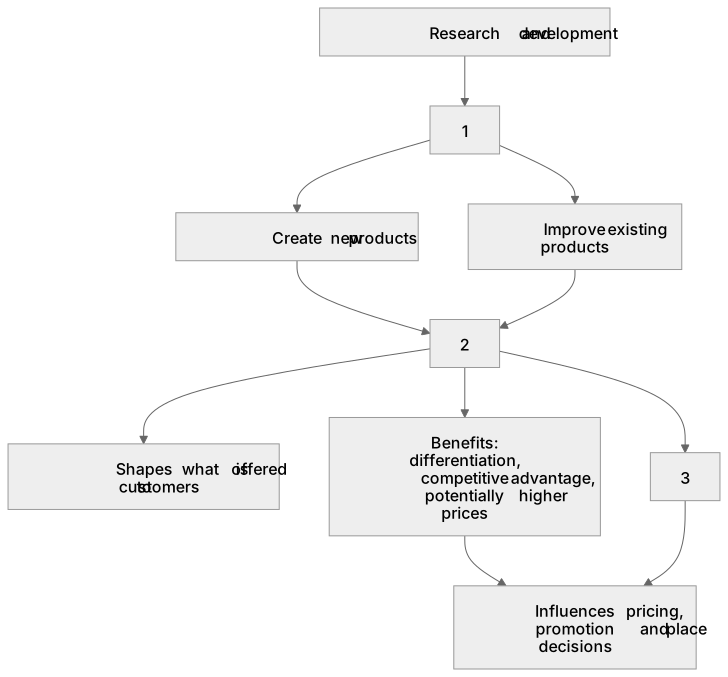
1Box 1
2Box 2
3Box 3
There is more to this lesson
The full lesson goes on to check your understanding and help you earn the marks. Create a free account to carry on, with your progress saved.
A week of Premium from your first lesson · Then the free plan continues · No card, no charge
Test your understanding of The elements of the marketing mix: price, product, promotion and place (4Ps): research and development
Active recall beats re-reading. Take an instant quiz now to test what you’ve learned and lock it into long-term memory.
A week of Premium from your first lesson · Then the free plan continues · No card, no charge