AQA · GCSE · Business
Course version: 8132 · Version from Sept 2017
Price, product, promotion and place (4Ps): Students should have an…
Full specification wording
The elements of the marketing mix: price, product, promotion and place (4Ps): Students should have an understanding of the product life cycle and demonstrate how demand for a product or service might change over time.
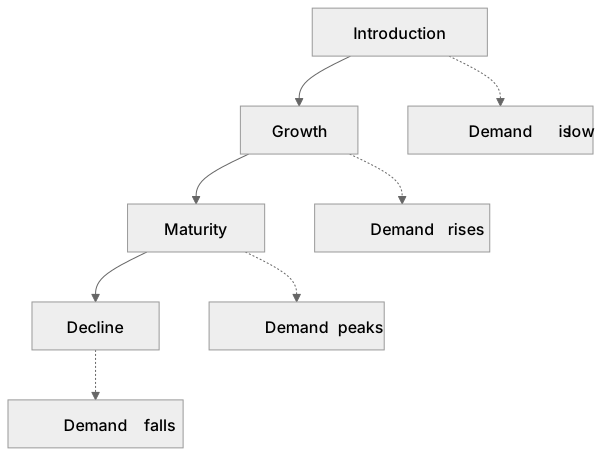
The cycle has four stages: introduction, growth, maturity and decline.
Checked against the AQA 8132 specification (opens in a new tab) on .
- Point 22 of 80
- 4 key terms
Study notes
From the checked teaching notes for this specification point.
The idea
The cycle has four stages: introduction, growth, maturity and decline. Demand is low at introduction, rises during growth, peaks at maturity and falls in decline. They should also apply the model to real or hypothetical products, suggesting how a business might respond at each stage, for example by using price skimming at introduction or extension strategies at maturity. Understanding the cycle helps businesses plan their marketing mix effectively.
What earns the marks
- Describes the product life cycle stages and links each stage to a change in demand.
- Explains why demand changes over time, referring to factors such as customer awareness, competition, changing tastes or technological advances.
- Applies the model to a specific product or service, showing how demand might rise, peak and fall.
- Suggests appropriate marketing mix responses at different stages, such as promotional offers during growth or price reductions during decline.
- Evaluates the usefulness of the product life cycle model, recognising that not all products follow the same pattern and that demand can be influenced by external factors.
Common mistakes and how to put them right
Describing the stages without linking them to changes in demand.
Put it right: The focus should be on how demand changes over time, not just naming the stages.
Assuming demand always falls in maturity.
Put it right: Demand may plateau rather than fall, and decline may be delayed by extension strategies.
Ignoring the impact of external factors such as a recession or a competitor's new product, which can change demand at any stage.
Confusing demand with sales volume.
Put it right: Demand is the willingness and ability to buy, while sales are actual purchases; they are related but not identical.
Exam tips
- Use a diagram of the product life cycle to support your answer, labelling the axes as time and sales or demand.
- When explaining changes in demand, refer to specific stages and give a reason for each change, such as 'in growth, demand rises because more customers become aware of the product through advertising'.
- Apply your answer to the context given in the question; if the question mentions a particular business or product, use that throughout.
- For evaluation, consider whether the product life cycle is a useful planning tool for the business in question, and what limitations it has.
Try the lesson
The start of the The elements of the marketing mix: price, product, promotion and place (4Ps): Students should have an understanding of the product life cycle and demonstrate how demand for a product or service might change over time. lesson, made from checked teaching notes for this specification point.
Have a go first
A product life cycle diagram shows how demand for a product changes over time. During which stage does demand for a product usually fall?
Listen
The cycle has four stages: introduction, growth, maturity and decline. Demand is low at introduction, rises during growth, peaks at maturity and falls in decline. They should also apply the model to real or hypothetical products, suggesting how a business might respond at each stage, for example by using price skimming at introduction or extension strategies at maturity. Understanding the cycle helps businesses plan their marketing mix effectively. A strong answer earns marks for these points. Describes the product life cycle stages and links each stage to a change in demand. Explains why demand changes over time, referring to factors such as customer awareness, competition, changing tastes or technological advances. Applies the model to a specific product or service, showing how demand might rise, peak and fall. Suggests appropriate marketing mix responses at different stages, such as promotional offers during growth or price reductions during decline. Exam tip: Use a diagram of the product life cycle to support your answer, labelling the axes as time and sales or demand.
See it
Key words
Say what each word means before you turn the card.
Product life cycle stages
Try answering aloud or in your head before turning the card.
Demand changes over time
Try answering aloud or in your head before turning the card.
Marketing mix responses
Try answering aloud or in your head before turning the card.
External influences on demand
Try answering aloud or in your head before turning the card.
See every definition
- Product life cycle stages
- The cycle has four stages: introduction, growth, maturity and decline.
- Demand changes over time
- Demand is low at introduction, rises during growth, peaks at maturity and falls in decline.
- Marketing mix responses
- A business might respond at each stage, for example by using price skimming at introduction or extension strategies at maturity.
- External influences on demand
- Demand can be influenced by external factors, such as a recession or a competitor's new product, which can change demand at any stage.
Label the diagram
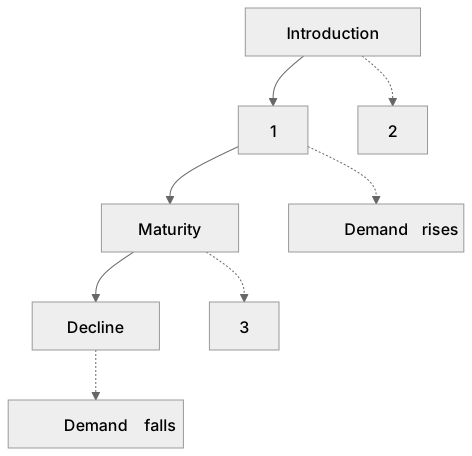
Some boxes have lost their names. Pick the right name for each number.
1Box 1
2Box 2
3Box 3
There is more to this lesson
The full lesson goes on to check your understanding and help you earn the marks. Create a free account to carry on, with your progress saved.
A week of Premium from your first lesson · Then the free plan continues · No card, no charge
Test your understanding of The elements of the marketing mix: price, product, promotion and place (4Ps): Students should have an understanding of the product life cycle and demonstrate how demand for a product or service might change over time.
Active recall beats re-reading. Take an instant quiz now to test what you’ve learned and lock it into long-term memory.
A week of Premium from your first lesson · Then the free plan continues · No card, no charge