AQA · GCSE · Business
Course version: 8132 · Version from Sept 2017
Price, product, promotion and place (4Ps): retailers
Full specification wording
The elements of the marketing mix: price, product, promotion and place (4Ps): retailers
A retailer is an intermediary that buys goods from a producer or wholesaler and sells them to final customers, usually in small quantities from a shop or website.
Checked against the AQA 8132 specification (opens in a new tab) on .
- Point 70 of 80
- 4 key terms
Study notes
From the checked teaching notes for this specification point.
The idea
A retailer is an intermediary that buys goods from a producer or wholesaler and sells them to final customers, usually in small quantities from a shop or website. Retailers provide place utility: they hold stock in convenient locations, offer choice across many brands and let customers buy single items rather than bulk packs. For a producer, selling through retailers gives access to potential customers who already shop there, but the retailer takes a margin, so the producer receives less per unit and has less control over how the product is displayed or priced. Retailers range from small independents to national chains and online sellers. Their scale affects the producer's reach: a national chain can place a product in front of many customers, while an independent serves a local market.
What earns the marks
- Defines a retailer as a business that buys goods and sells them to final customers, typically in small quantities.
- Explains the retailer's role in breaking bulk, holding stock and offering customers a convenient range of products in one place.
- Explains that selling through retailers gives a producer access to the retailer's existing customers and locations.
- Analyses the cost of using retailers, since the retailer's margin reduces the producer's revenue per unit sold.
- Applies the role of retailers to a context, for example a small food producer gaining shelf space in a supermarket chain.
- Evaluates whether using a particular retailer is worthwhile by comparing extra customer access with lost margin and reduced control.
Common mistakes and how to put them right
Describing a retailer as a manufacturer.
Put it right: A retailer buys finished goods and resells them to final customers without making them.
Saying retailers always sell in bulk.
Put it right: Retailers typically break bulk and sell small quantities to consumers, while wholesalers sell larger quantities to retailers.
Ignoring the retailer's margin.
Put it right: The margin is a cost to the producer and should be weighed against the extra customers the retailer reaches.
Exam tips
- Use the word retailer precisely in answers, and distinguish it from wholesaler and producer where the case allows.
- Support points with the named retailer or type of shop in the case rather than writing about shops in general.
- When evaluating, state what the producer gains in customer access and what it gives up in margin or control.
Try the lesson
The start of the The elements of the marketing mix: price, product, promotion and place (4Ps): retailers lesson, made from checked teaching notes for this specification point.
Have a go first
Which of the following is a retailer?
Listen
A retailer is an intermediary that buys goods from a producer or wholesaler and sells them to final customers, usually in small quantities from a shop or website. Retailers provide place utility: they hold stock in convenient locations, offer choice across many brands and let customers buy single items rather than bulk packs. For a producer, selling through retailers gives access to potential customers who already shop there, but the retailer takes a margin, so the producer receives less per unit and has less control over how the product is displayed or priced. Retailers range from small independents to national chains and online sellers. Their scale affects the producer's reach: a national chain can place a product in front of many customers, while an independent serves a local market. A strong answer earns marks for these points. Defines a retailer as a business that buys goods and sells them to final customers, typically in small quantities. Explains the retailer's role in breaking bulk, holding stock and offering customers a convenient range of products in one place. Explains that selling through retailers gives a producer access to the retailer's existing customers and locations. Analyses the cost of using retailers, since the retailer's margin reduces the producer's revenue per unit sold. A common slip: Describing a retailer as a manufacturer. Instead, a retailer buys finished goods and resells them to final customers without making them. Exam tip: Use the word retailer precisely in answers, and distinguish it from wholesaler and producer where the case allows.
See it
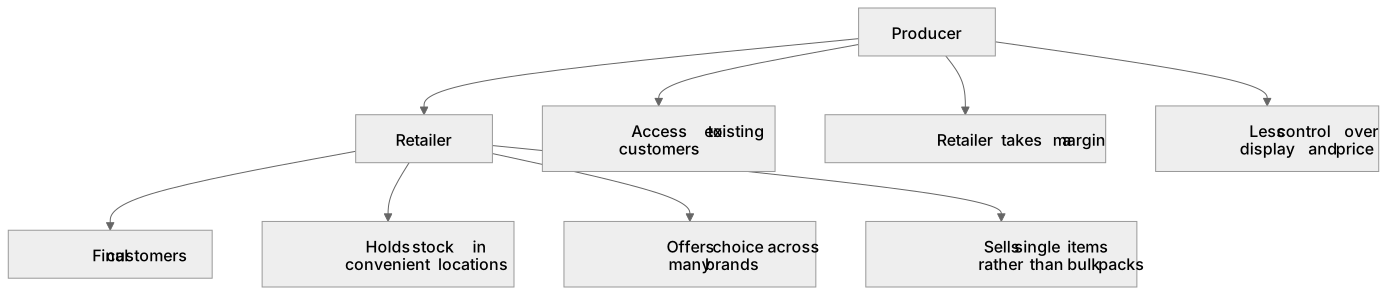
Key words
Say what each word means before you turn the card.
Intermediary role
Try answering aloud or in your head before turning the card.
Breaking bulk and convenience
Try answering aloud or in your head before turning the card.
Access to customers
Try answering aloud or in your head before turning the card.
Margin and control
Try answering aloud or in your head before turning the card.
See every definition
- Intermediary role
- A retailer buys goods from a producer or wholesaler and sells them to final customers, usually in small quantities from a shop or website.
- Breaking bulk and convenience
- Retailers hold stock in convenient locations, offer choice across many brands and let customers buy single items rather than bulk packs.
- Access to customers
- Selling through retailers gives a producer access to potential customers who already shop there, and the retailer's scale affects the producer's reach.
- Margin and control
- The retailer takes a margin, so the producer receives less per unit and has less control over how the product is displayed or priced.
Label the diagram
Some boxes have lost their names. Pick the right name for each number.
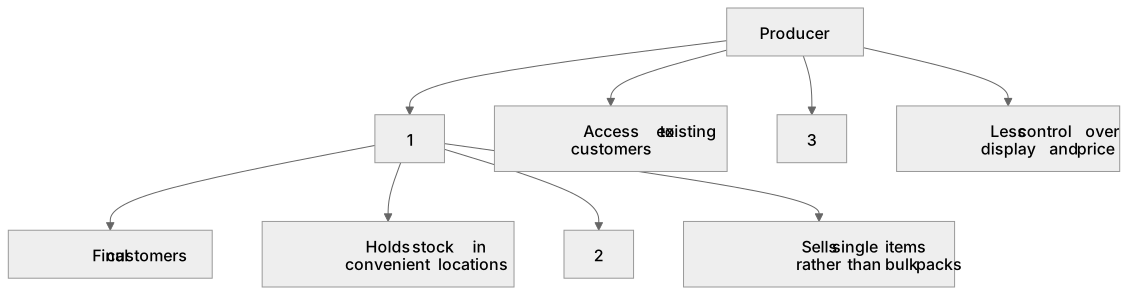
1Box 1
2Box 2
3Box 3
There is more to this lesson
The full lesson goes on to check your understanding and help you earn the marks. Create a free account to carry on, with your progress saved.
A week of Premium from your first lesson · Then the free plan continues · No card, no charge
Test your understanding of The elements of the marketing mix: price, product, promotion and place (4Ps): retailers
Active recall beats re-reading. Take an instant quiz now to test what you’ve learned and lock it into long-term memory.
A week of Premium from your first lesson · Then the free plan continues · No card, no charge