AQA · GCSE · Business
Course version: 8132 · Version from Sept 2017
Price, product, promotion and place (4Ps): Students should be familiar…
Full specification wording
The elements of the marketing mix: price, product, promotion and place (4Ps): Students should be familiar with the different channels of distribution used by businesses to gain access to potential customers.
Place decisions determine how a product travels from producer to customer.
Checked against the AQA 8132 specification (opens in a new tab) on .
- Point 69 of 80
- 4 key terms
Study notes
From the checked teaching notes for this specification point.
The idea
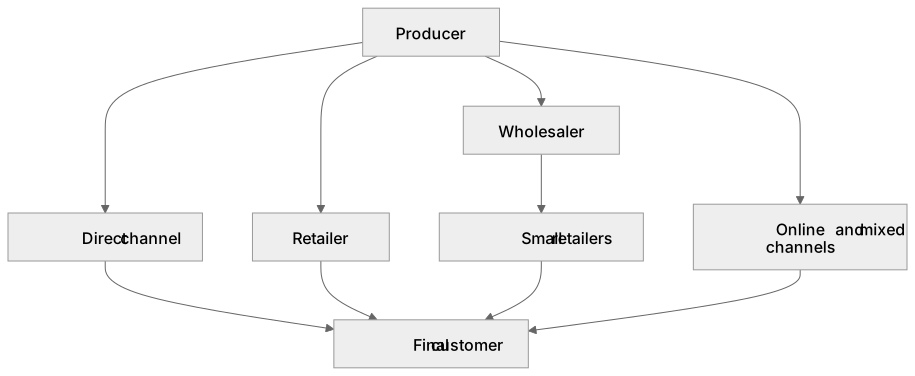
Place decisions determine how a product travels from producer to customer. A channel of distribution is the route taken, and each route reaches a different set of potential customers. Direct channels sell straight to the buyer, for example a farm shop or a manufacturer's own website; the business keeps more of the selling price but must attract every customer itself. Indirect channels use intermediaries: a retailer buys from the producer and sells to the public, while a wholesaler buys in bulk and supplies many small retailers. Longer channels widen access to potential customers because existing shops already attract footfall, but each intermediary takes a margin, so the producer's share of the final price falls. Channels may also combine, such as selling online and through retailers. Choosing well means matching the channel to the target market, the product and the business's resources.
What earns the marks
- Defines a channel of distribution as the route a product takes from producer to final customer, and identifies the main options: direct selling, retailer, wholesaler plus retailer, and online or mixed channels.
- Explains that each channel gives access to a different group of potential customers, so the choice affects the size and type of market reachable.
- Analyses the trade-off between reach and control: intermediaries widen access to customers but reduce the producer's control over pricing, presentation and customer relationships.
- Explains the effect of intermediaries on the producer's revenue per unit, since each intermediary in the chain takes a margin from the final selling price.
- Applies channel choice to context, for example a small producer using a wholesaler to reach many independent shops it could not supply itself.
- Evaluates a channel decision by weighing wider access to potential customers against lower margins and less direct customer contact.
Common mistakes and how to put them right
Treating distribution as only physical transport.
Put it right: Distribution is about the route and the intermediaries involved in reaching customers, not just delivery.
Assuming more intermediaries always means more profit.
Put it right: Extra intermediaries widen access but each takes a margin, so the producer's share of the final price usually falls.
Confusing wholesalers with retailers.
Put it right: A wholesaler buys in bulk and supplies retailers, while a retailer sells directly to the final customer.
Exam tips
- Name the specific channel in the case, such as selling through a national retailer, rather than writing generally about advertising or delivery.
- Link each channel to potential customers: state which group of buyers it reaches and why that matters for the business in the case.
- For evaluation, compare at least two channels on reach, cost or margin, then give a justified recommendation for the business described.
Try the lesson
The start of the The elements of the marketing mix: price, product, promotion and place (4Ps): Students should be familiar with the different channels of distribution used by businesses to gain access to potential customers. lesson, made from checked teaching notes for this specification point.
Have a go first
Which term describes the route a product takes from the producer to the final consumer?
Listen
Place decisions determine how a product travels from producer to customer. A channel of distribution is the route taken, and each route reaches a different set of potential customers. Direct channels sell straight to the buyer, for example a farm shop or a manufacturer's own website; the business keeps more of the selling price but must attract every customer itself. Indirect channels use intermediaries: a retailer buys from the producer and sells to the public, while a wholesaler buys in bulk and supplies many small retailers. Longer channels widen access to potential customers because existing shops already attract footfall, but each intermediary takes a margin, so the producer's share of the final price falls. Channels may also combine, such as selling online and through retailers. Choosing well means matching the channel to the target market, the product and the business's resources. A strong answer earns marks for these points. Defines a channel of distribution as the route a product takes from producer to final customer, and identifies the main options: direct selling, retailer, wholesaler plus retailer, and online or mixed channels. Explains that each channel gives access to a different group of potential customers, so the choice affects the size and type of market reachable. Analyses the trade-off between reach and control: intermediaries widen access to customers but reduce the producer's control over pricing, presentation and customer relationships. Explains the effect of intermediaries on the producer's revenue per unit, since each intermediary in the chain takes a margin from the final selling price. A common slip: Treating distribution as only physical transport. Instead, distribution is about the route and the intermediaries involved in reaching customers, not just delivery. Exam tip: Name the specific channel in the case, such as selling through a national retailer, rather than writing generally about advertising or delivery.
See it
Key words
Say what each word means before you turn the card.
Channel of distribution
Try answering aloud or in your head before turning the card.
Direct channel
Try answering aloud or in your head before turning the card.
Intermediaries
Try answering aloud or in your head before turning the card.
Margin
Try answering aloud or in your head before turning the card.
See every definition
- Channel of distribution
- The route a product takes from producer to final customer, with options including direct selling, retailer, wholesaler plus retailer, and online or mixed channels.
- Direct channel
- A route that sells straight to the buyer, for example a farm shop or a manufacturer's own website, so the business keeps more of the selling price but must attract every customer itself.
- Intermediaries
- Businesses in an indirect channel, such as a retailer that buys from the producer and sells to the public, or a wholesaler that buys in bulk and supplies many small retailers.
- Margin
- The share each intermediary takes from the final selling price, so the producer's share of the final price falls as the chain lengthens.
Label the diagram
Some boxes have lost their names. Pick the right name for each number.
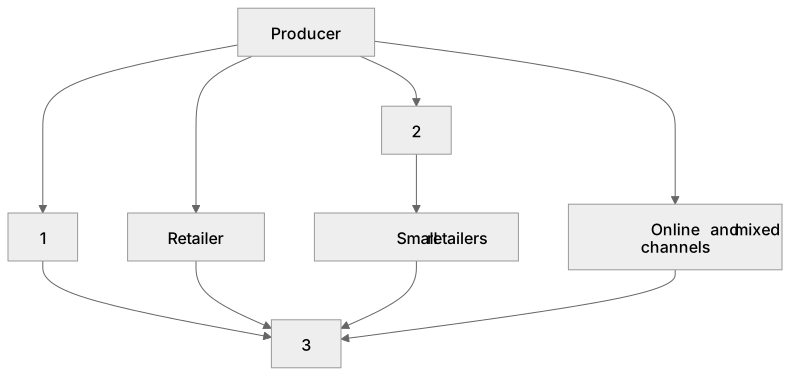
1Box 1
2Box 2
3Box 3
There is more to this lesson
The full lesson goes on to check your understanding and help you earn the marks. Create a free account to carry on, with your progress saved.
A week of Premium from your first lesson · Then the free plan continues · No card, no charge
Test your understanding of The elements of the marketing mix: price, product, promotion and place (4Ps): Students should be familiar with the different channels of distribution used by businesses to gain access to potential customers.
Active recall beats re-reading. Take an instant quiz now to test what you’ve learned and lock it into long-term memory.
A week of Premium from your first lesson · Then the free plan continues · No card, no charge