AQA · GCSE · Business
Course version: 8132 · Version from Sept 2017
Price, product, promotion and place (4Ps): Students should be able to…
Full specification wording
The elements of the marketing mix: price, product, promotion and place (4Ps): Students should be able to recommend appropriate marketing activities for a given business.
Recommending marketing activities means choosing actions across the 4Ps that fit a named business's context.
Checked against the AQA 8132 specification (opens in a new tab) on .
- Point 79 of 80
- 4 key terms
Study notes
From the checked teaching notes for this specification point.
The idea
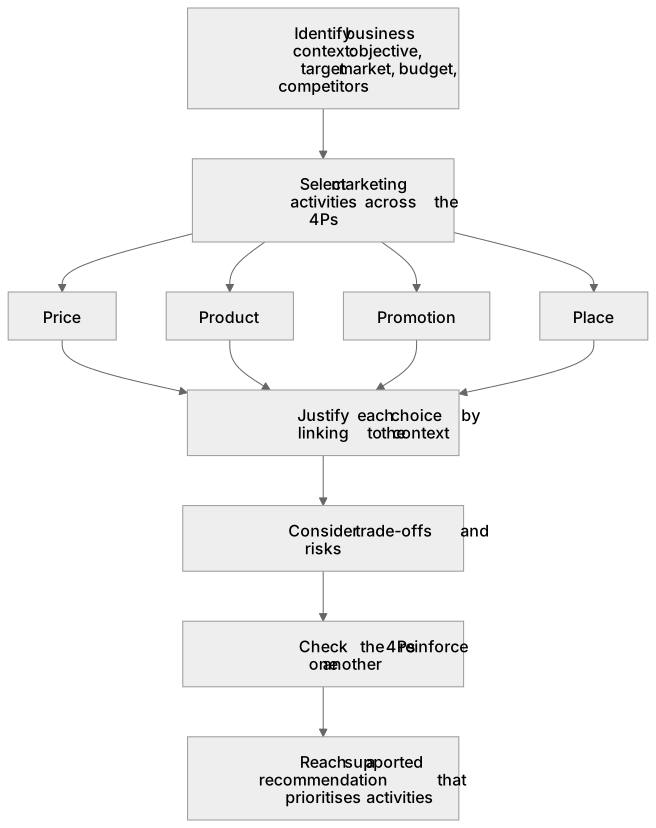
Recommending marketing activities means choosing actions across the 4Ps that fit a named business's context. First identify the business's objective, target market, budget and competitors. Then select a coherent mix: for example, a premium bakery might use price skimming, distinctive packaging, local press coverage and a town-centre shop. Justify each choice by linking it to the context, and consider trade-offs, such as discounting raising volume but harming prestige. A recommendation is stronger when the 4Ps reinforce one another rather than conflict. Explain how the choice meets customer needs and the business aim, and note any risk or limitation.
What earns the marks
- Identifies relevant context from the case, such as target market, budget, competitors or business objective, and uses it to shape the recommendation.
- Selects marketing activities across more than one element of the marketing mix, for example a pricing method alongside a promotional method and a distribution channel.
- Justifies each recommended activity by linking it explicitly to the given business's circumstances rather than describing the tool generically.
- Considers trade-offs or risks, such as lower margins from penetration pricing or wasted spend on an unsuitable promotion.
- Reaches a supported recommendation that prioritises activities and explains why they suit this business better than alternatives.
Common mistakes and how to put them right
Listing every marketing tool without choosing.
Put it right: Select a small, coherent set and justify each choice for the named business.
Ignoring the case context.
Put it right: Tie the activity to the stated target market, budget or objective.
Treating the 4Ps as independent.
Put it right: Check that price, product, promotion and place reinforce one another.
Exam tips
- Underline the business's objective, target market and budget in the case before writing, then refer back to those words in each justification.
- Use connectives such as because, therefore and however to show the link between an activity and its expected effect.
- Finish with a short judgement naming the single most important activity and the reason it matters most for this business.
Try the lesson
The start of the The elements of the marketing mix: price, product, promotion and place (4Ps): Students should be able to recommend appropriate marketing activities for a given business. lesson, made from checked teaching notes for this specification point.
Have a go first
A small bakery wants to sell more cakes to local customers. Which marketing activity is most appropriate for this bakery?
Listen
Recommending marketing activities means choosing actions across the 4Ps that fit a named business's context. First identify the business's objective, target market, budget and competitors. Then select a coherent mix: for example, a premium bakery might use price skimming, distinctive packaging, local press coverage and a town-centre shop. Justify each choice by linking it to the context, and consider trade-offs, such as discounting raising volume but harming prestige. A recommendation is stronger when the 4Ps reinforce one another rather than conflict. Explain how the choice meets customer needs and the business aim, and note any risk or limitation. A strong answer earns marks for these points. Identifies relevant context from the case, such as target market, budget, competitors or business objective, and uses it to shape the recommendation. Selects marketing activities across more than one element of the marketing mix, for example a pricing method alongside a promotional method and a distribution channel. Justifies each recommended activity by linking it explicitly to the given business's circumstances rather than describing the tool generically. Considers trade-offs or risks, such as lower margins from penetration pricing or wasted spend on an unsuitable promotion. A common slip: Listing every marketing tool without choosing: the error is describing the 4Ps generally. Instead, select a small, coherent set and justify each choice for the named business. Exam tip: Underline the business's objective, target market and budget in the case before writing, then refer back to those words in each justification.
See it
Key words
Say what each word means before you turn the card.
Marketing mix coherence
Try answering aloud or in your head before turning the card.
Contextual justification
Try answering aloud or in your head before turning the card.
Trade-offs and risk
Try answering aloud or in your head before turning the card.
Customer needs and business objectives
Try answering aloud or in your head before turning the card.
See every definition
- Marketing mix coherence
- A recommendation is stronger when the 4Ps reinforce one another rather than conflict.
- Contextual justification
- Justify each choice by linking it to the context, and consider trade-offs.
- Trade-offs and risk
- Consider trade-offs, such as discounting raising volume but harming prestige, and note any risk or limitation.
- Customer needs and business objectives
- Explain how the choice meets customer needs and the business aim.
Label the diagram
Some boxes have lost their names. Pick the right name for each number.
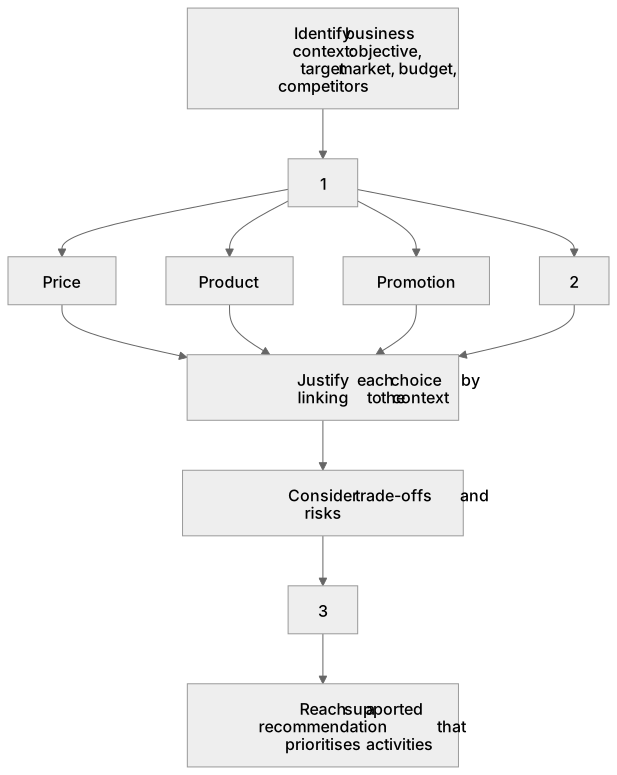
1Box 1
2Box 2
3Box 3
There is more to this lesson
The full lesson goes on to check your understanding and help you earn the marks. Create a free account to carry on, with your progress saved.
A week of Premium from your first lesson · Then the free plan continues · No card, no charge
Test your understanding of The elements of the marketing mix: price, product, promotion and place (4Ps): Students should be able to recommend appropriate marketing activities for a given business.
Active recall beats re-reading. Take an instant quiz now to test what you’ve learned and lock it into long-term memory.
A week of Premium from your first lesson · Then the free plan continues · No card, no charge