AQA · GCSE · Business
Course version: 8132 · Version from Sept 2017
Price, product, promotion and place (4Ps): Students should be aware of the…
Full specification wording
The elements of the marketing mix: price, product, promotion and place (4Ps): Students should be aware of the importance of the four elements and how they work together.
Each element of the marketing mix matters because it influences whether customers buy.
Checked against the AQA 8132 specification (opens in a new tab) on .
- Point 78 of 80
- 2 key terms
Study notes
From the checked teaching notes for this specification point.
The idea
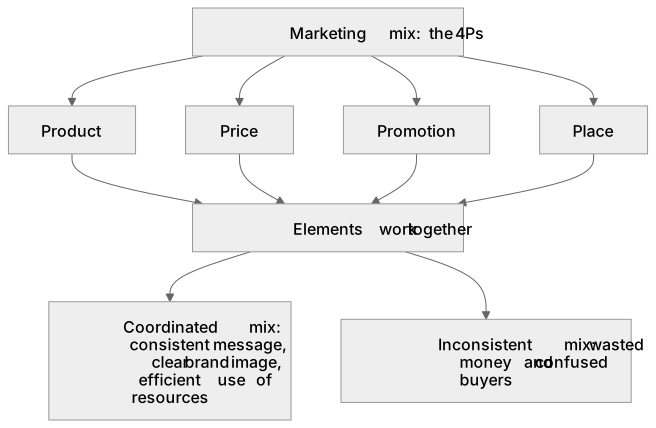
Each element of the marketing mix matters because it influences whether customers buy. Product must satisfy needs through design, quality and features; price must be acceptable to customers and profitable for the business; promotion must communicate the offer to the right audience; place must make the product available where and when customers want it. Their importance lies in how they work together: a strong product with a poor price, weak promotion or unsuitable outlet may still fail. For example, a new healthy snack priced above competitors, advertised only to children and sold in gyms sends conflicting signals. A coordinated mix reinforces one message, builds a clear brand image and uses resources efficiently, while inconsistency wastes money and confuses buyers.
What earns the marks
- Explains the importance of product decisions, including design, quality and features, in meeting customer needs and differentiating from rivals.
- Explains the importance of price decisions in attracting customers, covering costs and reflecting the product's positioning.
- Explains the importance of promotion decisions in raising awareness and persuading the target market to buy.
- Explains the importance of place decisions in making the product conveniently available through suitable channels.
- Analyses how the four elements work together, showing that consistency between them strengthens the brand and improves the chance of commercial success.
Common mistakes and how to put them right
Judging each element in isolation and ignoring the links between them.
Put it right: Explain how a change in one element, such as a higher price, requires supporting changes in product quality, promotion or place.
Assuming promotion alone guarantees sales.
Put it right: Recognise that promotion must be supported by an appropriate product, price and availability.
Ignoring the target market when judging importance.
Put it right: Relate each element to the needs and expectations of the specific customers being served.
Exam tips
- Structure answers around the four elements in turn, then add a paragraph explaining how they combine, so both parts of the statement are covered.
- Support each point with a short consequence, such as how poor availability reduces sales even when advertising is strong.
- Use comparative language, such as more important or less effective, only when you justify the comparison with context.
Try the lesson
The start of the The elements of the marketing mix: price, product, promotion and place (4Ps): Students should be aware of the importance of the four elements and how they work together. lesson, made from checked teaching notes for this specification point.
Have a go first
A café lowers the price of its sandwiches but does not change its product, promotion or place. Why might this single change fail to increase total sales revenue?
Listen
Each element of the marketing mix matters because it influences whether customers buy. Product must satisfy needs through design, quality and features; price must be acceptable to customers and profitable for the business; promotion must communicate the offer to the right audience; place must make the product available where and when customers want it. Their importance lies in how they work together: a strong product with a poor price, weak promotion or unsuitable outlet may still fail. For example, a new healthy snack priced above competitors, advertised only to children and sold in gyms sends conflicting signals. A coordinated mix reinforces one message, builds a clear brand image and uses resources efficiently, while inconsistency wastes money and confuses buyers. A strong answer earns marks for these points. Explains the importance of product decisions, including design, quality and features, in meeting customer needs and differentiating from rivals. Explains the importance of price decisions in attracting customers, covering costs and reflecting the product's positioning. Explains the importance of promotion decisions in raising awareness and persuading the target market to buy. Explains the importance of place decisions in making the product conveniently available through suitable channels. A common slip: Judging each element in isolation and ignoring the links between them. Instead, explain how a change in one element, such as a higher price, requires supporting changes in product quality, promotion or place. Exam tip: Structure answers around the four elements in turn, then add a paragraph explaining how they combine, so both parts of the statement are covered.
See it
Key words
Say what each word means before you turn the card.
Brand consistency
Try answering aloud or in your head before turning the card.
Resource efficiency
Try answering aloud or in your head before turning the card.
See every definition
- Brand consistency
- A coordinated mix reinforces one message and builds a clear brand image, while inconsistency confuses buyers.
- Resource efficiency
- A coordinated mix uses resources efficiently, while inconsistency wastes money.
Label the diagram
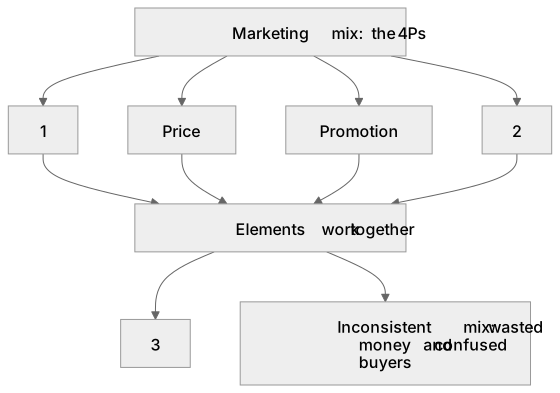
Some boxes have lost their names. Pick the right name for each number.
1Box 1
2Box 2
3Box 3
There is more to this lesson
The full lesson goes on to check your understanding and help you earn the marks. Create a free account to carry on, with your progress saved.
A week of Premium from your first lesson · Then the free plan continues · No card, no charge
Test your understanding of The elements of the marketing mix: price, product, promotion and place (4Ps): Students should be aware of the importance of the four elements and how they work together.
Active recall beats re-reading. Take an instant quiz now to test what you’ve learned and lock it into long-term memory.
A week of Premium from your first lesson · Then the free plan continues · No card, no charge