AQA · GCSE · Business
Course version: 8132 · Version from Sept 2017
Price, product, promotion and place (4Ps): the nature of the market
Full specification wording
The elements of the marketing mix: price, product, promotion and place (4Ps): the nature of the market
The nature of the market describes how a market is structured and how competitive it is.
Checked against the AQA 8132 specification (opens in a new tab) on .
- Point 61 of 80
- 4 key terms
Study notes
From the checked teaching notes for this specification point.
The idea
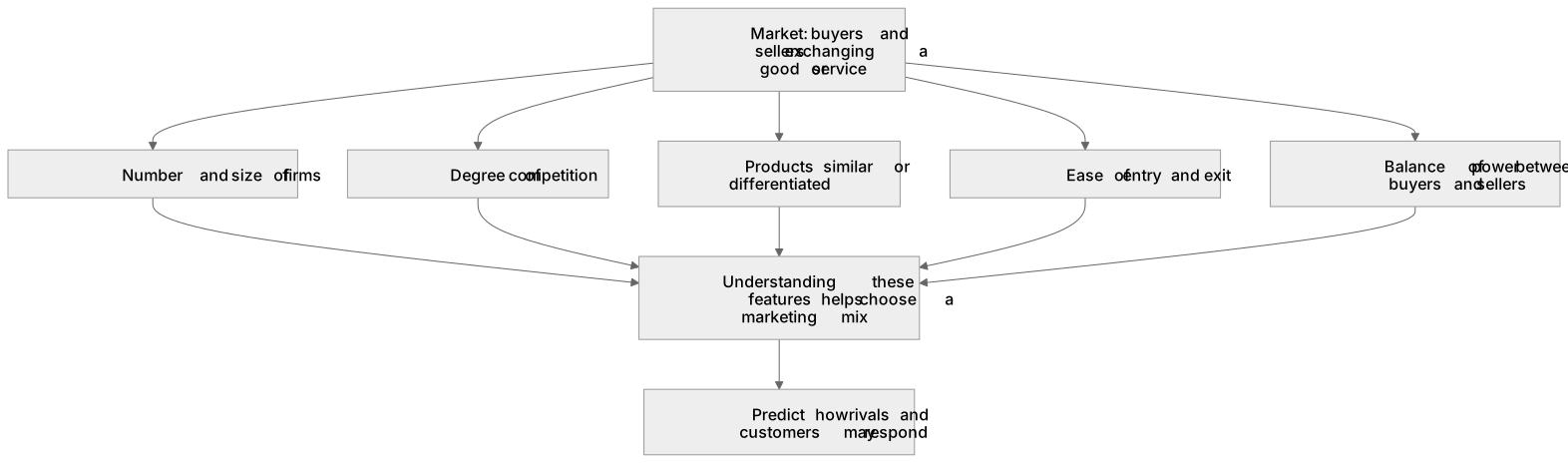
The nature of the market describes how a market is structured and how competitive it is. A market consists of buyers and sellers exchanging a particular good or service. Its nature includes: the number and size of firms (from many small firms to a few large ones or a single dominant firm); the degree of competition; whether products are similar or differentiated; the ease of entry and exit; and the balance of power between buyers and sellers. For example, a local café market has many small firms, low barriers to entry and differentiated products, whereas the UK energy market has a few large suppliers, high barriers and relatively homogeneous products. Understanding these features helps a business choose an appropriate marketing mix and predict how rivals and customers may respond.
What earns the marks
- Defines a market as any set of arrangements where buyers and sellers exchange a good or service, and explains that its nature is the set of structural features that shape competition.
- Identifies key features that describe a market's nature: number and size of firms, degree of competition, product similarity or differentiation, barriers to entry and exit, and buyer or seller power.
- Uses a concrete example, such as a local café market compared with the UK energy market, to show how the features differ and why that matters for business decisions.
- Explains how the nature of the market influences the marketing mix, for example that many similar rivals may lead to competitive pricing and strong promotion, while a differentiated market may support higher prices.
- Applies the concept to a case study by selecting relevant evidence about the market and using it to justify a marketing mix recommendation.
Common mistakes and how to put them right
Treating 'the market' as only the place where goods are sold, rather than the whole system of buyers, sellers and competitive conditions.
Put it right by defining it as the exchange arrangements and the features that shape competition.
Confusing the nature of the market with market research or market segmentation.
Put it right by focusing on structural features such as the number of firms, competition and barriers to entry, not on how a business gathers data or groups customers.
Assuming all markets are perfectly competitive.
Put it right by recognising that markets range from many small firms with low barriers to a few large firms or a single dominant firm with high barriers.
Exam tips
- When a question asks about the nature of the market, name at least two structural features and link each to a likely effect on the business's marketing mix.
- Use the case study: quote or paraphrase a specific fact about the market, such as the number of competitors or the strength of customer loyalty, and explain what it means for pricing, product, promotion or place.
- Avoid vague phrases such as 'the market is competitive'; instead state what makes it competitive, for example many similar firms, low switching costs or easy entry.
Try the lesson
The start of the The elements of the marketing mix: price, product, promotion and place (4Ps): the nature of the market lesson, made from checked teaching notes for this specification point.
Have a go first
Which term describes the group of buyers and sellers who exchange a particular good or service?
Listen
The nature of the market describes how a market is structured and how competitive it is. A market consists of buyers and sellers exchanging a particular good or service. Its nature includes: the number and size of firms (from many small firms to a few large ones or a single dominant firm); the degree of competition; whether products are similar or differentiated; the ease of entry and exit; and the balance of power between buyers and sellers. For example, a local café market has many small firms, low barriers to entry and differentiated products, whereas the UK energy market has a few large suppliers, high barriers and relatively homogeneous products. Understanding these features helps a business choose an appropriate marketing mix and predict how rivals and customers may respond. A strong answer earns marks for these points. Defines a market as any set of arrangements where buyers and sellers exchange a good or service, and explains that its nature is the set of structural features that shape competition. Identifies key features that describe a market's nature: number and size of firms, degree of competition, product similarity or differentiation, barriers to entry and exit, and buyer or seller power. Uses a concrete example, such as a local café market compared with the UK energy market, to show how the features differ and why that matters for business decisions. Explains how the nature of the market influences the marketing mix, for example that many similar rivals may lead to competitive pricing and strong promotion, while a differentiated market may support higher prices. A common slip: Treating 'the market' as only the place where goods are sold, rather than the whole system of buyers, sellers and competitive conditions. Instead, defining it as the exchange arrangements and the features that shape competition. Exam tip: When a question asks about the nature of the market, name at least two structural features and link each to a likely effect on the business's marketing mix.
See it
Key words
Say what each word means before you turn the card.
Market
Try answering aloud or in your head before turning the card.
Number and size of firms
Try answering aloud or in your head before turning the card.
Barriers to entry and exit
Try answering aloud or in your head before turning the card.
Buyer and seller power
Try answering aloud or in your head before turning the card.
See every definition
- Market
- Any set of arrangements where buyers and sellers exchange a particular good or service.
- Number and size of firms
- A structural feature ranging from many small firms to a few large ones or a single dominant firm.
- Barriers to entry and exit
- A structural feature describing the ease of entry to and exit from a market.
- Buyer and seller power
- A structural feature describing the balance of power between buyers and sellers in a market.
Label the diagram
Some boxes have lost their names. Pick the right name for each number.
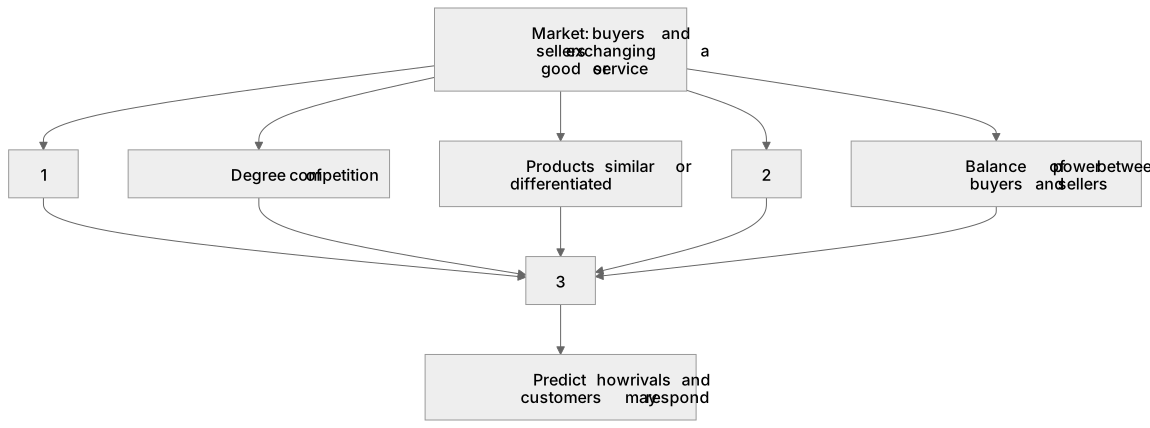
1Box 1
2Box 2
3Box 3
There is more to this lesson
The full lesson goes on to check your understanding and help you earn the marks. Create a free account to carry on, with your progress saved.
A week of Premium from your first lesson · Then the free plan continues · No card, no charge
Test your understanding of The elements of the marketing mix: price, product, promotion and place (4Ps): the nature of the market
Active recall beats re-reading. Take an instant quiz now to test what you’ve learned and lock it into long-term memory.
A week of Premium from your first lesson · Then the free plan continues · No card, no charge