AQA · GCSE · Business
Course version: 8132 · Version from Sept 2017
Price, product, promotion and place (4Ps): Using the marketing mix to…
Full specification wording
The elements of the marketing mix: price, product, promotion and place (4Ps): Using the marketing mix to inform and implement business decisions
The marketing mix is the coordinated set of decisions a business makes about product, price, promotion and place.
Checked against the AQA 8132 specification (opens in a new tab) on .
- Point 77 of 80
- 4 key terms
Study notes
From the checked teaching notes for this specification point.
The idea
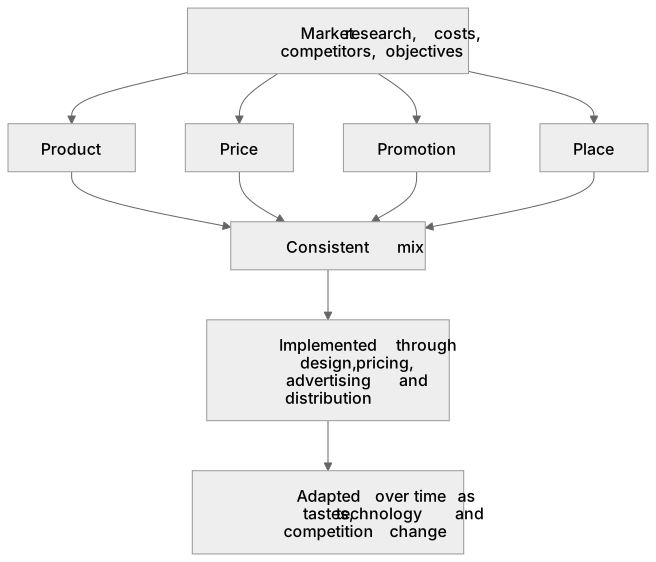
The marketing mix is the coordinated set of decisions a business makes about product, price, promotion and place. It informs decisions because research into customer needs, competitors and costs shapes what each element should be; for example, a premium price signals quality and must match a high-quality product, while a low price suits a mass-market budget item. It implements decisions because the chosen mix is put into action through design, pricing, advertising and distribution. The four elements must be consistent: a luxury product sold in discount shops, or a budget product advertised as exclusive, confuses customers and wastes resources. Businesses also adapt the mix over time as tastes, technology and competition change.
What earns the marks
- Defines the marketing mix as the combination of product, price, promotion and place decisions used to meet customer needs and compete in a market.
- Explains how market research, costs, competitor actions and business objectives inform the choice of each element of the mix.
- Explains how the chosen mix is implemented through product design, pricing strategy, promotional methods and distribution channels.
- Analyses how the four elements work together, using a consistent example such as a premium product with a high price, selective distribution and quality-focused promotion.
- Evaluates the consequences of an inconsistent mix, such as lost sales, damaged reputation or wasted promotional spending.
Common mistakes and how to put them right
Treating the four elements as separate, unrelated decisions.
Put it right: Show how each choice supports the others, for example a high price matched by high quality and exclusive outlets.
Assuming the mix is fixed once chosen.
Put it right: Recognise that businesses review and adapt the mix as customer tastes, costs and competitors change.
Confusing informing decisions with implementing them.
Put it right: Separate the analysis and research stage from the practical actions taken to carry out the mix.
Exam tips
- Use a named business or product throughout so each element of the mix can be applied concretely rather than described in the abstract.
- When asked to analyse, link at least two elements together and state the effect on sales, costs or customer perceptions.
- For evaluation questions, weigh the benefits of a consistent mix against the risks of inconsistency or of failing to adapt to change, then reach a supported judgement.
Try the lesson
The start of the The elements of the marketing mix: price, product, promotion and place (4Ps): Using the marketing mix to inform and implement business decisions lesson, made from checked teaching notes for this specification point.
Have a go first
Which element of the marketing mix is concerned with how a business tells customers about its products?
Listen
The marketing mix is the coordinated set of decisions a business makes about product, price, promotion and place. It informs decisions because research into customer needs, competitors and costs shapes what each element should be; for example, a premium price signals quality and must match a high-quality product, while a low price suits a mass-market budget item. It implements decisions because the chosen mix is put into action through design, pricing, advertising and distribution. The four elements must be consistent: a luxury product sold in discount shops, or a budget product advertised as exclusive, confuses customers and wastes resources. Businesses also adapt the mix over time as tastes, technology and competition change. A strong answer earns marks for these points. Defines the marketing mix as the combination of product, price, promotion and place decisions used to meet customer needs and compete in a market. Explains how market research, costs, competitor actions and business objectives inform the choice of each element of the mix. Explains how the chosen mix is implemented through product design, pricing strategy, promotional methods and distribution channels. Analyses how the four elements work together, using a consistent example such as a premium product with a high price, selective distribution and quality-focused promotion. A common slip: Treating the four elements as separate, unrelated decisions. Instead, show how each choice supports the others, for example a high price matched by high quality and exclusive outlets. Exam tip: Use a named business or product throughout so each element of the mix can be applied concretely rather than described in the abstract.
See it
Key words
Say what each word means before you turn the card.
Coordination of the four Ps
Try answering aloud or in your head before turning the card.
Customer needs and market research
Try answering aloud or in your head before turning the card.
Competitive positioning
Try answering aloud or in your head before turning the card.
Adaptation to change
Try answering aloud or in your head before turning the card.
See every definition
- Coordination of the four Ps
- The four elements must be consistent, because a luxury product sold in discount shops or a budget product advertised as exclusive confuses customers and wastes resources.
- Customer needs and market research
- Research into customer needs, competitors and costs shapes what each element of the mix should be.
- Competitive positioning
- A premium price signals quality and must match a high-quality product, while a low price suits a mass-market budget item.
- Adaptation to change
- Businesses adapt the mix over time as tastes, technology and competition change.
Label the diagram
Some boxes have lost their names. Pick the right name for each number.
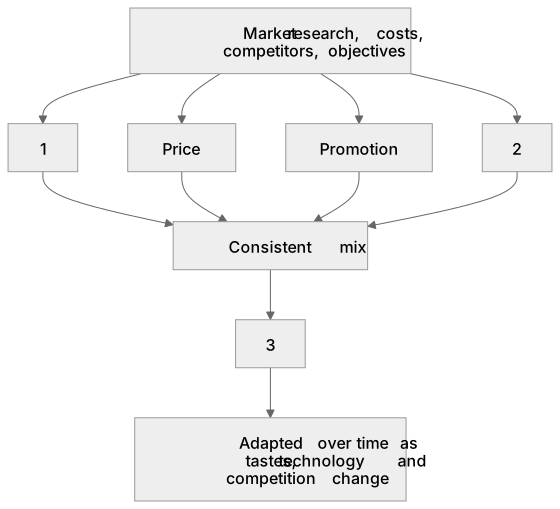
1Box 1
2Box 2
3Box 3
There is more to this lesson
The full lesson goes on to check your understanding and help you earn the marks. Create a free account to carry on, with your progress saved.
A week of Premium from your first lesson · Then the free plan continues · No card, no charge
Test your understanding of The elements of the marketing mix: price, product, promotion and place (4Ps): Using the marketing mix to inform and implement business decisions
Active recall beats re-reading. Take an instant quiz now to test what you’ve learned and lock it into long-term memory.
A week of Premium from your first lesson · Then the free plan continues · No card, no charge