AQA · GCSE · Business
Course version: 8132 · Version from Sept 2017
The purpose and methods of market research: Collect information about:
This statement introduces the types of information that market research collects.
Checked against the AQA 8132 specification (opens in a new tab) on .
- Point 3 of 19
- 4 key terms
Study notes
From the checked teaching notes for this specification point.
The idea
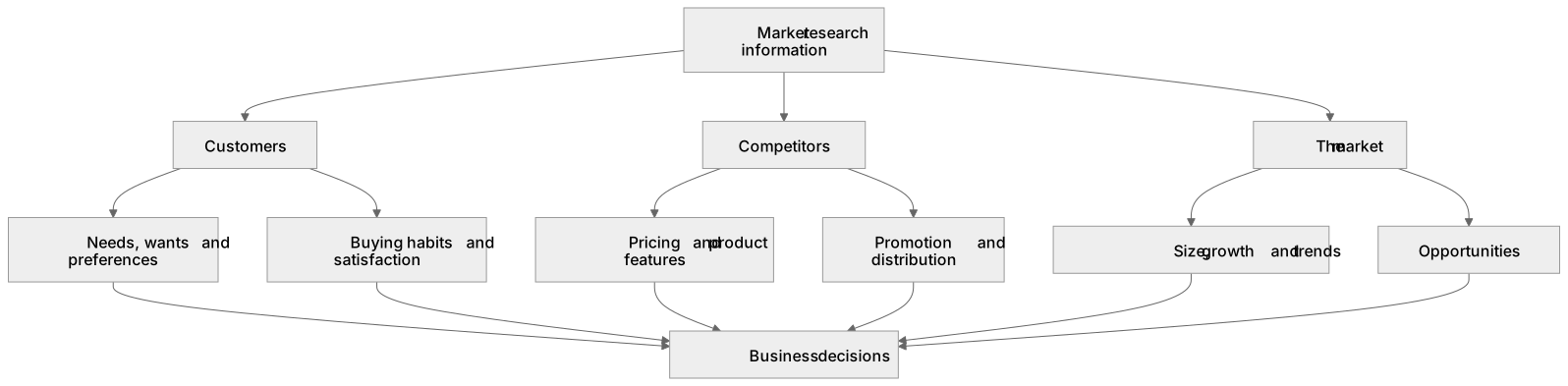
This statement introduces the types of information that market research collects. Businesses gather data about customers, competitors and the market. Customer information includes needs, wants, preferences, buying habits and satisfaction. Competitor information includes pricing, product features, promotion and distribution. Market information includes size, growth, trends and opportunities. For example, a new bakery might collect data on local demand, rival prices and customer tastes. This information is then analysed to support decisions such as what to sell, what price to charge and where to locate. The clause is completed by the specification's following points, which list these categories in detail.
What earns the marks
- Identifies that market research collects information about customers, including their needs, wants and preferences.
- Identifies that market research collects information about competitors, such as their products, prices and promotional methods.
- Identifies that market research collects information about the market, including size, growth and trends.
- Explains how each type of information can be used to inform business decisions, such as product development or pricing.
- Uses a relevant example to show what information might be collected and why it is useful.
Common mistakes and how to put them right
Thinking that market research only collects information about customers.
Put it right: It also collects information about competitors and the wider market.
Confusing primary and secondary research when describing what information is collected.
Put it right: The statement is about the content of the information, not the method used to collect it.
Assuming all collected information is equally useful.
Put it right: Relevance and reliability should be considered when deciding what information to collect.
Exam tips
- When asked what information is collected, structure your answer around customers, competitors and the market to ensure coverage.
- Link each type of information to a specific business decision to show understanding of its purpose.
- Use examples from the case study or a familiar business to make your answer concrete.
Try the lesson
The start of the The purpose and methods of market research: Collect information about: lesson, made from checked teaching notes for this specification point.
Have a go first
Which of the following is information that market research collects about customers?
Listen
This statement introduces the types of information that market research collects. Businesses gather data about customers, competitors and the market. Customer information includes needs, wants, preferences, buying habits and satisfaction. Competitor information includes pricing, product features, promotion and distribution. Market information includes size, growth, trends and opportunities. For example, a new bakery might collect data on local demand, rival prices and customer tastes. This information is then analysed to support decisions such as what to sell, what price to charge and where to locate. The clause is completed by the specification's following points, which list these categories in detail. A strong answer earns marks for these points. Identifies that market research collects information about customers, including their needs, wants and preferences. Identifies that market research collects information about competitors, such as their products, prices and promotional methods. Identifies that market research collects information about the market, including size, growth and trends. Explains how each type of information can be used to inform business decisions, such as product development or pricing. A common slip: Thinking that market research only collects information about customers. Instead, it also collects information about competitors and the wider market. Exam tip: When asked what information is collected, structure your answer around customers, competitors and the market to ensure coverage.
See it
Key words
Say what each word means before you turn the card.
Customer information
Try answering aloud or in your head before turning the card.
Competitor information
Try answering aloud or in your head before turning the card.
Market information
Try answering aloud or in your head before turning the card.
Using information for business decisions
Try answering aloud or in your head before turning the card.
See every definition
- Customer information
- Data about customers that includes their needs, wants, preferences, buying habits and satisfaction.
- Competitor information
- Data about rivals that includes their pricing, product features, promotion and distribution.
- Market information
- Data about the market that includes its size, growth, trends and opportunities.
- Using information for business decisions
- Analysing collected information to support decisions such as what to sell, what price to charge and where to locate.
Label the diagram
Some boxes have lost their names. Pick the right name for each number.
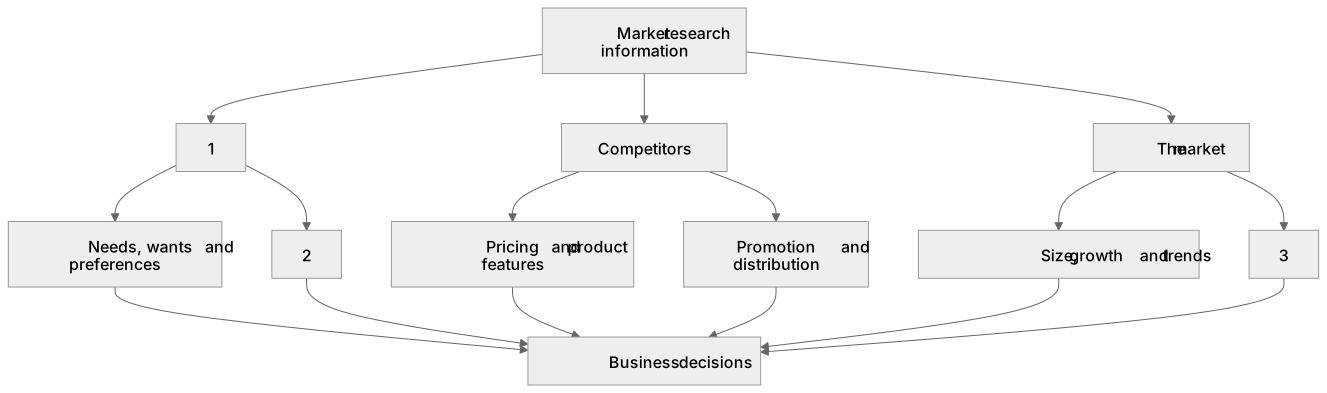
1Box 1
2Box 2
3Box 3
There is more to this lesson
The full lesson goes on to check your understanding and help you earn the marks. Create a free account to carry on, with your progress saved.
A week of Premium from your first lesson · Then the free plan continues · No card, no charge
Test your understanding of The purpose and methods of market research: Collect information about:
Active recall beats re-reading. Take an instant quiz now to test what you’ve learned and lock it into long-term memory.
A week of Premium from your first lesson · Then the free plan continues · No card, no charge