AQA · GCSE · Business
Course version: 8132 · Version from Sept 2017
Students should understand why businesses conduct market research, such as…
Full specification wording
The purpose and methods of market research: Students should understand why businesses conduct market research, such as to identify market opportunities and to get a better insight into their customers and competitors.
Market research is the systematic gathering and analysis of information to support business decisions.
Checked against the AQA 8132 specification (opens in a new tab) on .
- Point 2 of 19
- 4 key terms
Study notes
From the checked teaching notes for this specification point.
The idea
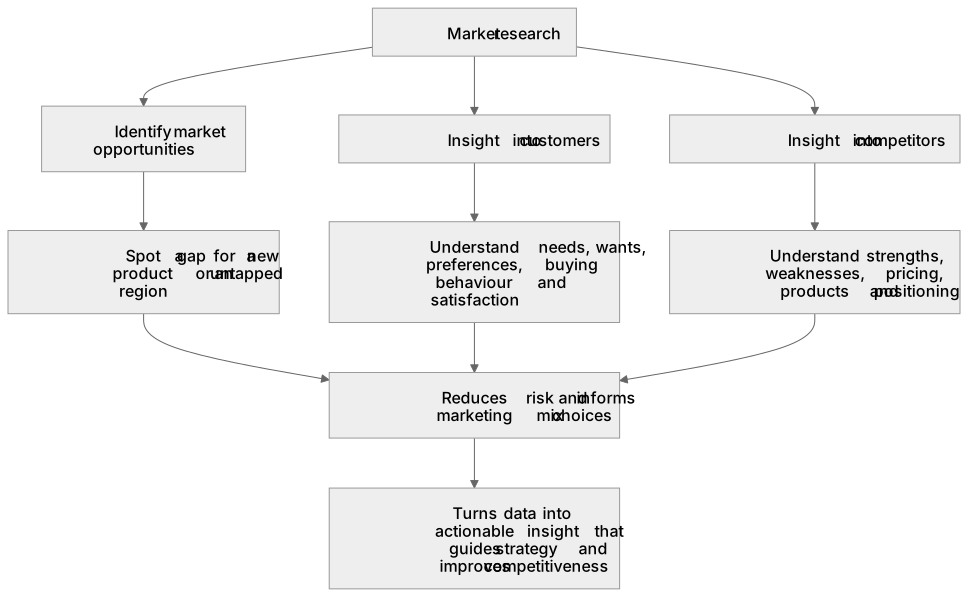
Market research is the systematic gathering and analysis of information to support business decisions. Businesses conduct it to identify market opportunities, such as spotting a gap for a new product or an untapped region, and to gain better insight into customers and competitors. For example, a café might survey local workers and find demand for breakfast, revealing an opportunity. It might also observe rival pricing and customer complaints to understand competitors and customer needs. This reduces risk, informs marketing mix choices and helps allocate resources effectively. The purpose is not just to collect data but to turn it into actionable insight that guides strategy and improves competitiveness.
What earns the marks
- Defines market research as the process of collecting and analysing information about customers, competitors and the market.
- Explains that identifying market opportunities involves finding gaps in the market or unmet customer needs that a business could serve.
- Explains that gaining insight into customers means understanding their needs, wants, preferences, buying behaviour and satisfaction levels.
- Explains that gaining insight into competitors means understanding their strengths, weaknesses, pricing, products and market positioning.
- Links the purpose of market research to reducing the risk of poor business decisions and to informing the marketing mix.
- Uses a relevant example, such as a business using research to decide whether to launch a new product or enter a new market.
Common mistakes and how to put them right
Confusing market research with marketing (promotion).
Put it right: Market research is about gathering and analysing information, while marketing involves activities such as advertising and pricing.
Thinking market research only involves asking customers questions.
Put it right: It also includes studying competitors, market trends and secondary data sources.
Assuming market research guarantees success.
Put it right: It reduces risk and informs decisions but cannot eliminate uncertainty or guarantee commercial success.
Exam tips
- When explaining a purpose, always link it to a business decision or outcome, such as entering a new market or adjusting the marketing mix.
- Use specific business examples to illustrate how research identifies opportunities or provides customer and competitor insight.
- For higher marks, develop your points by explaining how the insight leads to a benefit, such as increased sales or reduced waste.
Try the lesson
The start of the The purpose and methods of market research: Students should understand why businesses conduct market research, such as to identify market opportunities and to get a better insight into their customers and competitors. lesson, made from checked teaching notes for this specification point.
Have a go first
Which of the following is a reason why a business conducts market research?
Listen
Market research is the systematic gathering and analysis of information to support business decisions. Businesses conduct it to identify market opportunities, such as spotting a gap for a new product or an untapped region, and to gain better insight into customers and competitors. For example, a café might survey local workers and find demand for breakfast, revealing an opportunity. It might also observe rival pricing and customer complaints to understand competitors and customer needs. This reduces risk, informs marketing mix choices and helps allocate resources effectively. The purpose is not just to collect data but to turn it into actionable insight that guides strategy and improves competitiveness. A strong answer earns marks for these points. Defines market research as the process of collecting and analysing information about customers, competitors and the market. Explains that identifying market opportunities involves finding gaps in the market or unmet customer needs that a business could serve. Explains that gaining insight into customers means understanding their needs, wants, preferences, buying behaviour and satisfaction levels. Explains that gaining insight into competitors means understanding their strengths, weaknesses, pricing, products and market positioning. A common slip: Confusing market research with marketing (promotion). Instead, market research is about gathering and analysing information, while marketing involves activities such as advertising and pricing. Exam tip: When explaining a purpose, always link it to a business decision or outcome, such as entering a new market or adjusting the marketing mix.
See it
Key words
Say what each word means before you turn the card.
Identifying market opportunities
Try answering aloud or in your head before turning the card.
Understanding customer needs and behaviour
Try answering aloud or in your head before turning the card.
Understanding competitors and competitive advantage
Try answering aloud or in your head before turning the card.
Reducing business risk and informing decisions
Try answering aloud or in your head before turning the card.
See every definition
- Identifying market opportunities
- Finding gaps in the market or unmet customer needs that a business could serve, such as spotting a gap for a new product or an untapped region.
- Understanding customer needs and behaviour
- Gaining insight into customers' needs, wants, preferences, buying behaviour and satisfaction levels.
- Understanding competitors and competitive advantage
- Gaining insight into competitors' strengths, weaknesses, pricing, products and market positioning.
- Reducing business risk and informing decisions
- Reducing the risk of poor business decisions and informing the marketing mix.
Label the diagram
Some boxes have lost their names. Pick the right name for each number.
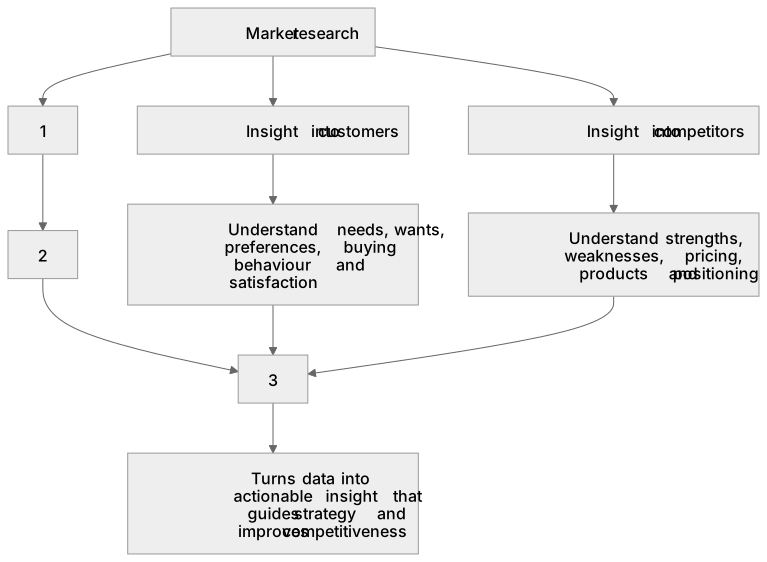
1Box 1
2Box 2
3Box 3
There is more to this lesson
The full lesson goes on to check your understanding and help you earn the marks. Create a free account to carry on, with your progress saved.
A week of Premium from your first lesson · Then the free plan continues · No card, no charge
Test your understanding of The purpose and methods of market research: Students should understand why businesses conduct market research, such as to identify market opportunities and to get a better insight into their customers and competitors.
Active recall beats re-reading. Take an instant quiz now to test what you’ve learned and lock it into long-term memory.
A week of Premium from your first lesson · Then the free plan continues · No card, no charge