AQA · GCSE · Business
Course version: 8132 · Version from Sept 2017
The purpose and methods of market research: focus groups
A focus group is a small, guided discussion with selected participants, used as a primary market research method to explore opinions, needs and reactions.
Checked against the AQA 8132 specification (opens in a new tab) on .
- Point 12 of 19
- 4 key terms
Study notes
From the checked teaching notes for this specification point.
The idea
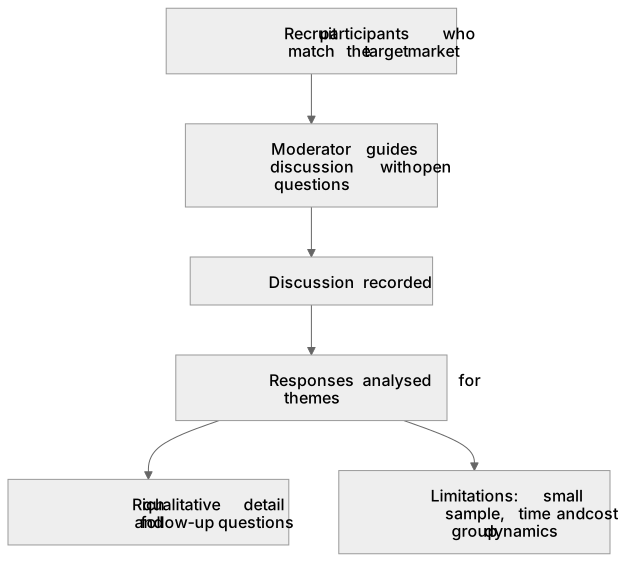
A focus group is a small, guided discussion with selected participants, used as a primary market research method to explore opinions, needs and reactions. A business recruits people who match its target market, then a moderator asks open questions about a product, brand or idea. The discussion is usually recorded so responses can be analysed for themes. For example, a café testing a new lunch menu might run two groups of eight customers, asking what they think of the dishes and prices. Focus groups give rich qualitative detail and allow follow-up questions, but they are time-consuming, can be expensive, and results may be influenced by group dynamics or a small sample. They are assessed through your ability to explain how the method works, apply it to a business context, and evaluate its strengths and limitations.
What earns the marks
- Defines a focus group as a small group discussion used to collect qualitative primary research about opinions, needs or reactions.
- Explains that participants are selected to match the target market and a moderator guides the discussion using open questions.
- Describes how the discussion is recorded and analysed to identify themes, preferences or concerns.
- Applies the method to a business context, such as testing a new product, brand or price with potential customers.
- Evaluates strengths, including rich detail, follow-up questioning and insight into why customers feel a certain way.
- Evaluates limitations, including small sample size, time and cost, and possible bias from group dynamics or moderator influence.
Common mistakes and how to put them right
Confusing a focus group with a questionnaire.
Put it right: A questionnaire collects written or online answers from many respondents, while a focus group is a guided group discussion that produces detailed qualitative data.
Assuming a focus group is representative of the whole market.
Put it right: A small group cannot represent all customers, so results should be treated as indicative rather than statistically reliable.
Ignoring the moderator's role.
Put it right: Without a skilled moderator, one participant may dominate, or the discussion may drift, reducing the usefulness of the findings.
Treating focus group data as quantitative.
Put it right: Focus groups mainly produce qualitative opinions and themes, not numerical data that can be easily generalised.
Exam tips
- When applying focus groups to a case study, name the business and state exactly what it wants to find out, such as whether customers would pay a higher price for a new product.
- For evaluation questions, weigh both benefits and drawbacks before reaching a judgement; for example, rich detail may be more useful than a larger but shallow survey.
- Use business terminology accurately, such as primary research, qualitative data, target market, moderator and sample, to show understanding.
- If asked to recommend a research method, justify why a focus group is suitable for the specific context, or explain why another method might be better.
Try the lesson
The start of the The purpose and methods of market research: focus groups lesson, made from checked teaching notes for this specification point.
Have a go first
What is a focus group? Select the correct answer.
Listen
A focus group is a small, guided discussion with selected participants, used as a primary market research method to explore opinions, needs and reactions. A business recruits people who match its target market, then a moderator asks open questions about a product, brand or idea. The discussion is usually recorded so responses can be analysed for themes. For example, a café testing a new lunch menu might run two groups of eight customers, asking what they think of the dishes and prices. Focus groups give rich qualitative detail and allow follow-up questions, but they are time-consuming, can be expensive, and results may be influenced by group dynamics or a small sample. They are assessed through your ability to explain how the method works, apply it to a business context, and evaluate its strengths and limitations. A strong answer earns marks for these points. Defines a focus group as a small group discussion used to collect qualitative primary research about opinions, needs or reactions. Explains that participants are selected to match the target market and a moderator guides the discussion using open questions. Describes how the discussion is recorded and analysed to identify themes, preferences or concerns. Applies the method to a business context, such as testing a new product, brand or price with potential customers. Exam tip: When applying focus groups to a case study, name the business and state exactly what it wants to find out, such as whether customers would pay a higher price for a new product.
See it
Key words
Say what each word means before you turn the card.
Focus group
Try answering aloud or in your head before turning the card.
Moderator
Try answering aloud or in your head before turning the card.
Qualitative detail
Try answering aloud or in your head before turning the card.
Group dynamics
Try answering aloud or in your head before turning the card.
See every definition
- Focus group
- A small, guided discussion with selected participants, used as a primary market research method to explore opinions, needs and reactions.
- Moderator
- The person who guides the discussion by asking open questions about a product, brand or idea.
- Qualitative detail
- Rich information from the discussion that allows follow-up questions and insight into why customers feel a certain way.
- Group dynamics
- The way participants interact in the discussion, which may influence the results.
Label the diagram
Some boxes have lost their names. Pick the right name for each number.
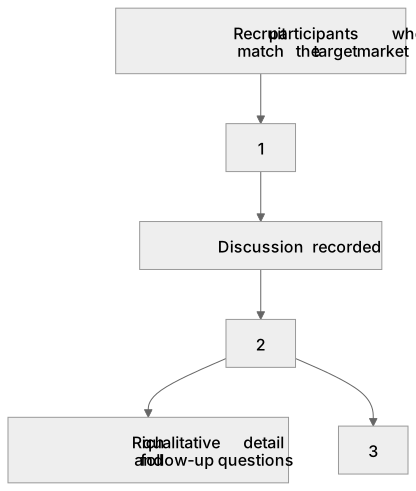
1Box 1
2Box 2
3Box 3
There is more to this lesson
The full lesson goes on to check your understanding and help you earn the marks. Create a free account to carry on, with your progress saved.
A week of Premium from your first lesson · Then the free plan continues · No card, no charge
Test your understanding of The purpose and methods of market research: focus groups
Active recall beats re-reading. Take an instant quiz now to test what you’ve learned and lock it into long-term memory.
A week of Premium from your first lesson · Then the free plan continues · No card, no charge