AQA · GCSE · Business
Course version: 8132 · Version from Sept 2017
The purpose and methods of market research: interviews
An interview is a live conversation in which a researcher asks a respondent questions and probes the answers.
Checked against the AQA 8132 specification (opens in a new tab) on .
- Point 11 of 19
- 4 key terms
Study notes
From the checked teaching notes for this specification point.
The idea
An interview is a live conversation in which a researcher asks a respondent questions and probes the answers. It suits qualitative market research because follow-up questions uncover reasons, feelings and detail that tick-box surveys miss. Interviews may be one to one or in a small group, and structured, semi-structured or unstructured. They can happen face to face, by phone or by video call. A small restaurant might interview ten regular diners to learn why they choose it, then use those reasons to shape its menu. Interviews give depth but reach few people, take time, cost more per respondent and risk interviewer bias, so they often complement a survey.
What earns the marks
- Defines an interview as a live conversation in which a researcher questions a respondent and can probe answers.
- Explains that interviews suit qualitative research because follow-up questions reveal reasons, opinions and feelings.
- Distinguishes one-to-one interviews from group interviews, and structured, semi-structured and unstructured formats.
- Identifies delivery methods such as face to face, telephone and video call, and links each to cost, reach or rapport.
- Explains limitations: small samples, time and cost per respondent, and possible interviewer bias.
- Applies interview findings to a decision, such as reshaping a menu after ten regular diners explain their choices.
Common mistakes and how to put them right
Assuming interviews produce representative statistics.
Put it right: Small samples give depth, so findings are indicative rather than statistically representative.
Letting the interviewer's expectations shape the questions.
Put it right: Use neutral, consistent prompts so answers are not led.
Confusing an interview with a survey.
Put it right: An interview is a live conversation allowing follow-up, while a survey uses a fixed question set for many respondents.
Exam tips
- State whether the interview is one to one or group and structured or unstructured, then link that choice to the research purpose.
- Give one depth advantage and one cost or bias drawback, using the case context rather than generic statements.
- Recommend interviews alongside a survey when the business needs both reasons and measurable data.
Try the lesson
The start of the The purpose and methods of market research: interviews lesson, made from checked teaching notes for this specification point.
Have a go first
Which of the following best describes an interview as a method of market research?
Listen
An interview is a live conversation in which a researcher asks a respondent questions and probes the answers. It suits qualitative market research because follow-up questions uncover reasons, feelings and detail that tick-box surveys miss. Interviews may be one to one or in a small group, and structured, semi-structured or unstructured. They can happen face to face, by phone or by video call. A small restaurant might interview ten regular diners to learn why they choose it, then use those reasons to shape its menu. Interviews give depth but reach few people, take time, cost more per respondent and risk interviewer bias, so they often complement a survey. A strong answer earns marks for these points. Defines an interview as a live conversation in which a researcher questions a respondent and can probe answers. Explains that interviews suit qualitative research because follow-up questions reveal reasons, opinions and feelings. Distinguishes one-to-one interviews from group interviews, and structured, semi-structured and unstructured formats. Identifies delivery methods such as face to face, telephone and video call, and links each to cost, reach or rapport. A common slip: Assuming interviews produce representative statistics. Instead, small samples give depth, so findings are indicative rather than statistically representative. Exam tip: State whether the interview is one to one or group and structured or unstructured, then link that choice to the research purpose.
See it
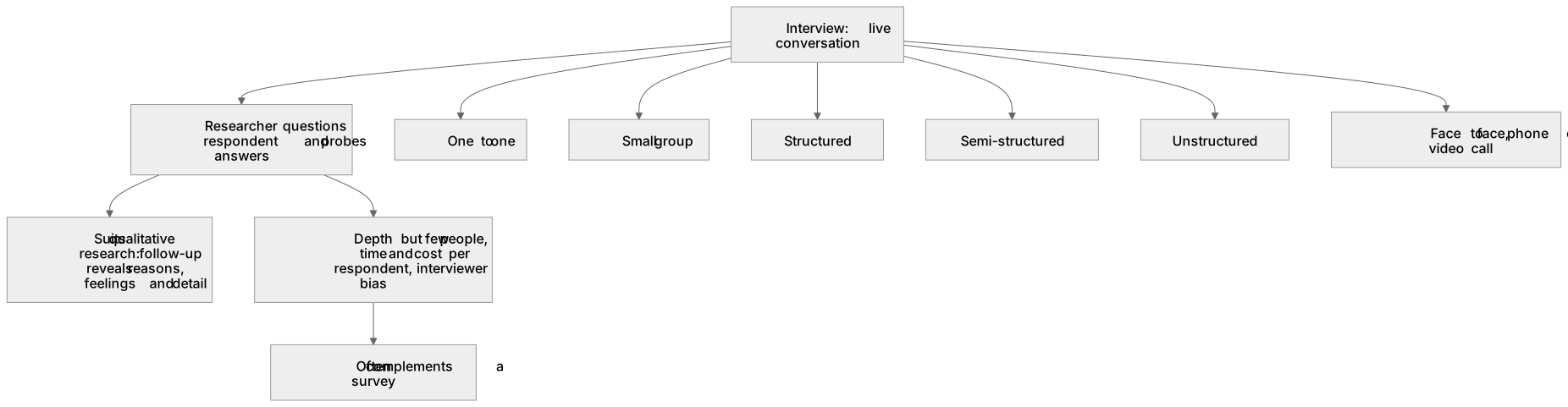
Key words
Say what each word means before you turn the card.
Interview
Try answering aloud or in your head before turning the card.
Qualitative market research
Try answering aloud or in your head before turning the card.
Interviewer bias
Try answering aloud or in your head before turning the card.
Depth versus breadth of research
Try answering aloud or in your head before turning the card.
See every definition
- Interview
- A live conversation in which a researcher asks a respondent questions and probes the answers.
- Qualitative market research
- Research that uncovers reasons, feelings and detail through follow-up questions, which tick-box surveys miss.
- Interviewer bias
- A risk of interviews where the interviewer's expectations may shape the questions, so neutral, consistent prompts should be used.
- Depth versus breadth of research
- Interviews give depth but reach few people, take time and cost more per respondent, so they often complement a survey.
Label the diagram
Some boxes have lost their names. Pick the right name for each number.
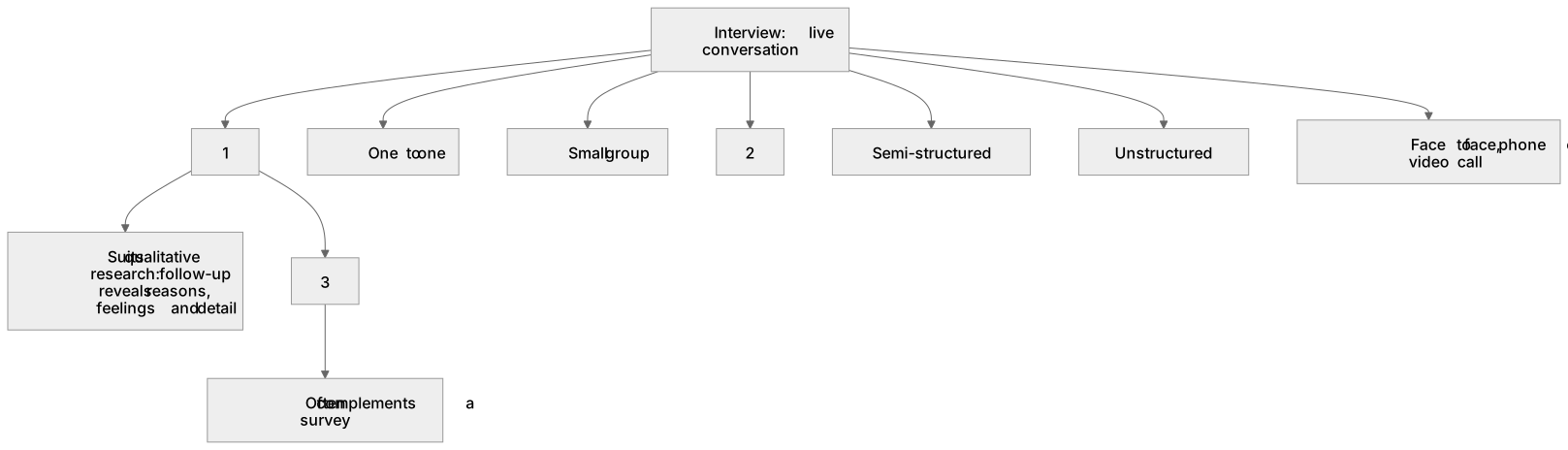
1Box 1
2Box 2
3Box 3
There is more to this lesson
The full lesson goes on to check your understanding and help you earn the marks. Create a free account to carry on, with your progress saved.
A week of Premium from your first lesson · Then the free plan continues · No card, no charge
Test your understanding of The purpose and methods of market research: interviews
Active recall beats re-reading. Take an instant quiz now to test what you’ve learned and lock it into long-term memory.
A week of Premium from your first lesson · Then the free plan continues · No card, no charge