AQA · GCSE · Business
Course version: 8132 · Version from Sept 2017
The purpose and methods of market research: questionnaires
A questionnaire is a market research method that asks a set of written or spoken questions to gather information from respondents.
Checked against the AQA 8132 specification (opens in a new tab) on .
- Point 9 of 19
- 4 key terms
Study notes
From the checked teaching notes for this specification point.
The idea
A questionnaire is a market research method that asks a set of written or spoken questions to gather information from respondents. It can collect quantitative data through closed questions with fixed responses, such as yes/no or rating scales, and qualitative data through open questions that invite detailed answers. Questionnaires can be administered face-to-face, by post, by telephone or online. They are relatively inexpensive for large samples and can reach many people quickly, but response rates may be low and answers may be inaccurate if questions are poorly designed or biased. For example, a business testing a new snack might ask closed questions about purchase likelihood and open questions about preferred flavours. Effective questionnaires use clear, neutral wording and a logical order to avoid leading respondents.
What earns the marks
- Defines a questionnaire as a set of questions used to collect information from respondents.
- Explains that questionnaires can produce quantitative data from closed questions and qualitative data from open questions.
- Describes common administration methods such as online, postal, telephone or face-to-face.
- Identifies advantages, such as low cost per respondent and ability to reach a large sample.
- Identifies disadvantages, such as low response rates, potential for inaccurate answers and question design bias.
- Explains how question design affects the quality and usefulness of the data collected.
Common mistakes and how to put them right
Assuming questionnaires always produce quantitative data.
Put it right: They can also produce qualitative data if open questions are used.
Ignoring the impact of poor question design.
Put it right: Leading or ambiguous questions can bias results and reduce validity.
Believing that a questionnaire guarantees a representative sample.
Put it right: The sample depends on who is asked and who responds, not just the method.
Exam tips
- When describing questionnaires, mention at least one advantage and one disadvantage to show balanced understanding.
- Link the method to the type of data it generates, using terms such as closed questions and open questions.
- Use a specific business example to illustrate how a questionnaire would be used and what it would measure.
Try the lesson
The start of the The purpose and methods of market research: questionnaires lesson, made from checked teaching notes for this specification point.
Have a go first
Which of the following best describes a questionnaire as a method of market research?
Listen
A questionnaire is a market research method that asks a set of written or spoken questions to gather information from respondents. It can collect quantitative data through closed questions with fixed responses, such as yes/no or rating scales, and qualitative data through open questions that invite detailed answers. Questionnaires can be administered face-to-face, by post, by telephone or online. They are relatively inexpensive for large samples and can reach many people quickly, but response rates may be low and answers may be inaccurate if questions are poorly designed or biased. For example, a business testing a new snack might ask closed questions about purchase likelihood and open questions about preferred flavours. Effective questionnaires use clear, neutral wording and a logical order to avoid leading respondents. A strong answer earns marks for these points. Defines a questionnaire as a set of questions used to collect information from respondents. Explains that questionnaires can produce quantitative data from closed questions and qualitative data from open questions. Describes common administration methods such as online, postal, telephone or face-to-face. Identifies advantages, such as low cost per respondent and ability to reach a large sample. Exam tip: When describing questionnaires, mention at least one advantage and one disadvantage to show balanced understanding.
See it
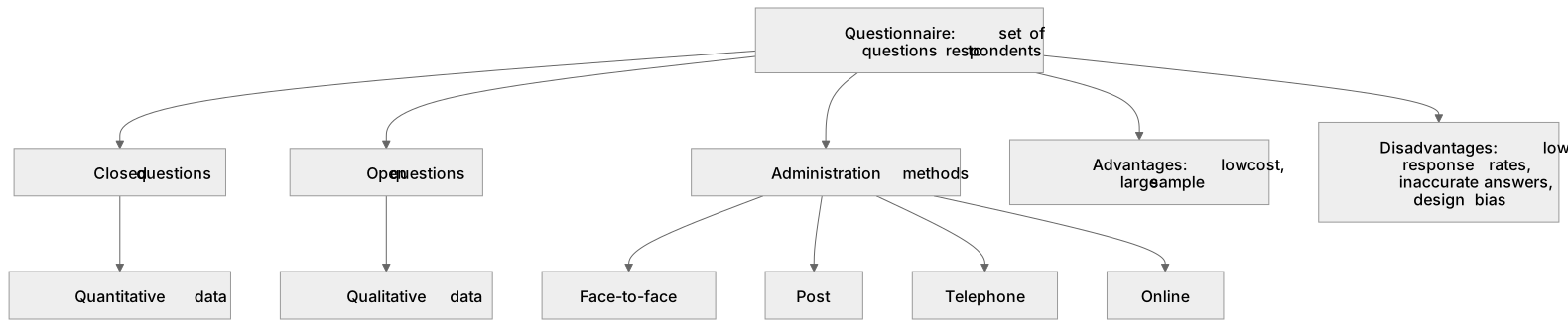
Key words
Say what each word means before you turn the card.
Questionnaire
Try answering aloud or in your head before turning the card.
Closed questions
Try answering aloud or in your head before turning the card.
Open questions
Try answering aloud or in your head before turning the card.
Question design bias
Try answering aloud or in your head before turning the card.
See every definition
- Questionnaire
- A market research method that asks a set of written or spoken questions to gather information from respondents.
- Closed questions
- Questions with fixed responses, such as yes/no or rating scales, that collect quantitative data.
- Open questions
- Questions that invite detailed answers and collect qualitative data.
- Question design bias
- Inaccurate answers that may arise if questions are poorly designed or biased, so clear, neutral wording and a logical order are used to avoid leading respondents.
Label the diagram
Some boxes have lost their names. Pick the right name for each number.
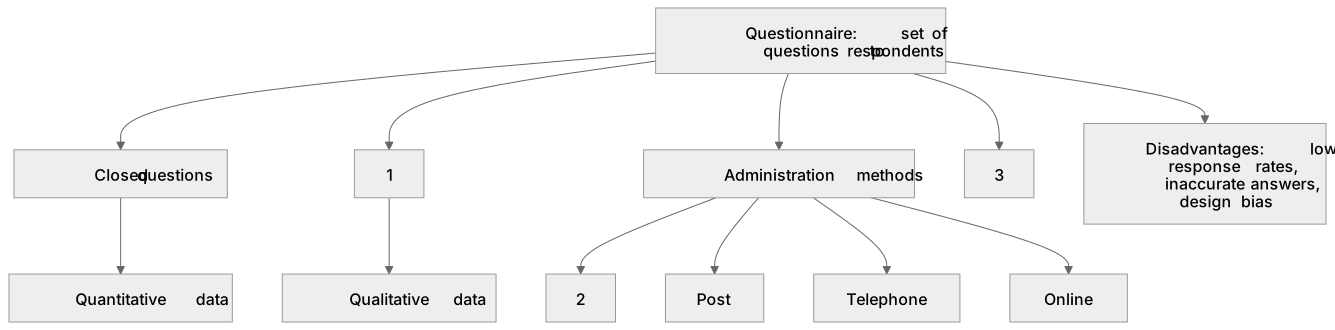
1Box 1
2Box 2
3Box 3
There is more to this lesson
The full lesson goes on to check your understanding and help you earn the marks. Create a free account to carry on, with your progress saved.
A week of Premium from your first lesson · Then the free plan continues · No card, no charge
Test your understanding of The purpose and methods of market research: questionnaires
Active recall beats re-reading. Take an instant quiz now to test what you’ve learned and lock it into long-term memory.
A week of Premium from your first lesson · Then the free plan continues · No card, no charge