AQA · GCSE · Business
Course version: 8132 · Version from Sept 2017
The purpose and nature of businesses: Basic functions and types of business
Full specification wording
The purpose and nature of businesses: Basic functions and types of business
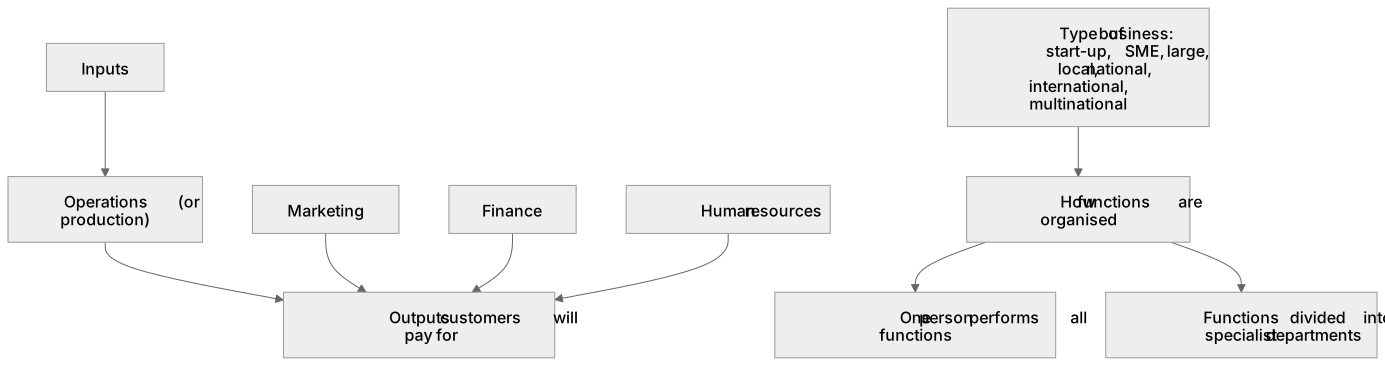
Every business carries out basic functions that turn inputs into outputs customers will pay for.
Checked against the AQA 8132 specification (opens in a new tab) on .
- Point 3 of 14
- 4 key terms
Study notes
From the checked teaching notes for this specification point.
The idea
Every business carries out basic functions that turn inputs into outputs customers will pay for. These functions include operations (or production), marketing, finance and human resources. A start-up may have one person performing all functions, while a large multinational separates them into specialist departments. Businesses also come in different types based on size and scale: start-ups, SMEs (small and medium-sized enterprises), large, local, national, international and multinational. The type chosen affects how functions are organised. For example, a local SME might have a small team handling marketing, whereas a multinational will have a global marketing department. Understanding both functions and types helps explain why businesses behave differently and how they structure their operations.
What earns the marks
- Identifies the main business functions: operations or production, marketing, finance and human resources, explaining their roles.
- Explains that functions may be combined in a start-up or SME but divided into specialist departments in large businesses.
- Describes different types of business by size and scale: start-ups, SMEs, large, local, national, international and multinational.
- Compares business types using criteria such as scale of operations and geographical reach.
- Links the type of business to how the basic functions are carried out, for example a local start-up handling finance personally.
- Uses a relevant example, such as a local SME versus a multinational corporation.
Common mistakes and how to put them right
Confusing types of business (start-ups, SMEs, large, local, national, international, multinational) with business ownership structures (sole traders, limited companies).
Put it right: Types refer to size and scale, ownership refers to legal structure.
Treating marketing as only advertising.
Put it right: Marketing also covers market research, pricing, distribution and product decisions.
Assuming all international businesses are multinationals.
Put it right: An international business trades globally, but a multinational has physical operations or facilities in more than one country.
Exam tips
- Read the command word carefully: describe requires features, whereas explain requires reasons or consequences.
- Use a named or realistic business context to make function and type links concrete.
- When discussing types of business, ensure you refer to size (SME, large) or scale (local, national, multinational) rather than legal ownership.
Try the lesson
The start of the The purpose and nature of businesses: Basic functions and types of business lesson, made from checked teaching notes for this specification point.
Have a go first
Which one of the following is a basic function carried out by a business?
Listen
Every business carries out basic functions that turn inputs into outputs customers will pay for. These functions include operations (or production), marketing, finance and human resources. A start-up may have one person performing all functions, while a large multinational separates them into specialist departments. Businesses also come in different types based on size and scale: start-ups, SMEs (small and medium-sized enterprises), large, local, national, international and multinational. The type chosen affects how functions are organised. For example, a local SME might have a small team handling marketing, whereas a multinational will have a global marketing department. Understanding both functions and types helps explain why businesses behave differently and how they structure their operations. A strong answer earns marks for these points. Identifies the main business functions: operations or production, marketing, finance and human resources, explaining their roles. Explains that functions may be combined in a start-up or SME but divided into specialist departments in large businesses. Describes different types of business by size and scale: start-ups, SMEs, large, local, national, international and multinational. Compares business types using criteria such as scale of operations and geographical reach. A common slip: Confusing types of business (start-ups, SMEs, large, local, national, international, multinational) with business ownership structures (sole traders, limited companies). Instead, types refer to size and scale, ownership refers to legal structure. Exam tip: Read the command word carefully: describe requires features, whereas explain requires reasons or consequences.
See it
Key words
Say what each word means before you turn the card.
Business functions
Try answering aloud or in your head before turning the card.
Business size and scale
Try answering aloud or in your head before turning the card.
Business growth and structure
Try answering aloud or in your head before turning the card.
Purpose of business activity
Try answering aloud or in your head before turning the card.
See every definition
- Business functions
- Operations (or production), marketing, finance and human resources are the basic functions that turn inputs into outputs customers will pay for.
- Business size and scale
- Businesses come in different types based on size and scale: start-ups, SMEs, large, local, national, international and multinational.
- Business growth and structure
- A start-up may have one person performing all functions, while a large multinational separates them into specialist departments.
- Purpose of business activity
- Every business carries out basic functions that turn inputs into outputs customers will pay for.
Label the diagram
Some boxes have lost their names. Pick the right name for each number.
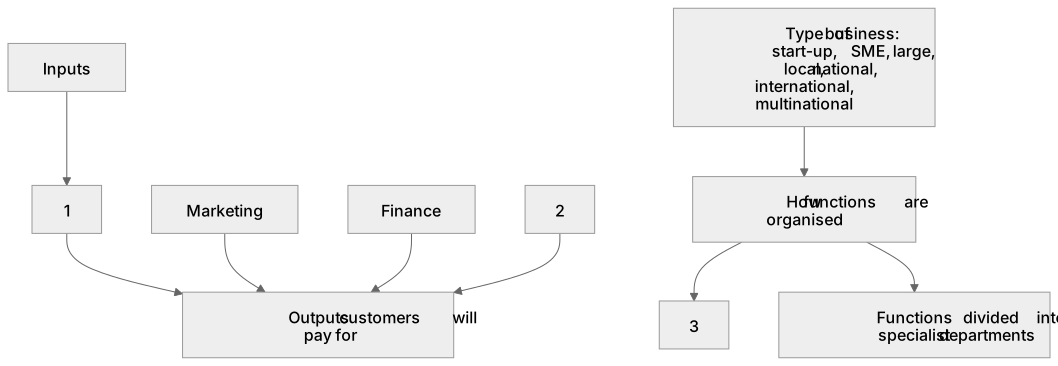
1Box 1
2Box 2
3Box 3
There is more to this lesson
The full lesson goes on to check your understanding and help you earn the marks. Create a free account to carry on, with your progress saved.
A week of Premium from your first lesson · Then the free plan continues · No card, no charge
Test your understanding of The purpose and nature of businesses: Basic functions and types of business
Active recall beats re-reading. Take an instant quiz now to test what you’ve learned and lock it into long-term memory.
A week of Premium from your first lesson · Then the free plan continues · No card, no charge