AQA · GCSE · Business
Course version: 8132 · Version from Sept 2017
Business enterprise and entrepreneurship
Full specification wording
The purpose and nature of businesses: Business enterprise and entrepreneurship
Enterprise is the process of spotting an opportunity and turning an idea into a trading business, taking on risk in the hope of reward.
Checked against the AQA 8132 specification (opens in a new tab) on .
- Point 4 of 14
- 4 key terms
Study notes
From the checked teaching notes for this specification point.
The idea
Enterprise is the process of spotting an opportunity and turning an idea into a trading business, taking on risk in the hope of reward. An entrepreneur drives this: generating the idea, organising resources, making decisions and bearing the risk of failure. Motives include profit, independence, a gap in the market, social aims or turning a hobby into income. Entrepreneurs create added value, defined as the difference between the selling price of a product and the cost of its bought-in materials, components and services. Value can be added through convenience, branding, quality, design, and a unique selling point (USP). They also face risks such as uncertain demand, cash-flow problems, rising costs and personal financial exposure.
For example: Someone opening a café must secure premises, staff and stock before knowing whether customers will come.
What earns the marks
- Defines enterprise as the process of identifying a business opportunity and organising resources to exploit it.
- Defines an entrepreneur as the individual who takes the initiative and risk in starting and running a business.
- Explains motives for starting a business, such as profit, independence, filling a market gap or social objectives.
- Explains risks and rewards, including uncertain demand, financial loss, personal liability, profit and independence.
- Describes how entrepreneurs create added value, calculated as the selling price minus the cost of bought-in materials, components and services.
- Identifies methods of adding value, including convenience, branding, quality, design, and a unique selling point (USP).
Common mistakes and how to put them right
Conflating added value with broader economic contributions like job creation.
Put it right: Added value is specifically the selling price minus the cost of bought-in materials, components and services.
Assuming entrepreneurs always succeed.
Put it right: Many new businesses fail because of cash-flow problems, weak demand or poor planning.
Believing risk means only money.
Put it right: Risk also includes time, reputation, health and personal security.
Exam tips
- Anchor answers in a specific business idea so risk, reward and added value are concrete rather than abstract.
- Distinguish clearly between the entrepreneur as a person and enterprise as a process when the question uses either term.
- When calculating or discussing added value, always refer to the formula: selling price minus cost of bought-in materials, components and services.
Try the lesson
The start of the The purpose and nature of businesses: Business enterprise and entrepreneurship lesson, made from checked teaching notes for this specification point.
Have a go first
Which one of the following best describes an entrepreneur?
Listen
Enterprise is the process of spotting an opportunity and turning an idea into a trading business, taking on risk in the hope of reward. An entrepreneur drives this: generating the idea, organising resources, making decisions and bearing the risk of failure. Motives include profit, independence, a gap in the market, social aims or turning a hobby into income. Entrepreneurs create added value, defined as the difference between the selling price of a product and the cost of its bought-in materials, components and services. Value can be added through convenience, branding, quality, design, and a unique selling point (USP). They also face risks such as uncertain demand, cash-flow problems, rising costs and personal financial exposure. For example, someone opening a café must secure premises, staff and stock before knowing whether customers will come. A strong answer earns marks for these points. Defines enterprise as the process of identifying a business opportunity and organising resources to exploit it. Defines an entrepreneur as the individual who takes the initiative and risk in starting and running a business. Explains motives for starting a business, such as profit, independence, filling a market gap or social objectives. Explains risks and rewards, including uncertain demand, financial loss, personal liability, profit and independence. A common slip: Conflating added value with broader economic contributions like job creation. Instead, added value is specifically the selling price minus the cost of bought-in materials, components and services. Exam tip: Anchor answers in a specific business idea so risk, reward and added value are concrete rather than abstract.
See it
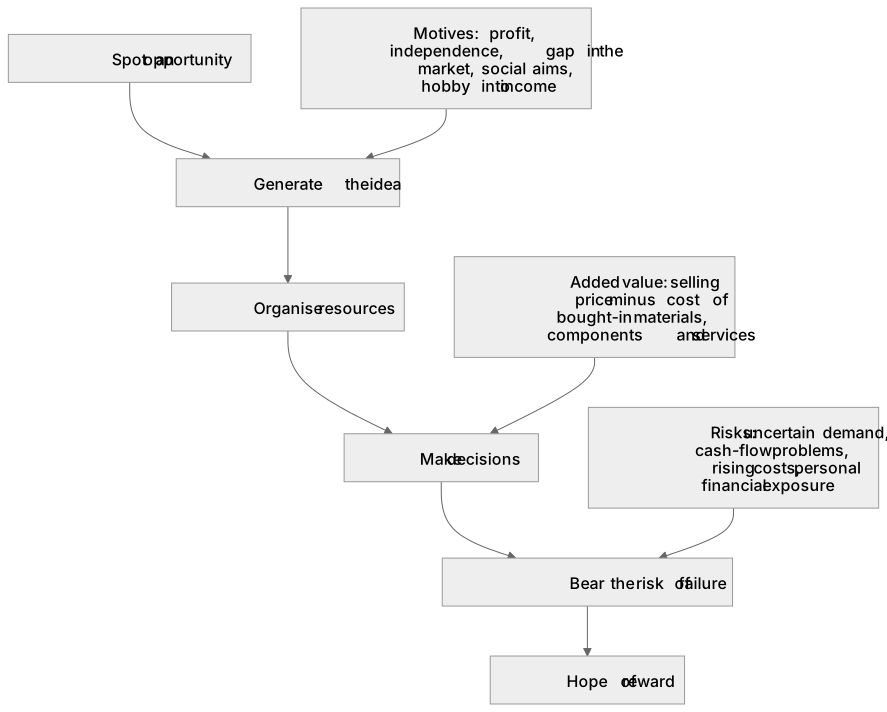
Key words
Say what each word means before you turn the card.
Enterprise
Try answering aloud or in your head before turning the card.
Entrepreneur
Try answering aloud or in your head before turning the card.
Added value
Try answering aloud or in your head before turning the card.
Unique selling point (USP)
Try answering aloud or in your head before turning the card.
See every definition
- Enterprise
- The process of spotting an opportunity and turning an idea into a trading business, taking on risk in the hope of reward.
- Entrepreneur
- The individual who drives the business by generating the idea, organising resources, making decisions and bearing the risk of failure.
- Added value
- The difference between the selling price of a product and the cost of its bought-in materials, components and services.
- Unique selling point (USP)
- One of the methods through which value can be added, alongside convenience, branding, quality and design.
Label the diagram
Some boxes have lost their names. Pick the right name for each number.
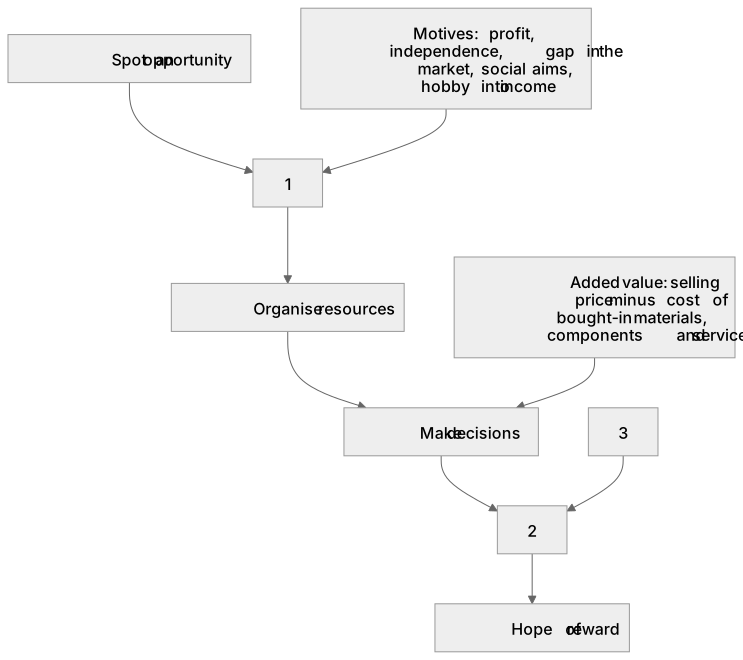
1Box 1
2Box 2
3Box 3
There is more to this lesson
The full lesson goes on to check your understanding and help you earn the marks. Create a free account to carry on, with your progress saved.
A week of Premium from your first lesson · Then the free plan continues · No card, no charge
Test your understanding of The purpose and nature of businesses: Business enterprise and entrepreneurship
Active recall beats re-reading. Take an instant quiz now to test what you’ve learned and lock it into long-term memory.
A week of Premium from your first lesson · Then the free plan continues · No card, no charge