AQA · GCSE · Business
Course version: 8132 · Version from Sept 2017
Define the three sectors of primary, secondary and tertiary and give…
Full specification wording
The purpose and nature of businesses: define the three sectors of primary, secondary and tertiary and give examples of types of business that operate in each sector
Business activity is often classified into three sectors.
Checked against the AQA 8132 specification (opens in a new tab) on .
- Point 10 of 14
- 4 key terms
Study notes
From the checked teaching notes for this specification point.
The idea
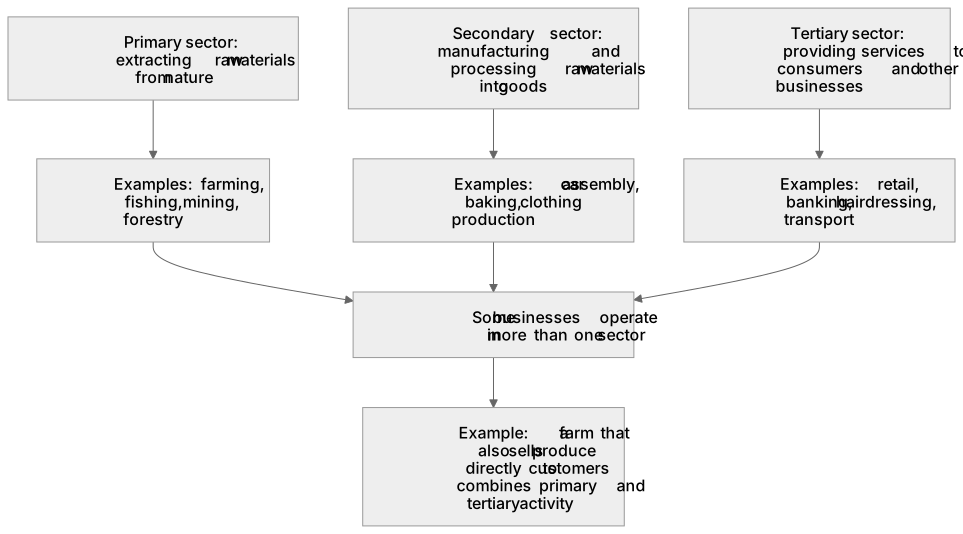
Business activity is often classified into three sectors. The primary sector involves extracting raw materials from nature, such as farming, fishing, mining and forestry. The secondary sector involves manufacturing and processing raw materials into finished or semi-finished goods, such as car assembly, baking and clothing production. The tertiary sector provides services to consumers and other businesses, such as retail, banking, hairdressing and transport. Some businesses may operate in more than one sector; for example, a farm that also sells produce directly to customers combines primary and tertiary activity. Understanding these sectors helps analyse how economies develop and how businesses create value. In the UK, the tertiary sector is the largest, but primary and secondary remain important. Each sector has distinct characteristics and examples.
What earns the marks
- Defines the primary sector as extraction of raw materials from nature, with examples such as farming, mining or fishing.
- Defines the secondary sector as manufacturing or processing of raw materials into goods, with examples such as car manufacturing or baking.
- Defines the tertiary sector as providing services, with examples such as retail, banking or hairdressing.
- Gives at least one correct example of a business type for each sector.
- Recognises that some businesses may operate across more than one sector.
Common mistakes and how to put them right
Classifying retail as secondary because it sells goods.
Put it right: Retail is tertiary because it provides a service.
Thinking primary sector only includes farming.
Put it right: It also includes mining, fishing, forestry and oil extraction.
Assuming a business belongs to only one sector.
Put it right: Some businesses, like a farm shop, span primary and tertiary sectors.
Exam tips
- Use specific UK examples, such as 'a coal mine' for primary, 'a car factory' for secondary and 'a supermarket' for tertiary.
- If asked for examples, give one clear example per sector to avoid confusion.
- Be prepared to explain why a business fits a sector, not just name it.
Try the lesson
The start of the The purpose and nature of businesses: define the three sectors of primary, secondary and tertiary and give examples of types of business that operate in each sector lesson, made from checked teaching notes for this specification point.
Have a go first
Which sector of the economy involves extracting raw materials from the land or sea?
Listen
Business activity is often classified into three sectors. The primary sector involves extracting raw materials from nature, such as farming, fishing, mining and forestry. The secondary sector involves manufacturing and processing raw materials into finished or semi-finished goods, such as car assembly, baking and clothing production. The tertiary sector provides services to consumers and other businesses, such as retail, banking, hairdressing and transport. Some businesses may operate in more than one sector; for example, a farm that also sells produce directly to customers combines primary and tertiary activity. Understanding these sectors helps analyse how economies develop and how businesses create value. In the UK, the tertiary sector is the largest, but primary and secondary remain important. Each sector has distinct characteristics and examples. A strong answer earns marks for these points. Defines the primary sector as extraction of raw materials from nature, with examples such as farming, mining or fishing. Defines the secondary sector as manufacturing or processing of raw materials into goods, with examples such as car manufacturing or baking. Defines the tertiary sector as providing services, with examples such as retail, banking or hairdressing. Gives at least one correct example of a business type for each sector. A common slip: Classifying retail as secondary because it sells goods. Instead, retail is tertiary because it provides a service. Exam tip: Use specific UK examples, such as 'a coal mine' for primary, 'a car factory' for secondary and 'a supermarket' for tertiary.
See it
Key words
Say what each word means before you turn the card.
Primary sector
Try answering aloud or in your head before turning the card.
Secondary sector
Try answering aloud or in your head before turning the card.
Tertiary sector
Try answering aloud or in your head before turning the card.
Classification of business activity
Try answering aloud or in your head before turning the card.
See every definition
- Primary sector
- Involves extracting raw materials from nature, such as farming, fishing, mining and forestry.
- Secondary sector
- Involves manufacturing and processing raw materials into finished or semi-finished goods, such as car assembly, baking and clothing production.
- Tertiary sector
- Provides services to consumers and other businesses, such as retail, banking, hairdressing and transport.
- Classification of business activity
- Business activity is often classified into three sectors, and some businesses may operate in more than one sector.
Label the diagram
Some boxes have lost their names. Pick the right name for each number.
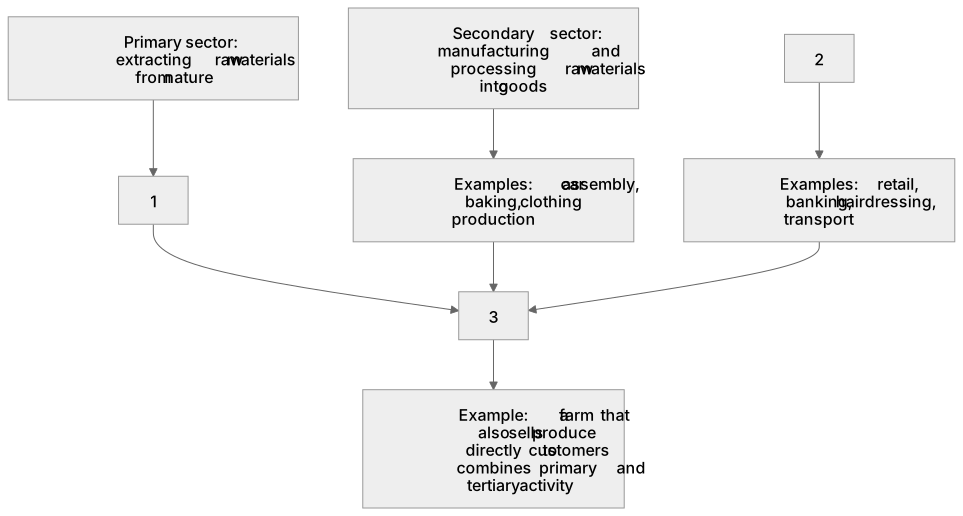
1Box 1
2Box 2
3Box 3
There is more to this lesson
The full lesson goes on to check your understanding and help you earn the marks. Create a free account to carry on, with your progress saved.
A week of Premium from your first lesson · Then the free plan continues · No card, no charge
Test your understanding of The purpose and nature of businesses: define the three sectors of primary, secondary and tertiary and give examples of types of business that operate in each sector
Active recall beats re-reading. Take an instant quiz now to test what you’ve learned and lock it into long-term memory.
A week of Premium from your first lesson · Then the free plan continues · No card, no charge