AQA · GCSE · Business
Course version: 8132 · Version from Sept 2017
The purpose and nature of businesses: define opportunity cost
Opportunity cost is the value of the next best alternative forgone when a choice is made.
Checked against the AQA 8132 specification (opens in a new tab) on .
- Point 9 of 14
- 4 key terms
Study notes
From the checked teaching notes for this specification point.
The idea
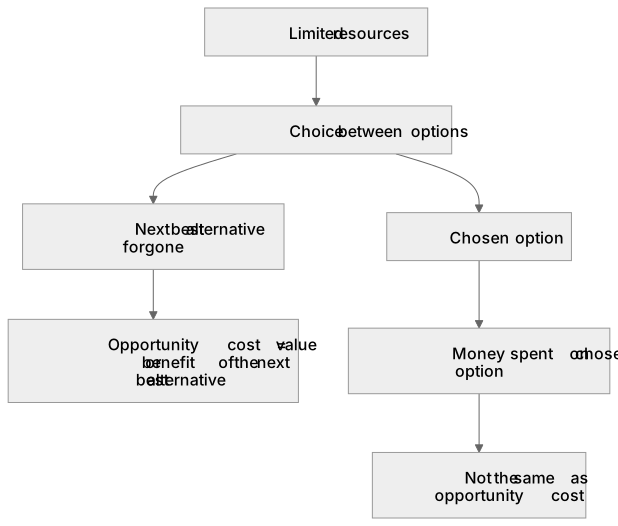
Opportunity cost is the value of the next best alternative forgone when a choice is made. In business, resources such as money, time, labour and machinery are limited, so choosing one use means giving up another. For example, a bakery with £10,000 could buy a new oven or run a marketing campaign; if it buys the oven, the opportunity cost is the marketing campaign it cannot now afford. Opportunity cost is not simply the money spent; it is the benefit or value of the alternative not chosen. It applies to personal, business and government decisions. Understanding opportunity cost helps businesses compare options and justify decisions, especially when resources are scarce. It is a fundamental concept in economics and business, underpinning choices about production, investment and resource allocation.
What earns the marks
- Defines opportunity cost as the value or benefit of the next best alternative forgone when making a choice.
- Recognises that resources are limited, so choosing one option means sacrificing another.
- Applies the concept to a business context, such as choosing between buying equipment and spending on advertising.
- Distinguishes opportunity cost from the actual money spent, focusing on the alternative not chosen.
- Explains that opportunity cost applies to individuals, businesses and governments.
Common mistakes and how to put them right
Confusing opportunity cost with the monetary cost of the chosen option.
Put it right: Opportunity cost is the value of the next best alternative given up, not the price paid.
Thinking opportunity cost is the sum of all alternatives forgone.
Put it right: It is only the next best alternative, not every possible option.
Believing opportunity cost only applies to money.
Put it right: It can apply to time, resources, labour and other scarce factors.
Exam tips
- Use a clear business example to show you can apply the concept, such as a firm choosing between two projects.
- State explicitly that it is the 'next best' alternative, not just any alternative.
- Link opportunity cost to scarcity of resources to show deeper understanding.
Try the lesson
The start of the The purpose and nature of businesses: define opportunity cost lesson, made from checked teaching notes for this specification point.
Have a go first
Which statement best defines opportunity cost?
Listen
Opportunity cost is the value of the next best alternative forgone when a choice is made. In business, resources such as money, time, labour and machinery are limited, so choosing one use means giving up another. For example, a bakery with £10,000 could buy a new oven or run a marketing campaign; if it buys the oven, the opportunity cost is the marketing campaign it cannot now afford. Opportunity cost is not simply the money spent; it is the benefit or value of the alternative not chosen. It applies to personal, business and government decisions. Understanding opportunity cost helps businesses compare options and justify decisions, especially when resources are scarce. It is a fundamental concept in economics and business, underpinning choices about production, investment and resource allocation. A strong answer earns marks for these points. Defines opportunity cost as the value or benefit of the next best alternative forgone when making a choice. Recognises that resources are limited, so choosing one option means sacrificing another. Applies the concept to a business context, such as choosing between buying equipment and spending on advertising. Distinguishes opportunity cost from the actual money spent, focusing on the alternative not chosen. A common slip: Confusing opportunity cost with the monetary cost of the chosen option. Instead, opportunity cost is the value of the next best alternative given up, not the price paid. Exam tip: Use a clear business example to show you can apply the concept, such as a firm choosing between two projects.
See it
Key words
Say what each word means before you turn the card.
Opportunity cost
Try answering aloud or in your head before turning the card.
Scarcity and choice
Try answering aloud or in your head before turning the card.
Resource allocation
Try answering aloud or in your head before turning the card.
Decision making
Try answering aloud or in your head before turning the card.
See every definition
- Opportunity cost
- The value of the next best alternative forgone when a choice is made.
- Scarcity and choice
- Resources such as money, time, labour and machinery are limited, so choosing one use means giving up another.
- Resource allocation
- Choices about production, investment and resource allocation are underpinned by opportunity cost.
- Decision making
- Understanding opportunity cost helps businesses compare options and justify decisions, especially when resources are scarce.
Label the diagram
Some boxes have lost their names. Pick the right name for each number.
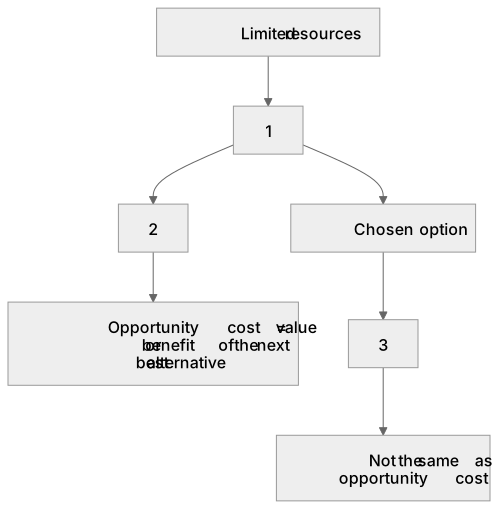
1Box 1
2Box 2
3Box 3
There is more to this lesson
The full lesson goes on to check your understanding and help you earn the marks. Create a free account to carry on, with your progress saved.
A week of Premium from your first lesson · Then the free plan continues · No card, no charge
Test your understanding of The purpose and nature of businesses: define opportunity cost
Active recall beats re-reading. Take an instant quiz now to test what you’ve learned and lock it into long-term memory.
A week of Premium from your first lesson · Then the free plan continues · No card, no charge