AQA · GCSE · Business
Course version: 8132 · Version from Sept 2017
Cutting any waste and unnecessary costs to create a streamlined process…
Full specification wording
The role of procurement: cutting any waste and unnecessary costs to create a streamlined process and fast production times.
Lean production focuses on cutting any waste and unnecessary costs to maximise efficiency.
Checked against the AQA 8132 specification (opens in a new tab) on .
- Point 21 of 21
- 3 key terms
Study notes
From the checked teaching notes for this specification point.
The idea
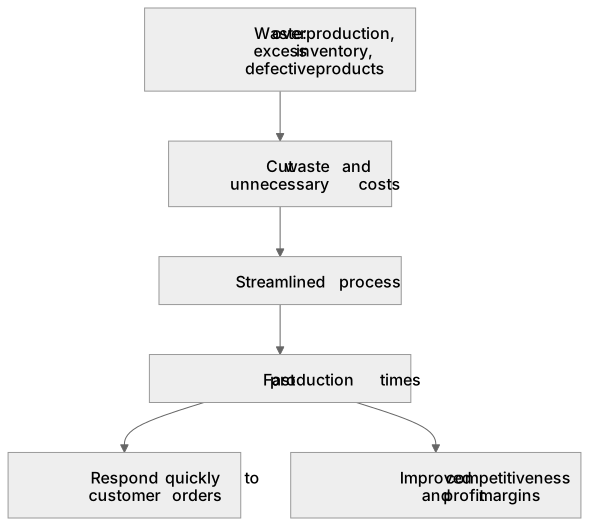
Lean production focuses on cutting any waste and unnecessary costs to maximise efficiency. Waste takes forms such as overproduction, excess inventory, or defective products. By eliminating these inefficiencies, a business can create a streamlined process where goods flow smoothly without delay. For example, a manufacturer might implement just-in-time delivery to ensure parts arrive exactly when needed, cutting unnecessary storage costs. This streamlined approach directly leads to fast production times, allowing the business to respond quickly to customer orders. Ultimately, reducing waste and costs while accelerating production improves competitiveness and profit margins, provided product quality is maintained.
What earns the marks
- Defines waste in production as any activity that consumes resources but does not add value for the customer, such as holding excess stock.
- Explains that cutting unnecessary costs, like warehouse storage fees, improves overall profit margins.
- Describes a streamlined process as one with minimal bottlenecks, ensuring a smooth and continuous workflow.
- Links the elimination of waste and streamlined processes directly to achieving fast production times.
- Evaluates the impact of fast production times on customer satisfaction and the ability to meet demand quickly.
Common mistakes and how to put them right
Equating fast production times with rushed or lower-quality work.
Put it right: A streamlined process achieves speed by removing delays and waste, not by compromising on quality.
Assuming that cutting unnecessary costs only refers to using cheaper materials.
Put it right: It primarily involves eliminating non-value-adding activities, such as overproduction or unnecessary movement.
Forgetting to link waste reduction to production speed.
Put it right: Explain how cutting waste (e.g., waiting times) directly creates a streamlined process and faster output.
Exam tips
- Use the specific context of the business in the exam question to give examples of what 'waste' might look like (e.g., wasted ingredients in a restaurant).
- Clearly connect the concepts: explain how cutting waste leads to a streamlined process, which in turn results in fast production times.
Try the lesson
The start of the The role of procurement: cutting any waste and unnecessary costs to create a streamlined process and fast production times. lesson, made from checked teaching notes for this specification point.
Have a go first
A manufacturer wants to cut waste and unnecessary costs in its procurement so that production is streamlined with fast production times. Which action best matches this aim?
Listen
Lean production focuses on cutting any waste and unnecessary costs to maximise efficiency. Waste takes forms such as overproduction, excess inventory, or defective products. By eliminating these inefficiencies, a business can create a streamlined process where goods flow smoothly without delay. For example, a manufacturer might implement just-in-time delivery to ensure parts arrive exactly when needed, cutting unnecessary storage costs. This streamlined approach directly leads to fast production times, allowing the business to respond quickly to customer orders. Ultimately, reducing waste and costs while accelerating production improves competitiveness and profit margins, provided product quality is maintained. A strong answer earns marks for these points. Defines waste in production as any activity that consumes resources but does not add value for the customer, such as holding excess stock. Explains that cutting unnecessary costs, like warehouse storage fees, improves overall profit margins. Describes a streamlined process as one with minimal bottlenecks, ensuring a smooth and continuous workflow. Links the elimination of waste and streamlined processes directly to achieving fast production times. A common slip: Equating fast production times with rushed or lower-quality work. Instead, A streamlined process achieves speed by removing delays and waste, not by compromising on quality. Exam tip: Use the specific context of the business in the exam question to give examples of what 'waste' might look like (e.g., wasted ingredients in a restaurant).
See it
Key words
Say what each word means before you turn the card.
Lean production processes
Try answering aloud or in your head before turning the card.
Waste reduction
Try answering aloud or in your head before turning the card.
Operational efficiency
Try answering aloud or in your head before turning the card.
See every definition
- Lean production processes
- Cutting any waste and unnecessary costs to create a streamlined process and fast production times.
- Waste reduction
- Eliminating inefficiencies such as overproduction, excess inventory or defective products so that goods flow smoothly without delay.
- Operational efficiency
- Creating a streamlined process where goods flow smoothly without delay by eliminating waste and unnecessary costs.
Label the diagram
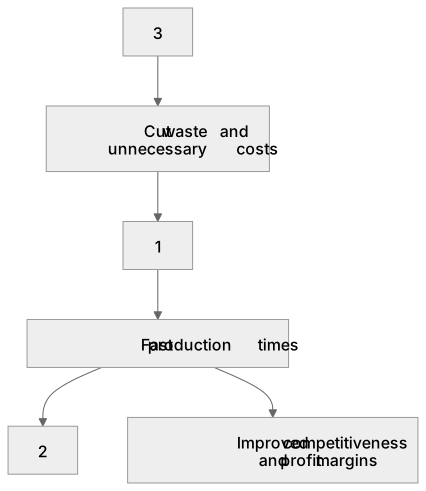
Some boxes have lost their names. Pick the right name for each number.
1Box 1
2Box 2
3Box 3
There is more to this lesson
The full lesson goes on to check your understanding and help you earn the marks. Create a free account to carry on, with your progress saved.
A week of Premium from your first lesson · Then the free plan continues · No card, no charge
Test your understanding of The role of procurement: cutting any waste and unnecessary costs to create a streamlined process and fast production times.
Active recall beats re-reading. Take an instant quiz now to test what you’ve learned and lock it into long-term memory.
A week of Premium from your first lesson · Then the free plan continues · No card, no charge