AQA · GCSE · Business
Course version: 8132 · Version from Sept 2017
Getting goods and services for the best price and value
Full specification wording
The role of procurement: getting goods and services for the best price and value
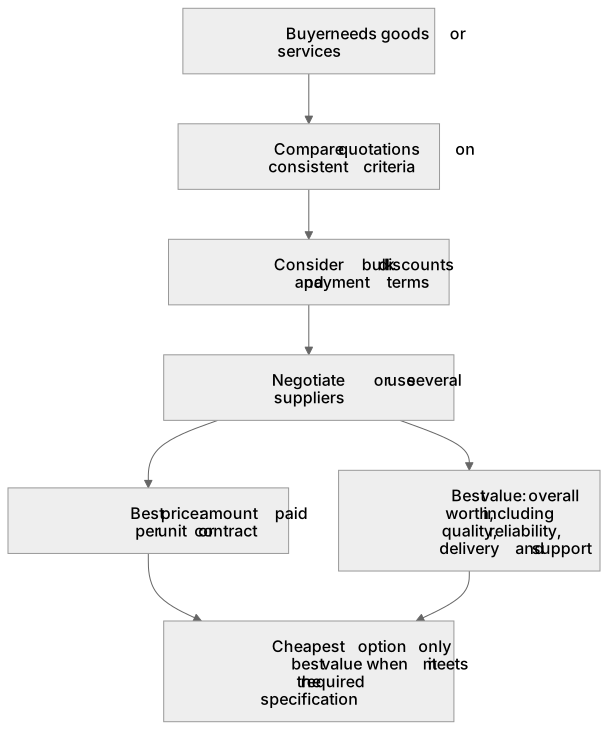
Best price and best value are related but not identical.
Checked against the AQA 8132 specification (opens in a new tab) on .
- Point 20 of 21
- 4 key terms
Study notes
From the checked teaching notes for this specification point.
The idea
Best price and best value are related but not identical. Price is what the business pays per unit or per contract; value is what it receives for that money, including quality, reliability, delivery speed and after-sales support. A hotel choosing a laundry contractor might accept a higher unit price if the contractor collects daily and returns linen undamaged, because replacement linen and complaints cost more than the saving. Buyers therefore compare quotations on consistent criteria, consider bulk discounts and payment terms, and may negotiate or use several suppliers to keep competitive pressure. Value for money is judged against the needs of the operation, so the cheapest option is only best when it meets the required specification.
What earns the marks
- Defines best price as the amount paid and best value as the overall worth of the purchase to the business.
- Explains that value includes quality, reliability, delivery and support, not price alone.
- Shows how a buyer compares quotations on consistent criteria before choosing a supplier.
- Explains how negotiation, bulk buying or payment terms can improve the price obtained.
- Uses a context example, such as a hotel weighing a cheaper laundry contract against daily collection and damage rates.
- Explains that the cheapest option is only best value when it meets the required specification.
Common mistakes and how to put them right
Equating best value with lowest price.
Put it right: Value weighs quality, reliability and support against the price paid.
Ignoring hidden costs such as delivery, storage and faulty goods.
Put it right: Include these when comparing quotations.
Assuming a single supplier is always best.
Put it right: Using several suppliers can maintain competitive pressure and reduce dependency.
Exam tips
- Define price and value separately before comparing them, so the distinction is explicit in the answer.
- Support each judgement with a figure or feature from the case, such as a discount rate or a delivery frequency.
- For evaluation, state the circumstances in which paying more secures better value, for example where downtime is very costly.
Try the lesson
The start of the The role of procurement: getting goods and services for the best price and value lesson, made from checked teaching notes for this specification point.
Have a go first
A small hotel compares two laundry services. One charges less per week but often returns linen late. What does choosing the service that gives the best value mean for the hotel?
Listen
Best price and best value are related but not identical. Price is what the business pays per unit or per contract; value is what it receives for that money, including quality, reliability, delivery speed and after-sales support. A hotel choosing a laundry contractor might accept a higher unit price if the contractor collects daily and returns linen undamaged, because replacement linen and complaints cost more than the saving. Buyers therefore compare quotations on consistent criteria, consider bulk discounts and payment terms, and may negotiate or use several suppliers to keep competitive pressure. Value for money is judged against the needs of the operation, so the cheapest option is only best when it meets the required specification. A strong answer earns marks for these points. Defines best price as the amount paid and best value as the overall worth of the purchase to the business. Explains that value includes quality, reliability, delivery and support, not price alone. Shows how a buyer compares quotations on consistent criteria before choosing a supplier. Explains how negotiation, bulk buying or payment terms can improve the price obtained. A common slip: Equating best value with lowest price. Instead, value weighs quality, reliability and support against the price paid. Exam tip: Define price and value separately before comparing them, so the distinction is explicit in the answer.
See it
Key words
Say what each word means before you turn the card.
Value for money
Try answering aloud or in your head before turning the card.
Best price
Try answering aloud or in your head before turning the card.
Best value
Try answering aloud or in your head before turning the card.
Supplier negotiation
Try answering aloud or in your head before turning the card.
See every definition
- Value for money
- The overall worth of the purchase to the business, judged against the needs of the operation, so the cheapest option is only best when it meets the required specification.
- Best price
- The amount the business pays per unit or per contract, which negotiation, bulk buying or payment terms can improve.
- Best value
- What the business receives for its money, including quality, reliability, delivery speed and after-sales support, not price alone.
- Supplier negotiation
- A way buyers can improve the price obtained, alongside bulk buying or payment terms, and may use several suppliers to keep competitive pressure.
Label the diagram
Some boxes have lost their names. Pick the right name for each number.
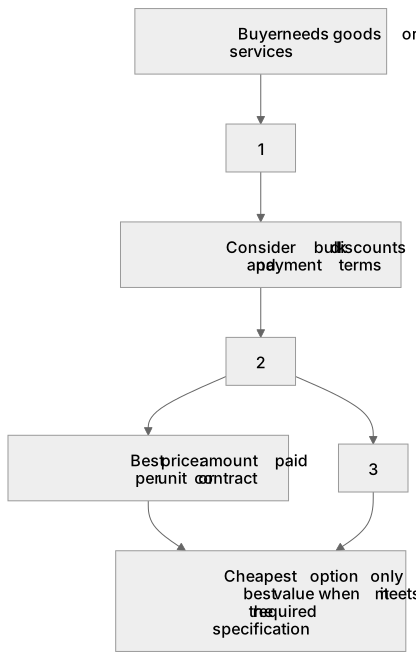
1Box 1
2Box 2
3Box 3
There is more to this lesson
The full lesson goes on to check your understanding and help you earn the marks. Create a free account to carry on, with your progress saved.
A week of Premium from your first lesson · Then the free plan continues · No card, no charge
Test your understanding of The role of procurement: getting goods and services for the best price and value
Active recall beats re-reading. Take an instant quiz now to test what you’ve learned and lock it into long-term memory.
A week of Premium from your first lesson · Then the free plan continues · No card, no charge