AQA · GCSE · Business
Course version: 8132 · Version from Sept 2017
Students should recognise that the benefits of reduced costs must be…
Full specification wording
The role of procurement: Students should recognise that the benefits of reduced costs must be balanced against the quality of service.
Cutting procurement costs can improve profit, but it can also damage the quality of service the business receives or gives.
Checked against the AQA 8132 specification (opens in a new tab) on .
- Point 16 of 21
- 4 key terms
Study notes
From the checked teaching notes for this specification point.
The idea
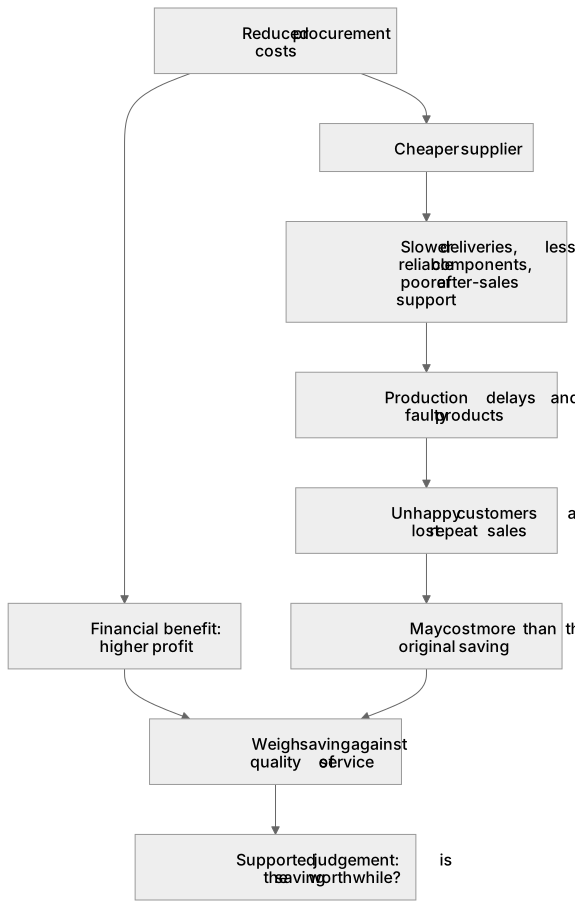
Cutting procurement costs can improve profit, but it can also damage the quality of service the business receives or gives. A business might switch to a cheaper supplier and save money, yet receive slower deliveries, less reliable components or poorer after-sales support. That can lead to production delays, faulty products, unhappy customers and lost repeat sales, which may cost more than the original saving.
For example: A hotel that buys cheaper food may reduce its costs but serve poorer meals and lose bookings.
What earns the marks
- Identifies a specific benefit of reduced procurement costs, such as higher profit, lower unit cost or a more competitive price.
- Identifies a specific quality-of-service risk, such as unreliable delivery, poorer materials or weaker after-sales support.
- Explains the chain of consequences from poor supplier quality to customer dissatisfaction, lost sales or reputational damage.
- Weighs the cost saving against the quality risk and reaches a supported judgement rather than listing points.
- Uses a relevant business example or context to show how the balance might differ between businesses.
Common mistakes and how to put them right
Listing benefits and drawbacks without comparing them.
Put it right: State which effect is likely to be greater and why.
Assuming cheaper always means worse quality.
Put it right: Quality must be judged on evidence such as delivery reliability, defect rates and customer feedback.
Ignoring the effect on the business's own customers.
Put it right: Trace how supplier quality affects the final product or service and therefore sales.
Exam tips
- Use connectives such as however, therefore and this depends on to show the balance between cost and quality.
- Anchor the answer in the case study or a named business so the judgement is contextual rather than generic.
- Finish with a clear conclusion that states whether the cost saving is justified and the condition under which that holds.
Try the lesson
The start of the The role of procurement: Students should recognise that the benefits of reduced costs must be balanced against the quality of service. lesson, made from checked teaching notes for this specification point.
Have a go first
A hotel switches to a cheaper laundry supplier to reduce its costs. Which statement best describes what the hotel should consider before making this change?
Listen
Cutting procurement costs can improve profit, but it can also damage the quality of service the business receives or gives. A business might switch to a cheaper supplier and save money, yet receive slower deliveries, less reliable components or poorer after-sales support. That can lead to production delays, faulty products, unhappy customers and lost repeat sales, which may cost more than the original saving. For example, a hotel that buys cheaper food may reduce its costs but serve poorer meals and lose bookings. A strong answer earns marks for these points. Identifies a specific benefit of reduced procurement costs, such as higher profit, lower unit cost or a more competitive price. Identifies a specific quality-of-service risk, such as unreliable delivery, poorer materials or weaker after-sales support. Explains the chain of consequences from poor supplier quality to customer dissatisfaction, lost sales or reputational damage. Weighs the cost saving against the quality risk and reaches a supported judgement rather than listing points. A common slip: Listing benefits and drawbacks without comparing them. Instead, state which effect is likely to be greater and why. Exam tip: Use connectives such as however, therefore and this depends on to show the balance between cost and quality.
See it
Key words
Say what each word means before you turn the card.
Cost versus quality trade-off
Try answering aloud or in your head before turning the card.
Supplier reliability and service levels
Try answering aloud or in your head before turning the card.
Customer satisfaction and reputation
Try answering aloud or in your head before turning the card.
Decision making and judgement
Try answering aloud or in your head before turning the card.
See every definition
- Cost versus quality trade-off
- The benefits of reduced costs must be balanced against the quality of service.
- Supplier reliability and service levels
- A cheaper supplier may bring slower deliveries, less reliable components or poorer after-sales support.
- Customer satisfaction and reputation
- Poor supplier quality can lead to production delays, faulty products, unhappy customers and lost repeat sales.
- Decision making and judgement
- Both sides should be weighed, the financial benefit of reduced costs against the effect on quality of service, to reach a supported judgement about whether the saving is worthwhile.
Label the diagram
Some boxes have lost their names. Pick the right name for each number.
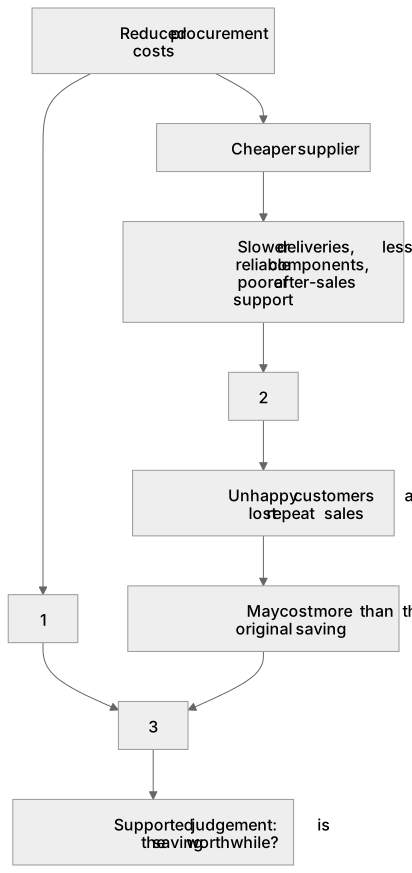
1Box 1
2Box 2
3Box 3
There is more to this lesson
The full lesson goes on to check your understanding and help you earn the marks. Create a free account to carry on, with your progress saved.
A week of Premium from your first lesson · Then the free plan continues · No card, no charge
Test your understanding of The role of procurement: Students should recognise that the benefits of reduced costs must be balanced against the quality of service.
Active recall beats re-reading. Take an instant quiz now to test what you’ve learned and lock it into long-term memory.
A week of Premium from your first lesson · Then the free plan continues · No card, no charge