AQA · GCSE · Business
Course version: 8132 · Version from Sept 2017
The role of procurement: lower unit costs.
Unit cost is the average cost of producing one unit, calculated as total costs divided by output.
Checked against the AQA 8132 specification (opens in a new tab) on .
- Point 15 of 21
- 3 key terms
Study notes
From the checked teaching notes for this specification point.
The idea
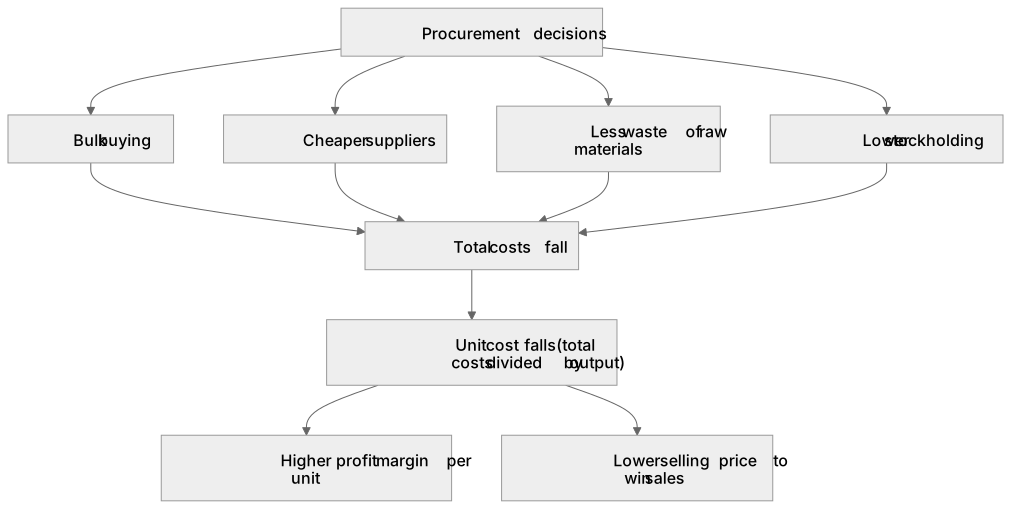
Unit cost is the average cost of producing one unit, calculated as total costs divided by output. Procurement can lower it in several ways: buying larger quantities to gain bulk-buy discounts, choosing cheaper suppliers, reducing waste of raw materials, and holding less stock so storage and insurance costs fall. For example, a bakery making 10,000 loaves a week with total costs of £20,000 has a unit cost of £2.00; negotiating a flour discount that cuts total costs to £18,000 lowers unit cost to £1.80. Lower unit costs increase the profit margin per unit, assuming the selling price remains constant, and can allow a lower selling price to win sales.
What earns the marks
- Defines unit cost as total costs divided by output, and applies the formula correctly to given figures.
- Explains at least two procurement methods that reduce unit cost, such as bulk buying, cheaper suppliers, less waste or lower stockholding.
- Uses a numerical example to show unit cost falling when total costs fall at constant output.
- Links lower unit costs to improved competitiveness or profit margins, showing the consequence for the business.
- Recognises that lower unit costs may result from lower purchase prices, greater efficiency or reduced waste, not price alone.
Common mistakes and how to put them right
Confusing unit cost with total cost.
Put it right: Unit cost is total costs divided by output, so it falls when total costs fall or output rises.
Assuming a lower purchase price always lowers unit cost.
Put it right: Unit cost also depends on output, waste and other costs, so the effect must be calculated.
Treating lower unit cost as automatically meaning higher profit.
Put it right: Profit also depends on selling price, sales volume and fixed costs.
Exam tips
- Show the unit cost calculation with the figures substituted, for example £18,000 ÷ 10,000 = £1.80, so the method is visible.
- Use business terms such as bulk buying, economies of scale and stockholding to show precise understanding.
- When asked to analyse, chain the reasoning: lower purchase price reduces total costs, so unit cost falls, which can increase profit margins.
Try the lesson
The start of the The role of procurement: lower unit costs. lesson, made from checked teaching notes for this specification point.
Have a go first
A bakery buys its flour from a supplier that charges a low price per sack. What does buying flour at a low price per sack help the bakery to achieve?
Listen
Unit cost is the average cost of producing one unit, calculated as total costs divided by output. Procurement can lower it in several ways: buying larger quantities to gain bulk-buy discounts, choosing cheaper suppliers, reducing waste of raw materials, and holding less stock so storage and insurance costs fall. For example, a bakery making 10,000 loaves a week with total costs of £20,000 has a unit cost of £2.00; negotiating a flour discount that cuts total costs to £18,000 lowers unit cost to £1.80. Lower unit costs increase the profit margin per unit, assuming the selling price remains constant, and can allow a lower selling price to win sales. A strong answer earns marks for these points. Defines unit cost as total costs divided by output, and applies the formula correctly to given figures. Explains at least two procurement methods that reduce unit cost, such as bulk buying, cheaper suppliers, less waste or lower stockholding. Uses a numerical example to show unit cost falling when total costs fall at constant output. Links lower unit costs to improved competitiveness or profit margins, showing the consequence for the business. A common slip: Confusing unit cost with total cost. Instead, unit cost is total costs divided by output, so it falls when total costs fall or output rises. Exam tip: Show the unit cost calculation with the figures substituted, for example £18,000 ÷ 10,000 = £1.80, so the method is visible.
See it
Key words
Say what each word means before you turn the card.
Unit cost
Try answering aloud or in your head before turning the card.
Procurement and supplier choice
Try answering aloud or in your head before turning the card.
Efficiency and waste reduction
Try answering aloud or in your head before turning the card.
See every definition
- Unit cost
- The average cost of producing one unit, calculated as total costs divided by output.
- Procurement and supplier choice
- Buying larger quantities to gain bulk-buy discounts and choosing cheaper suppliers, which can lower unit cost.
- Efficiency and waste reduction
- Reducing waste of raw materials and holding less stock so storage and insurance costs fall, which can lower unit cost.
Label the diagram
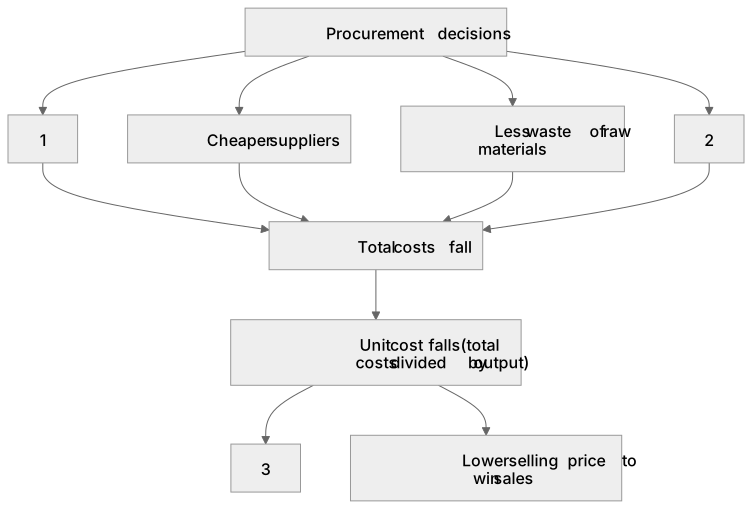
Some boxes have lost their names. Pick the right name for each number.
1Box 1
2Box 2
3Box 3
There is more to this lesson
The full lesson goes on to check your understanding and help you earn the marks. Create a free account to carry on, with your progress saved.
A week of Premium from your first lesson · Then the free plan continues · No card, no charge
Test your understanding of The role of procurement: lower unit costs.
Active recall beats re-reading. Take an instant quiz now to test what you’ve learned and lock it into long-term memory.
A week of Premium from your first lesson · Then the free plan continues · No card, no charge