AQA · GCSE · Business
Course version: 8132 · Version from Sept 2017
The benefits of having spare stock to satisfy demand balanced against the…
Full specification wording
The role of procurement: The benefits of having spare stock to satisfy demand balanced against the cost of holding buffer stock.
Buffer stock is extra inventory held to absorb unexpected demand or supply delays.
Checked against the AQA 8132 specification (opens in a new tab) on .
- Point 6 of 21
Study notes
From the checked teaching notes for this specification point.
The idea
Buffer stock is extra inventory held to absorb unexpected demand or supply delays. Benefits: avoids stockouts, maintains customer service, prevents lost sales and production stoppages. Costs: storage, insurance, tied-up working capital, and risk of obsolescence or damage. For example, a bakery holding 100 extra loaves costs £0.50 per loaf per day; if unexpected demand sells 80 loaves at £1.50 each, revenue is £120, extra cost £40, net benefit £80. If demand does not rise, the £50 daily holding cost is wasted. Businesses balance by comparing holding costs with potential lost contribution from stockouts. This is assessed through calculations and case-study analysis, not by drawing stock control charts.
What earns the marks
- Defines buffer stock as extra inventory held to meet unexpected demand or supply delays.
- Explains at least two benefits: avoiding stockouts, maintaining customer service, preventing lost sales, and keeping production flowing.
- Explains at least two costs: storage, insurance, tied-up working capital, obsolescence, and damage.
- Applies the trade-off to a given business context, showing how holding buffer stock can protect revenue but increase costs.
- Uses a calculation to compare the cost of holding buffer stock with the contribution from additional sales.
Common mistakes and how to put them right
Confusing buffer stock with reorder level.
Put it right: Buffer stock is the minimum extra held, while reorder level triggers a new order.
Ignoring the opportunity cost of tied-up working capital.
Put it right: Explain that cash spent on stock cannot be used elsewhere.
Assuming buffer stock always increases profit.
Put it right: Evaluate that holding costs may exceed the benefit if demand does not rise.
Exam tips
- Use the case study figures to calculate holding cost and contribution from extra sales before making a judgement.
- Structure answers to show both benefits and costs, then reach a clear conclusion about whether buffer stock is worthwhile.
- Avoid drawing stock control charts; focus on written analysis and calculations.
Try the lesson
The start of the The role of procurement: The benefits of having spare stock to satisfy demand balanced against the cost of holding buffer stock. lesson, made from checked teaching notes for this specification point.
Have a go first
What is the name given to the extra stock a business keeps so that it can still meet customer demand if deliveries are delayed?
Listen
Buffer stock is extra inventory held to absorb unexpected demand or supply delays. Benefits: avoids stockouts, maintains customer service, prevents lost sales and production stoppages. Costs: storage, insurance, tied-up working capital, and risk of obsolescence or damage. For example, a bakery holding 100 extra loaves costs £0.50 per loaf per day; if unexpected demand sells 80 loaves at £1.50 each, revenue is £120, extra cost £40, net benefit £80. If demand does not rise, the £50 daily holding cost is wasted. Businesses balance by comparing holding costs with potential lost contribution from stockouts. This is assessed through calculations and case-study analysis, not by drawing stock control charts. A strong answer earns marks for these points. Defines buffer stock as extra inventory held to meet unexpected demand or supply delays. Explains at least two benefits: avoiding stockouts, maintaining customer service, preventing lost sales, and keeping production flowing. Explains at least two costs: storage, insurance, tied-up working capital, obsolescence, and damage. Applies the trade-off to a given business context, showing how holding buffer stock can protect revenue but increase costs. A common slip: Confusing buffer stock with reorder level. Instead, buffer stock is the minimum extra held, while reorder level triggers a new order. Exam tip: Use the case study figures to calculate holding cost and contribution from extra sales before making a judgement.
See it
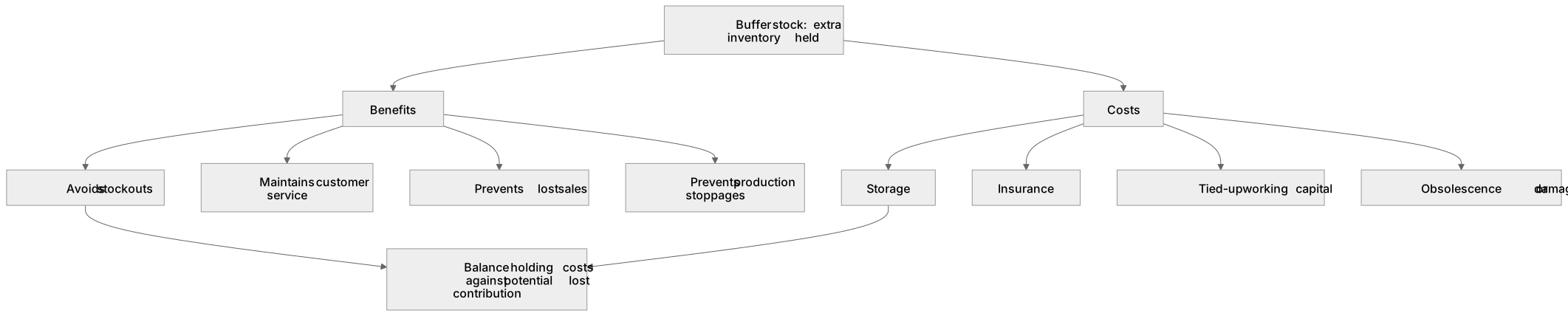
Label the diagram
Some boxes have lost their names. Pick the right name for each number.
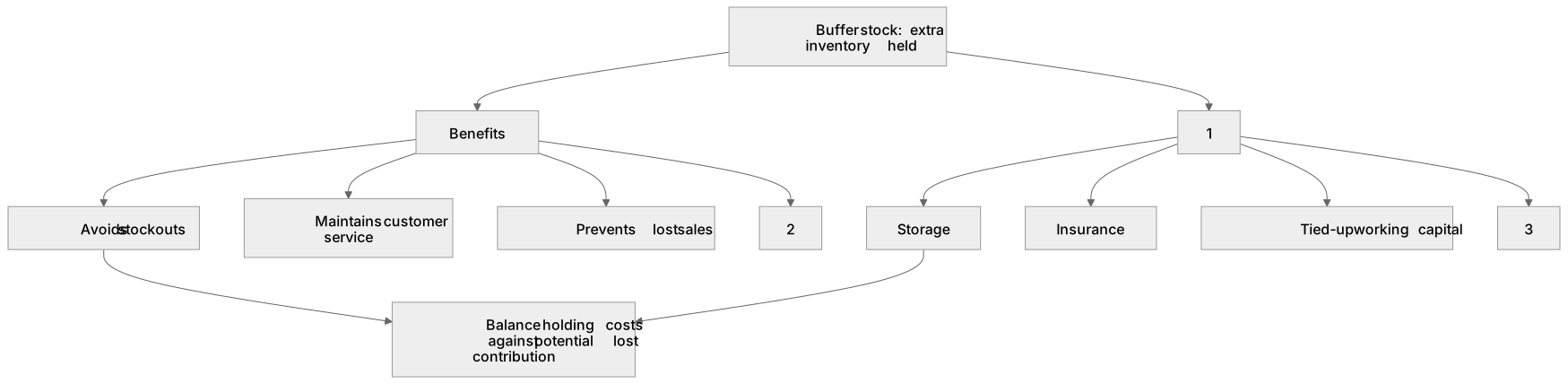
1Box 1
2Box 2
3Box 3
There is more to this lesson
The full lesson goes on to check your understanding and help you earn the marks. Create a free account to carry on, with your progress saved.
A week of Premium from your first lesson · Then the free plan continues · No card, no charge
Test your understanding of The role of procurement: The benefits of having spare stock to satisfy demand balanced against the cost of holding buffer stock.
Active recall beats re-reading. Take an instant quiz now to test what you’ve learned and lock it into long-term memory.
A week of Premium from your first lesson · Then the free plan continues · No card, no charge