AQA · GCSE · Business
Course version: 8132 · Version from Sept 2017
Training: explain the benefits of induction training
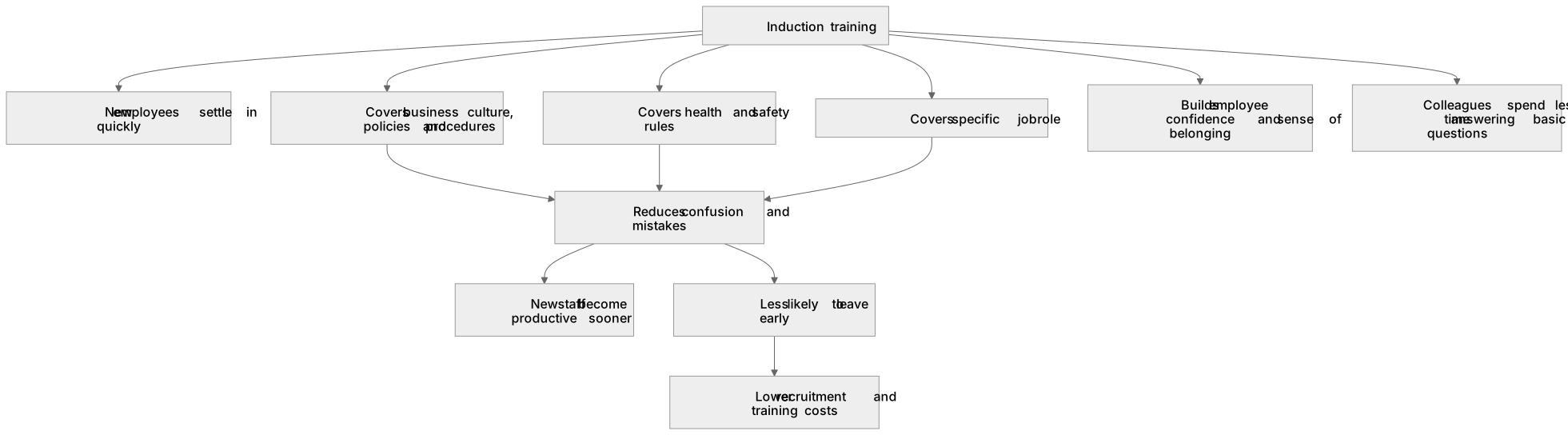
Induction training benefits a business by helping new employees settle in quickly and become productive sooner.
Checked against the AQA 8132 specification (opens in a new tab) on .
- Point 5 of 6
- 4 key terms
Study notes
From the checked teaching notes for this specification point.
The idea
Induction training benefits a business by helping new employees settle in quickly and become productive sooner. It introduces the business culture, policies, health and safety rules and the specific job role, which reduces confusion and mistakes. New starters who understand expectations are less likely to leave early, lowering recruitment and training costs. Induction also helps existing staff because colleagues spend less time answering basic questions. For the employee, induction builds confidence and a sense of belonging. For example, a supermarket inducting a new checkout operator on till procedures, customer service standards and emergency exits can reduce errors and improve customer experience. The benefits are strongest when induction is planned, relevant and delivered before or soon after the start date.
What earns the marks
- Explains that induction training helps new employees understand the business, its culture, policies and procedures.
- Explains that induction training covers health and safety requirements, reducing the risk of accidents and legal breaches.
- Explains that induction training helps employees understand their specific job role, duties and performance expectations, leading to fewer mistakes.
- Explains that effective induction can increase employee confidence, motivation and job satisfaction, which may reduce staff turnover.
- Explains that lower staff turnover reduces recruitment, selection and training costs for the business.
- Explains that induction can improve productivity because new staff become competent more quickly.
- Applies the benefits to a named business context, for example a hotel inducting receptionists on booking systems and customer service standards.
Common mistakes and how to put them right
Listing benefits without explaining how they arise.
Put it right: Link each benefit to a cause, such as induction covering health and safety leading to fewer accidents.
Confusing induction training with ongoing training.
Put it right: Induction is the initial introduction, while ongoing training develops skills throughout employment.
Assuming induction only benefits the employee.
Put it right: Explain benefits to the business, such as lower turnover and higher productivity, as well as to the employee.
Ignoring the costs or limitations of induction.
Put it right: Acknowledge that induction takes time and money, even though it can bring benefits.
Exam tips
- Use connectives such as 'because', 'therefore' and 'which leads to' to build explanation chains rather than listing points.
- Refer to a specific business or job role to show application of the benefits.
- Prioritise the most significant benefits if the question asks for a judgement, and justify your choice.
- Keep your answer focused on benefits; avoid drifting into a description of the induction process unless it supports an explanation.
Try the lesson
The start of the Training: explain the benefits of induction training lesson, made from checked teaching notes for this specification point.
Have a go first
A retail business provides a comprehensive induction training programme for all new shop assistants. Which of the following best explains a key benefit of this induction training for the business?
Listen
Induction training benefits a business by helping new employees settle in quickly and become productive sooner. It introduces the business culture, policies, health and safety rules and the specific job role, which reduces confusion and mistakes. New starters who understand expectations are less likely to leave early, lowering recruitment and training costs. Induction also helps existing staff because colleagues spend less time answering basic questions. For the employee, induction builds confidence and a sense of belonging. For example, a supermarket inducting a new checkout operator on till procedures, customer service standards and emergency exits can reduce errors and improve customer experience. The benefits are strongest when induction is planned, relevant and delivered before or soon after the start date. A strong answer earns marks for these points. Explains that induction training helps new employees understand the business, its culture, policies and procedures. Explains that induction training covers health and safety requirements, reducing the risk of accidents and legal breaches. Explains that induction training helps employees understand their specific job role, duties and performance expectations, leading to fewer mistakes. Explains that effective induction can increase employee confidence, motivation and job satisfaction, which may reduce staff turnover. A common slip: Listing benefits without explaining how they arise. Instead, link each benefit to a cause, such as induction covering health and safety leading to fewer accidents. Exam tip: Use connectives such as 'because', 'therefore' and 'which leads to' to build explanation chains rather than listing points.
See it
Key words
Say what each word means before you turn the card.
Employee integration and motivation
Try answering aloud or in your head before turning the card.
Health and safety compliance
Try answering aloud or in your head before turning the card.
Staff retention and cost control
Try answering aloud or in your head before turning the card.
Productivity and customer service
Try answering aloud or in your head before turning the card.
See every definition
- Employee integration and motivation
- Induction builds confidence and a sense of belonging, helping new employees settle in quickly and understand expectations.
- Health and safety compliance
- Induction introduces health and safety rules, reducing the risk of accidents and legal breaches.
- Staff retention and cost control
- New starters who understand expectations are less likely to leave early, lowering recruitment and training costs.
- Productivity and customer service
- Induction helps new employees become productive sooner and, with customer service standards, can improve customer experience.
Label the diagram
Some boxes have lost their names. Pick the right name for each number.
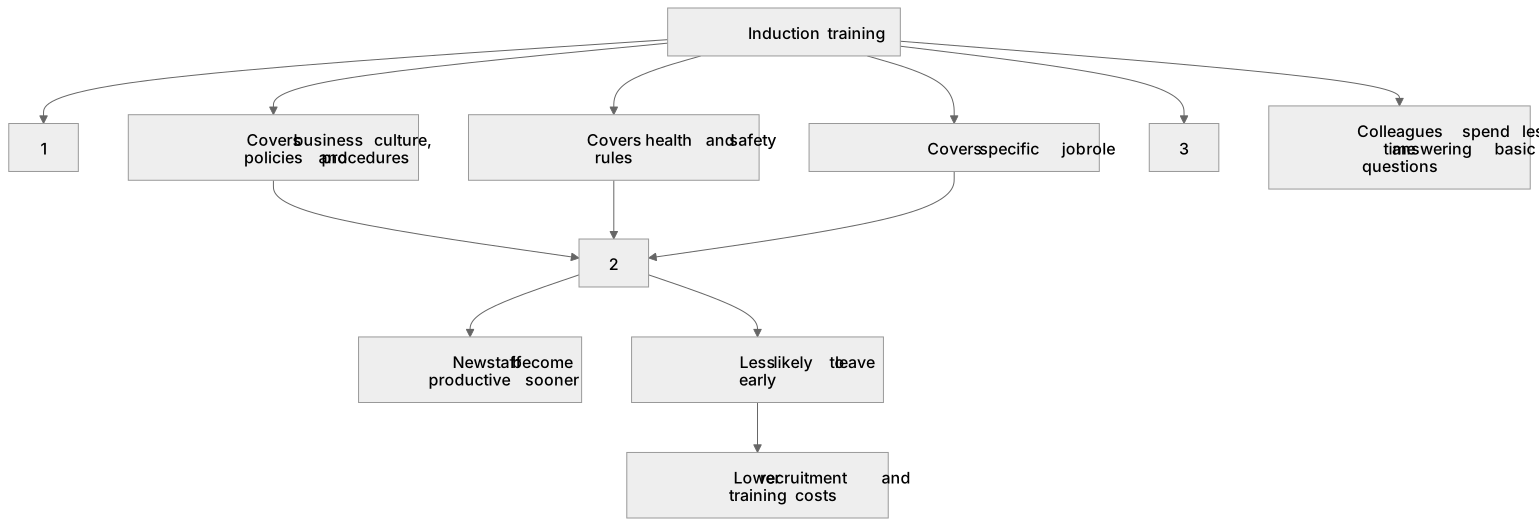
1Box 1
2Box 2
3Box 3
There is more to this lesson
The full lesson goes on to check your understanding and help you earn the marks. Create a free account to carry on, with your progress saved.
A week of Premium from your first lesson · Then the free plan continues · No card, no charge
Test your understanding of Training: explain the benefits of induction training
Active recall beats re-reading. Take an instant quiz now to test what you’ve learned and lock it into long-term memory.
A week of Premium from your first lesson · Then the free plan continues · No card, no charge