AQA · GCSE · Business
Course version: 8132 · Version from Sept 2017
Understand the methods of training undertaken by businesses, including…
Full specification wording
Training: understand the methods of training undertaken by businesses, including induction training, on the job training and off the job training
Businesses train staff to build capability and meet objectives.
Checked against the AQA 8132 specification (opens in a new tab) on .
- Point 4 of 6
- 3 key terms
Study notes
From the checked teaching notes for this specification point.
The idea
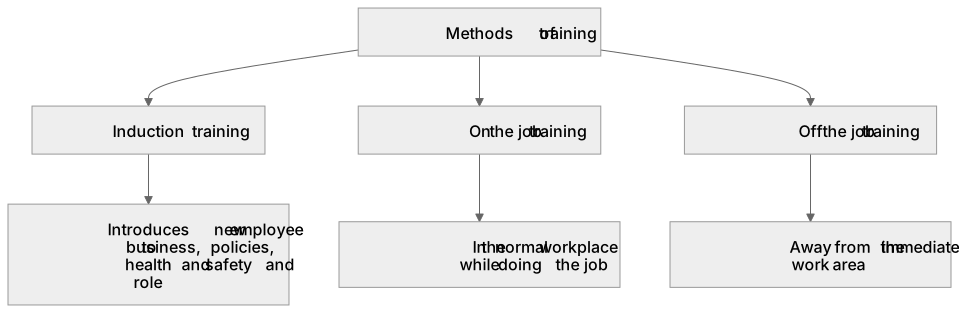
Businesses train staff to build capability and meet objectives. Induction training introduces new employees to the business, its policies, health and safety rules, and their role, often before or alongside starting work. On the job training happens in the normal workplace while doing the job, for example a supervisor showing a new barista how to use the till and make drinks during a shift. Off the job training takes place away from the immediate work area, such as a college course, online module or external workshop. Each method has strengths and limitations: induction helps new starters settle quickly but adds cost and time; on the job training is practical and relatively cheap but may pass on poor habits; off the job training can provide expert, up-to-date knowledge but is often more expensive and causes staff absence. Businesses choose a mix to suit roles, budgets and urgency.
What earns the marks
- Defines induction training as the introduction of a new employee to the business, its policies, procedures, health and safety requirements and their specific job role.
- Defines on the job training as training delivered in the normal workplace while the employee carries out their usual tasks, often led by an experienced colleague or supervisor.
- Defines off the job training as training that takes place away from the immediate workplace, for example at a college, training centre or through an external online provider.
- Explains at least one advantage and one disadvantage of each method, such as cost, time, quality of learning, disruption to production or relevance to the job.
- Applies the methods to a business context, for example a restaurant using induction for new waiting staff, on the job training for kitchen tasks and off the job training for a food hygiene certificate.
- Reaches a supported judgement about which method or combination is most suitable for a given business situation, referring to the nature of the job and the resources available.
Common mistakes and how to put them right
Confusing induction training with on the job training.
Put it right: Induction is the initial introduction to the business and role, while on the job training develops task skills in the workplace.
Assuming off the job training is always better because it is external.
Put it right: It can be more expensive and disruptive, and may be less specific to the business than on the job training.
Describing only one method when the question asks for methods in the plural.
Put it right: Cover induction, on the job and off the job training to show the full range.
Treating training as a cost with no benefit.
Put it right: Explain how training can improve productivity, quality, motivation and customer service.
Exam tips
- Use the command word to decide the depth required: 'identify' needs a brief name, 'explain' needs a reason or consequence, and 'analyse' needs chains of cause and effect.
- Anchor each method to a specific business example so your answer shows application rather than general knowledge alone.
- When comparing methods, refer to criteria such as cost, time, quality, disruption and relevance to the job to structure your evaluation.
- Check that you have covered every method named in the specification before finishing your answer.
Try the lesson
The start of the Training: understand the methods of training undertaken by businesses, including induction training, on the job training and off the job training lesson, made from checked teaching notes for this specification point.
Have a go first
Which method of training takes place while a new employee is working alongside an experienced colleague and learning the tasks of the job as they are performed?
Listen
Businesses train staff to build capability and meet objectives. Induction training introduces new employees to the business, its policies, health and safety rules, and their role, often before or alongside starting work. On the job training happens in the normal workplace while doing the job, for example a supervisor showing a new barista how to use the till and make drinks during a shift. Off the job training takes place away from the immediate work area, such as a college course, online module or external workshop. Each method has strengths and limitations: induction helps new starters settle quickly but adds cost and time; on the job training is practical and relatively cheap but may pass on poor habits; off the job training can provide expert, up-to-date knowledge but is often more expensive and causes staff absence. Businesses choose a mix to suit roles, budgets and urgency. A strong answer earns marks for these points. Defines induction training as the introduction of a new employee to the business, its policies, procedures, health and safety requirements and their specific job role. Defines on the job training as training delivered in the normal workplace while the employee carries out their usual tasks, often led by an experienced colleague or supervisor. Defines off the job training as training that takes place away from the immediate workplace, for example at a college, training centre or through an external online provider. Explains at least one advantage and one disadvantage of each method, such as cost, time, quality of learning, disruption to production or relevance to the job. A common slip: Confusing induction training with on the job training. Instead, induction is the initial introduction to the business and role, while on the job training develops task skills in the workplace. Exam tip: Use the command word to decide the depth required: 'identify' needs a brief name, 'explain' needs a reason or consequence, and 'analyse' needs chains of cause and effect.
See it
Key words
Say what each word means before you turn the card.
Induction training
Try answering aloud or in your head before turning the card.
On the job training
Try answering aloud or in your head before turning the card.
Off the job training
Try answering aloud or in your head before turning the card.
See every definition
- Induction training
- The introduction of a new employee to the business, its policies, procedures, health and safety requirements and their specific job role.
- On the job training
- Training delivered in the normal workplace while the employee carries out their usual tasks, often led by an experienced colleague or supervisor.
- Off the job training
- Training that takes place away from the immediate workplace, for example at a college, training centre or through an external online provider.
Label the diagram
Some boxes have lost their names. Pick the right name for each number.
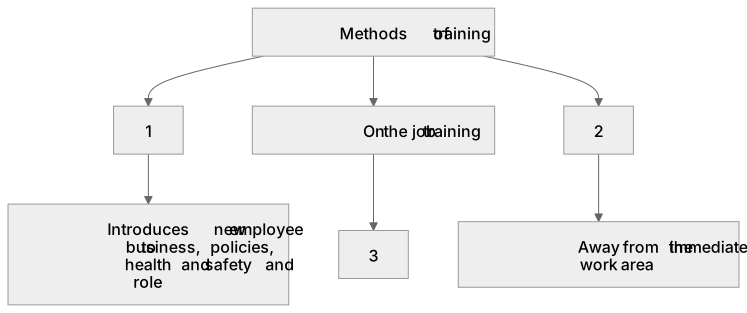
1Box 1
2Box 2
3Box 3
There is more to this lesson
The full lesson goes on to check your understanding and help you earn the marks. Create a free account to carry on, with your progress saved.
A week of Premium from your first lesson · Then the free plan continues · No card, no charge
Test your understanding of Training: understand the methods of training undertaken by businesses, including induction training, on the job training and off the job training
Active recall beats re-reading. Take an instant quiz now to test what you’ve learned and lock it into long-term memory.
A week of Premium from your first lesson · Then the free plan continues · No card, no charge