AQA · A-Level · Chemistry
Course version: 7405 · Version from Sept 2016
Cisplatin prevents DNA replication in cancer cells by a ligand replacement…
Full specification wording
Action of anticancer drugs (A-level only): Cisplatin prevents DNA replication in cancer cells by a ligand replacement reaction with DNA in which a bond is formed between platinum and a nitrogen atom on guanine.
Inside the cell it is the chloride ligands that leave.
Checked against the AQA 7405 specification (opens in a new tab) on .
- Point 2 of 4
- 4 key terms
Study notes
From the checked teaching notes for this specification point.
The idea
Inside the cell it is the chloride ligands that leave. A nitrogen atom in the ring of guanine keeps a lone pair that is not being used for bonding, and that lone pair attacks the platinum, forming a coordinate bond in place of a platinum to chlorine bond. Because the two chlorides sit next to each other, the same platinum atom can pick up two guanine bases, tying them together and kinking the strand. The double helix can then no longer unwind and separate, so the enzymes that copy DNA cannot run along it: replication stops and the cell cannot divide. Note what is not happening. No covalent bond in the sugar-phosphate backbone is broken; the damage is a new bond made, not an old one destroyed.
What earns the marks
- Stating that the chloride ligands, not the ammonia ligands, are the ones replaced.
- A coordinate bond formed from a lone pair on a nitrogen atom of guanine to the platinum.
- The two binding sites being adjacent, so one platinum bonds to two guanine bases.
- Explaining that the strands can no longer separate, so DNA cannot be replicated and the cell cannot divide.
Common mistakes and how to put them right
Saying the ammonia ligands are replaced, when it is the chlorides that are substituted.
Calling the new platinum to nitrogen bond ionic, or calling it a hydrogen bond, rather than coordinate.
Claiming the drug breaks the sugar-phosphate backbone.
Saying it bonds to the sugar or the phosphate instead of to a nitrogen atom on guanine.
Stopping at binds to DNA without saying that replication and cell division are prevented.
Exam tips
- Use the phrases ligand substitution and coordinate bond; both are specification vocabulary and both are usually marking points.
- Name guanine and name nitrogen. Binds to a base is too vague to credit.
- Two marks means two ideas, the bond formed and the consequence for replication, so write both.
Try the lesson
The start of the Action of anticancer drugs (A-level only): Cisplatin prevents DNA replication in cancer cells by a ligand replacement reaction with DNA in which a bond is formed between platinum and a nitrogen atom on guanine. lesson, made from checked teaching notes for this specification point.
Have a go first
In cisplatin's action on DNA, which atom on a guanine base forms a bond to platinum?
Listen
Inside the cell it is the chloride ligands that leave. A nitrogen atom in the ring of guanine keeps a lone pair that is not being used for bonding, and that lone pair attacks the platinum, forming a coordinate bond in place of a platinum to chlorine bond. Because the two chlorides sit next to each other, the same platinum atom can pick up two guanine bases, tying them together and kinking the strand. The double helix can then no longer unwind and separate, so the enzymes that copy DNA cannot run along it: replication stops and the cell cannot divide. Note what is not happening. No covalent bond in the sugar-phosphate backbone is broken; the damage is a new bond made, not an old one destroyed. A strong answer earns marks for these points. stating that the chloride ligands, not the ammonia ligands, are the ones replaced. a coordinate bond formed from a lone pair on a nitrogen atom of guanine to the platinum. the two binding sites being adjacent, so one platinum bonds to two guanine bases. explaining that the strands can no longer separate, so DNA cannot be replicated and the cell cannot divide. Exam tip: Use the phrases ligand substitution and coordinate bond; both are specification vocabulary and both are usually marking points.
See it
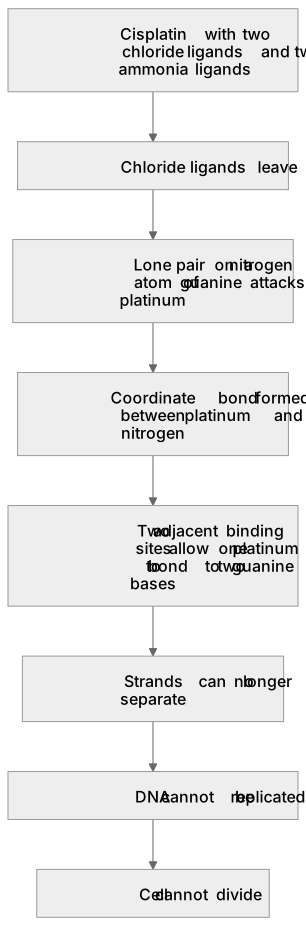
Put it in order
Put these steps in the order they happen.
- 1. Two adjacent binding sites allow one platinum to bond to two guanine bases
- 2. Cell cannot divide
- 3. Strands can no longer separate
- 4. Cisplatin with two chloride ligands and two ammonia ligands
- 5. Chloride ligands leave
- 6. DNA cannot be replicated
- 7. Lone pair on a nitrogen atom of guanine attacks platinum
- 8. Coordinate bond formed between platinum and nitrogen
Key words
Say what each word means before you turn the card.
ligand substitution
Try answering aloud or in your head before turning the card.
coordinate bond to nitrogen
Try answering aloud or in your head before turning the card.
guanine as the target
Try answering aloud or in your head before turning the card.
replication blocked
Try answering aloud or in your head before turning the card.
See every definition
- ligand substitution
- A reaction in which the chloride ligands leave and a nitrogen atom of guanine attacks the platinum in their place.
- coordinate bond to nitrogen
- A bond formed when a lone pair on a nitrogen atom of guanine attacks the platinum, replacing a platinum to chlorine bond.
- guanine as the target
- The base whose ring nitrogen keeps a lone pair not used for bonding, which attacks the platinum.
- replication blocked
- The double helix can no longer unwind and separate, so the enzymes that copy DNA cannot run along it and the cell cannot divide.
Label the diagram
Some boxes have lost their names. Pick the right name for each number.
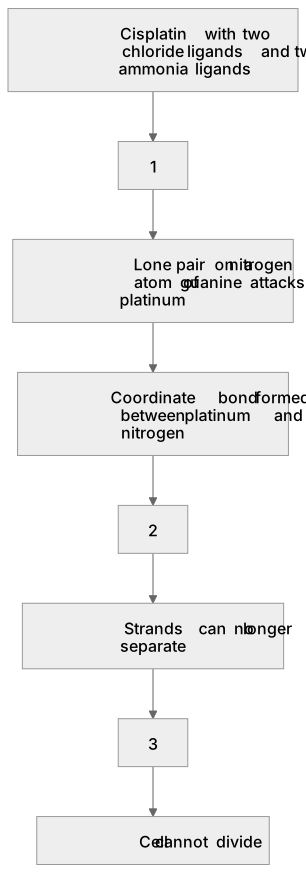
1Box 1
2Box 2
3Box 3
There is more to this lesson
The full lesson goes on to check your understanding and help you earn the marks. Create a free account to carry on, with your progress saved.
A week of Premium from your first lesson · Then the free plan continues · No card, no charge
Test your understanding of Action of anticancer drugs (A-level only): Cisplatin prevents DNA replication in cancer cells by a ligand replacement reaction with DNA in which a bond is formed between platinum and a nitrogen atom on guanine.
Active recall beats re-reading. Take an instant quiz now to test what you’ve learned and lock it into long-term memory.
A week of Premium from your first lesson · Then the free plan continues · No card, no charge