AQA · A-Level · Chemistry
Course version: 7405 · Version from Sept 2016
The Pt(II) complex cisplatin is used as an anticancer drug.
Full specification wording
Action of anticancer drugs (A-level only): The Pt(II) complex cisplatin is used as an anticancer drug.
The drug is [Pt(NH₃)₂Cl₂].
Checked against the AQA 7405 specification (opens in a new tab) on .
- Point 1 of 4
Study notes
From the checked teaching notes for this specification point.
The idea
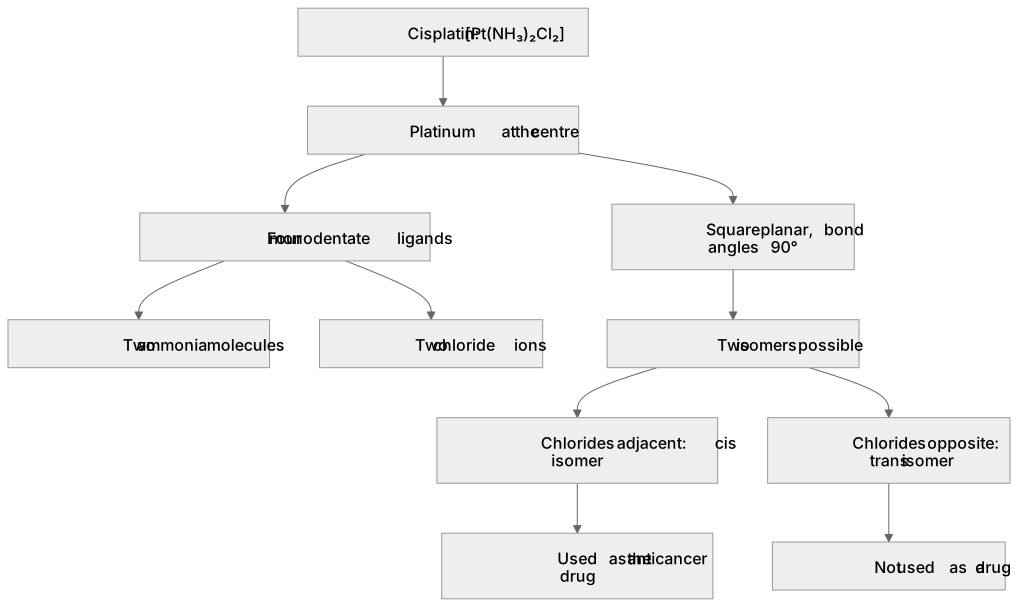
The drug is [Pt(NH₃)₂Cl₂]. Platinum sits at the centre with four monodentate ligands, two ammonia molecules and two chloride ions, arranged square planar with bond angles of 90°. A square planar arrangement allows two isomers: one with the chlorides next to each other, one with them opposite. Only the first is the anticancer drug, so the cis in the name is doing chemical work rather than decorating it. Deducing the oxidation state is a routine mark: ammonia is a neutral ligand and the whole complex carries no charge, so the two chloride ligands must be balanced by platinum in the +2 state. Square planar complexes of this kind are not chiral, so there is no optical isomerism to discuss here.
What earns the marks
- The formula [Pt(NH₃)₂Cl₂], with two ammonia and two chloride ligands.
- Describing the shape as square planar, with bond angles of 90°.
- Deducing the oxidation state of platinum as +2, because ammonia is neutral and the complex carries no overall charge.
- Drawing the two chloride ligands adjacent to each other, which is the cis isomer.
Common mistakes and how to put them right
Drawing the complex as tetrahedral, which is not the shape adopted by platinum in this oxidation state.
Writing the formula with an overall charge, when two chloride ligands and platinum in the +2 state make it neutral.
Putting the two chloride ligands opposite each other, which draws the trans isomer that is not used as a drug.
Calling the cis and trans forms optical isomers.
Giving the coordination number as two because only the chloride ligands are charged.
Exam tips
- Draw a square with platinum at the centre and a ligand at each corner; a sketch earns the shape mark that words often miss.
- State the oxidation state with its sign and show the reasoning from the charges on the ligands.
- If the question names the drug, the geometry is already given to you, so check your drawing agrees with the name.
Try the lesson
The start of the Action of anticancer drugs (A-level only): The Pt(II) complex cisplatin is used as an anticancer drug. lesson, made from checked teaching notes for this specification point.
Have a go first
What is the oxidation state of the central metal ion in the anticancer drug cisplatin?
Listen
The drug is [Pt(NH₃)₂Cl₂]. Platinum sits at the centre with four monodentate ligands, two ammonia molecules and two chloride ions, arranged square planar with bond angles of 90°. A square planar arrangement allows two isomers: one with the chlorides next to each other, one with them opposite. Only the first is the anticancer drug, so the cis in the name is doing chemical work rather than decorating it. Deducing the oxidation state is a routine mark: ammonia is a neutral ligand and the whole complex carries no charge, so the two chloride ligands must be balanced by platinum in the +2 state. Square planar complexes of this kind are not chiral, so there is no optical isomerism to discuss here. A strong answer earns marks for these points. the formula [Pt(NH₃)₂Cl₂], with two ammonia and two chloride ligands. describing the shape as square planar, with bond angles of 90°. deducing the oxidation state of platinum as +2, because ammonia is neutral and the complex carries no overall charge. drawing the two chloride ligands adjacent to each other, which is the cis isomer. Exam tip: Draw a square with platinum at the centre and a ligand at each corner; a sketch earns the shape mark that words often miss.
See it
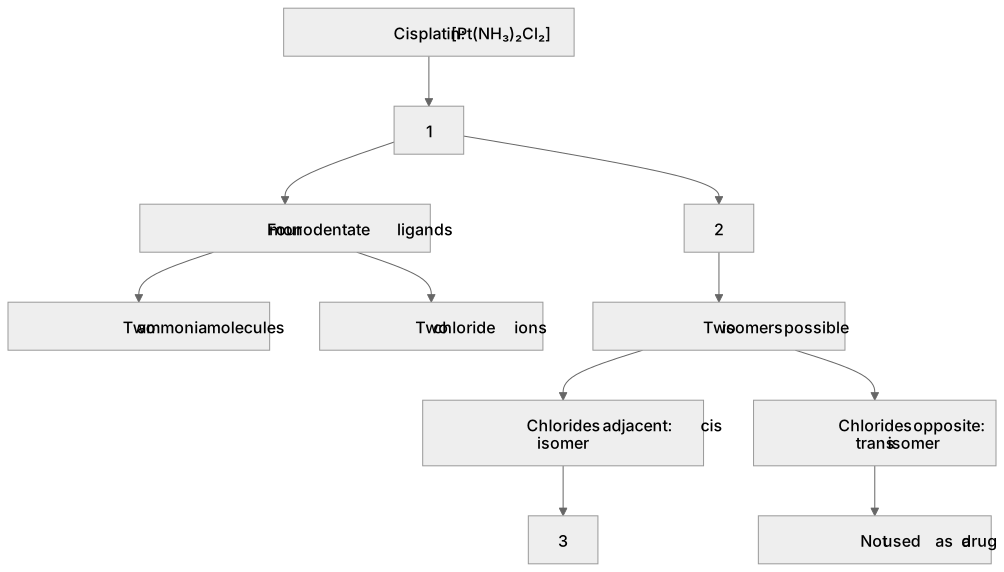
Label the diagram
Some boxes have lost their names. Pick the right name for each number.
1Box 1
2Box 2
3Box 3
There is more to this lesson
The full lesson goes on to check your understanding and help you earn the marks. Create a free account to carry on, with your progress saved.
A week of Premium from your first lesson · Then the free plan continues · No card, no charge
Test your understanding of Action of anticancer drugs (A-level only): The Pt(II) complex cisplatin is used as an anticancer drug.
Active recall beats re-reading. Take an instant quiz now to test what you’ve learned and lock it into long-term memory.
A week of Premium from your first lesson · Then the free plan continues · No card, no charge