AQA · A-Level · Chemistry
Course version: 7405 · Version from Sept 2016
The industrial advantages of ethanoic anhydride over ethanoyl chloride in…
Full specification wording
Acylation (A-level only): The industrial advantages of ethanoic anhydride over ethanoyl chloride in the manufacture of the drug aspirin.
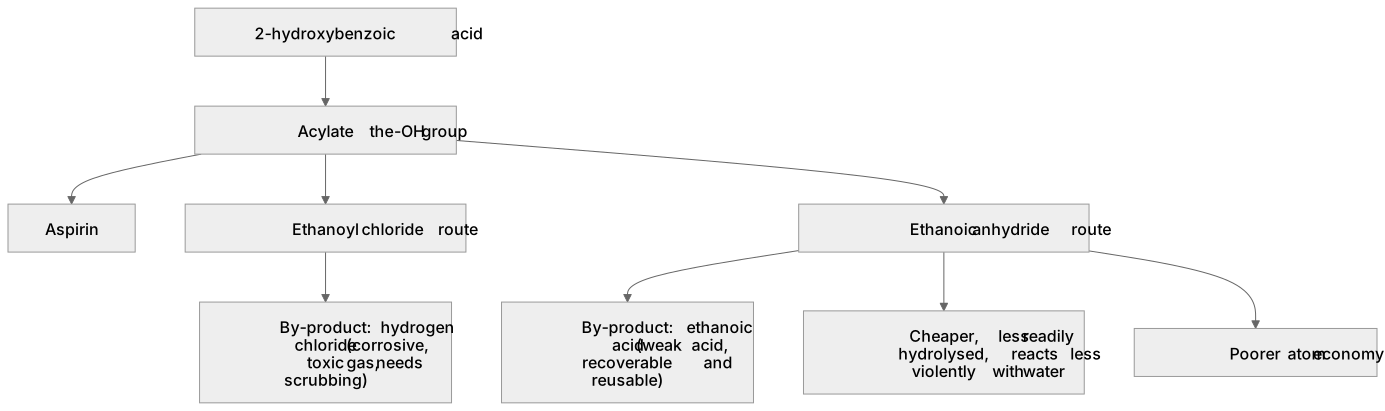
Aspirin is made by acylating the -OH group of 2-hydroxybenzoic acid; the -COOH on the ring is left alone.
Checked against the AQA 7405 specification (opens in a new tab) on .
- Point 3 of 5
- 4 key terms
Study notes
From the checked teaching notes for this specification point.
The idea
Aspirin is made by acylating the -OH group of 2-hydroxybenzoic acid; the -COOH on the ring is left alone. Either ethanoyl chloride or ethanoic anhydride will do the job, but industry chooses the anhydride. It is cheaper to buy, it is much less readily hydrolysed by moisture in the air so it can be stored and handled safely, and it reacts far less violently with water if there is a spill. The by-product matters just as much: the anhydride releases ethanoic acid, which is a weak acid that can be recovered and reused, while the acyl chloride releases hydrogen chloride, a corrosive and toxic gas that would need scrubbing. Against that, the anhydride has the poorer atom economy of the two.
What earns the marks
- The anhydride being cheaper or less corrosive than the acyl chloride.
- The anhydride reacting less vigorously with water, so it is safer to store and handle.
- Ethanoic acid rather than hydrogen chloride as the by-product.
- Identifying the -OH group of 2-hydroxybenzoic acid as the group that is acylated.
Common mistakes and how to put them right
Claiming the anhydride gives the better atom economy, when its larger by-product makes it worse.
Saying the -COOH group on the ring is esterified, rather than the -OH group.
Describing hydrogen chloride as a useful by-product without any qualification.
Arguing the anhydride is chosen because it is more reactive, when the opposite is the point.
Exam tips
- Give industrial reasons in pairs: a property and the consequence for a factory, such as 'less easily hydrolysed, so it can be stored'.
- Name the by-product in every comparison; that is usually where the mark is.
Try the lesson
The start of the Acylation (A-level only): The industrial advantages of ethanoic anhydride over ethanoyl chloride in the manufacture of the drug aspirin. lesson, made from checked teaching notes for this specification point.
Have a go first
In the industrial manufacture of aspirin, ethanoic anhydride is preferred to ethanoyl chloride mainly because ethanoic anhydride reacts less violently with water. Which additional property of ethanoic anhydride also makes it the safer industrial choice?
Listen
Aspirin is made by acylating the -OH group of 2-hydroxybenzoic acid; the -COOH on the ring is left alone. Either ethanoyl chloride or ethanoic anhydride will do the job, but industry chooses the anhydride. It is cheaper to buy, it is much less readily hydrolysed by moisture in the air so it can be stored and handled safely, and it reacts far less violently with water if there is a spill. The by-product matters just as much: the anhydride releases ethanoic acid, which is a weak acid that can be recovered and reused, while the acyl chloride releases hydrogen chloride, a corrosive and toxic gas that would need scrubbing. Against that, the anhydride has the poorer atom economy of the two. A strong answer earns marks for these points. the anhydride being cheaper or less corrosive than the acyl chloride. the anhydride reacting less vigorously with water, so it is safer to store and handle. ethanoic acid rather than hydrogen chloride as the by-product. identifying the -OH group of 2-hydroxybenzoic acid as the group that is acylated. Exam tip: Give industrial reasons in pairs: a property and the consequence for a factory, such as 'less easily hydrolysed, so it can be stored'.
See it
Key words
Say what each word means before you turn the card.
industrial choice of reagent
Try answering aloud or in your head before turning the card.
by-product handling
Try answering aloud or in your head before turning the card.
safety and storage
Try answering aloud or in your head before turning the card.
atom economy
Try answering aloud or in your head before turning the card.
See every definition
- industrial choice of reagent
- Industry chooses ethanoic anhydride over ethanoyl chloride because it is cheaper to buy and much less readily hydrolysed by moisture in the air.
- by-product handling
- The anhydride releases ethanoic acid, a weak acid that can be recovered and reused, while the acyl chloride releases hydrogen chloride, a corrosive and toxic gas that would need scrubbing.
- safety and storage
- The anhydride can be stored and handled safely and reacts far less violently with water if there is a spill.
- atom economy
- The anhydride has the poorer atom economy of the two, because its larger by-product makes it worse.
Label the diagram
Some boxes have lost their names. Pick the right name for each number.
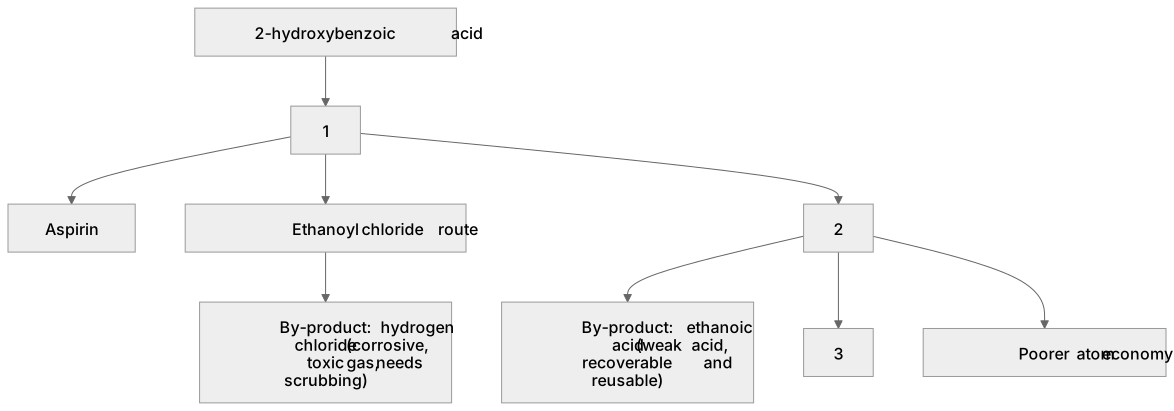
1Box 1
2Box 2
3Box 3
There is more to this lesson
The full lesson goes on to check your understanding and help you earn the marks. Create a free account to carry on, with your progress saved.
A week of Premium from your first lesson · Then the free plan continues · No card, no charge
Test your understanding of Acylation (A-level only): The industrial advantages of ethanoic anhydride over ethanoyl chloride in the manufacture of the drug aspirin.
Active recall beats re-reading. Take an instant quiz now to test what you’ve learned and lock it into long-term memory.
A week of Premium from your first lesson · Then the free plan continues · No card, no charge