AQA · A-Level · Chemistry
Course version: 7405 · Version from Sept 2016
The structures of: acid anhydrides acyl chlorides amides.
Full specification wording
Acylation (A-level only): The structures of: acid anhydrides acyl chlorides amides.
All three are relatives of the carboxylic acid with the -OH replaced.
Checked against the AQA 7405 specification (opens in a new tab) on .
- Point 1 of 5
- 4 key terms
Study notes
From the checked teaching notes for this specification point.
The idea
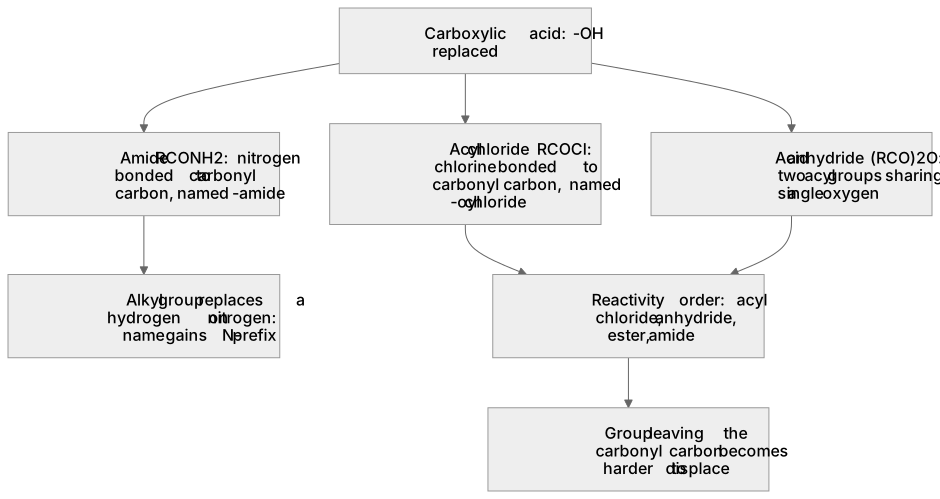
All three are relatives of the carboxylic acid with the -OH replaced. An acyl chloride is RCOCl, the chlorine bonded to the carbonyl carbon, named -oyl chloride, as in ethanoyl chloride. An acid anhydride is two acyl groups sharing a single oxygen, (RCO)₂O, and is what is left when two acid molecules lose one molecule of water between them, hence ethanoic anhydride. An amide has nitrogen on the carbonyl carbon, RCONH₂, named -amide; if an alkyl group replaces one of the hydrogens on the nitrogen the name gains an N- prefix, as in N-methylethanamide. Reactivity falls along the series acyl chloride, anhydride, ester, amide, because the group leaving the carbonyl carbon becomes harder to displace.
What earns the marks
- The acyl chloride drawn with chlorine bonded to the carbonyl carbon.
- The anhydride drawn as two C=O groups joined through a single oxygen atom.
- The amide drawn with nitrogen bonded to the carbonyl carbon.
- The correct IUPAC name, ending -oyl chloride, anhydride or -amide as appropriate.
Common mistakes and how to put them right
Bonding the chlorine to the carbonyl oxygen instead of the carbon.
Drawing an anhydride with an O-O link, which is a peroxide.
Naming CH₃COCl as ethanol chloride or as ethyl chloride.
Drawing the bond from the carbon chain to the O of -COCl, which AQA marks as an ambiguous structure.
Exam tips
- Always draw the bond to the carbon of a carbon-containing functional group; the bond to an oxygen there is penalised even when the rest is right.
- An N- prefix in an amide name tells you the group is on the nitrogen, not on the carbon chain.
Try the lesson
The start of the Acylation (A-level only): The structures of: acid anhydrides acyl chlorides amides. lesson, made from checked teaching notes for this specification point.
Have a go first
Which functional group is present in an acyl chloride such as ethanoyl chloride?
Listen
All three are relatives of the carboxylic acid with the -OH replaced. An acyl chloride is RCOCl, the chlorine bonded to the carbonyl carbon, named -oyl chloride, as in ethanoyl chloride. An acid anhydride is two acyl groups sharing a single oxygen, (RCO)₂O, and is what is left when two acid molecules lose one molecule of water between them, hence ethanoic anhydride. An amide has nitrogen on the carbonyl carbon, RCONH₂, named -amide; if an alkyl group replaces one of the hydrogens on the nitrogen the name gains an N- prefix, as in N-methylethanamide. Reactivity falls along the series acyl chloride, anhydride, ester, amide, because the group leaving the carbonyl carbon becomes harder to displace. A strong answer earns marks for these points. the acyl chloride drawn with chlorine bonded to the carbonyl carbon. the anhydride drawn as two C=O groups joined through a single oxygen atom. the amide drawn with nitrogen bonded to the carbonyl carbon. the correct IUPAC name, ending -oyl chloride, anhydride or -amide as appropriate. Exam tip: Always draw the bond to the carbon of a carbon-containing functional group; the bond to an oxygen there is penalised even when the rest is right.
See it
Key words
Say what each word means before you turn the card.
acyl chloride
Try answering aloud or in your head before turning the card.
acid anhydride
Try answering aloud or in your head before turning the card.
amide
Try answering aloud or in your head before turning the card.
order of reactivity
Try answering aloud or in your head before turning the card.
See every definition
- acyl chloride
- A compound RCOCl in which the chlorine is bonded to the carbonyl carbon, named -oyl chloride, as in ethanoyl chloride.
- acid anhydride
- Two acyl groups sharing a single oxygen, (RCO)₂O, left when two acid molecules lose one molecule of water between them, hence ethanoic anhydride.
- amide
- A compound with nitrogen on the carbonyl carbon, RCONH₂, named -amide, gaining an N- prefix if an alkyl group replaces one of the hydrogens on the nitrogen.
- order of reactivity
- Reactivity falls along the series acyl chloride, anhydride, ester, amide, because the group leaving the carbonyl carbon becomes harder to displace.
Label the diagram
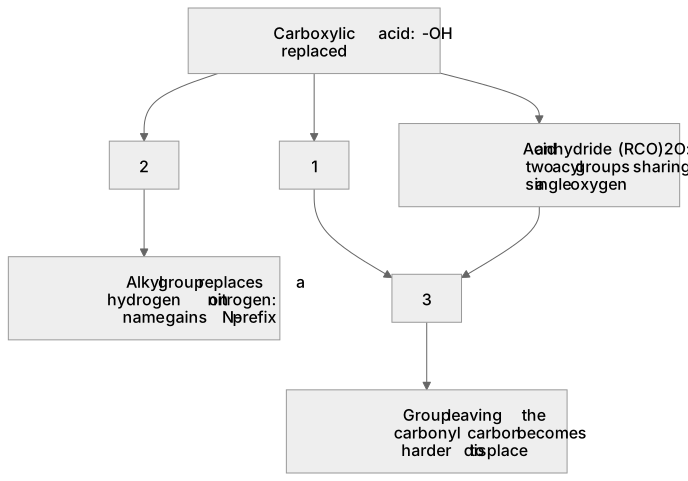
Some boxes have lost their names. Pick the right name for each number.
1Box 1
2Box 2
3Box 3
There is more to this lesson
The full lesson goes on to check your understanding and help you earn the marks. Create a free account to carry on, with your progress saved.
A week of Premium from your first lesson · Then the free plan continues · No card, no charge
Test your understanding of Acylation (A-level only): The structures of: acid anhydrides acyl chlorides amides.
Active recall beats re-reading. Take an instant quiz now to test what you’ve learned and lock it into long-term memory.
A week of Premium from your first lesson · Then the free plan continues · No card, no charge