AQA · A-Level · Chemistry
Course version: 7405 · Version from Sept 2016
Addition polymers are formed from alkenes and substituted alkenes.
Full specification wording
Addition polymers: Addition polymers are formed from alkenes and substituted alkenes.
In addition polymerisation the π bond of each monomer opens and the carbons join end to end into a long chain.
Checked against the AQA 7405 specification (opens in a new tab) on .
- Point 1 of 6
- 4 key terms
Study notes
From the checked teaching notes for this specification point.
The idea
In addition polymerisation the π bond of each monomer opens and the carbons join end to end into a long chain. Nothing else is formed, so the polymer has the same empirical formula as the monomer and the atom economy is one hundred per cent. Ethene gives poly(ethene), and substituted alkenes behave identically because the substituent is a spectator: chloroethene gives poly(chloroethene), propene gives poly(propene), and phenylethene gives poly(phenylethene). Write the equation with n monomer units on the left and the repeating unit in brackets with n outside on the right, with bonds drawn through the brackets to show the chain continues. The double bond must not survive into the product.
What earns the marks
- n monomer units on the left of the equation.
- The repeating unit in brackets with n outside on the right.
- Showing the C=C has become a C–C single bond.
- The two continuation bonds passing through the brackets, with no other product formed.
Common mistakes and how to put them right
Leaving a double bond inside the repeating unit.
Omitting the n from one side of the equation so the equation does not balance.
Stopping the bonds at the bracket instead of drawing them through it.
Adding a small molecule such as water as a by-product, which belongs to condensation polymerisation.
Exam tips
- Count the atoms in your repeating unit against the monomer; they must match exactly.
- Draw the backbone as two carbons in a straight line and hang the substituents off them, so the repeat is obvious.
- Write poly(monomer name) with brackets, not the trade name.
Try the lesson
The start of the Addition polymers: Addition polymers are formed from alkenes and substituted alkenes. lesson, made from checked teaching notes for this specification point.
Have a go first
Which type of monomer is used to make an addition polymer?
Listen
In addition polymerisation the π bond of each monomer opens and the carbons join end to end into a long chain. Nothing else is formed, so the polymer has the same empirical formula as the monomer and the atom economy is one hundred per cent. Ethene gives poly(ethene), and substituted alkenes behave identically because the substituent is a spectator: chloroethene gives poly(chloroethene), propene gives poly(propene), and phenylethene gives poly(phenylethene). Write the equation with n monomer units on the left and the repeating unit in brackets with n outside on the right, with bonds drawn through the brackets to show the chain continues. The double bond must not survive into the product. A strong answer earns marks for these points. n monomer units on the left of the equation. the repeating unit in brackets with n outside on the right. showing the C=C has become a C–C single bond. the two continuation bonds passing through the brackets, with no other product formed. Exam tip: Count the atoms in your repeating unit against the monomer; they must match exactly.
See it
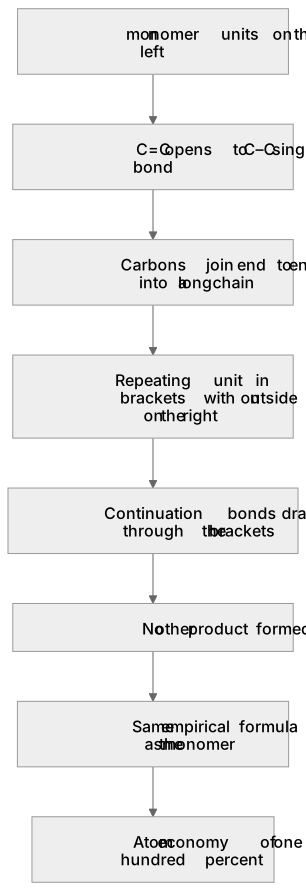
Put it in order
Put these steps in the order they happen.
- 1. Continuation bonds drawn through the brackets
- 2. Atom economy of one hundred per cent
- 3. No other product formed
- 4. n monomer units on the left
- 5. C=C opens to C–C single bond
- 6. Same empirical formula as the monomer
- 7. Carbons join end to end into a long chain
- 8. Repeating unit in brackets with n outside on the right
Key words
Say what each word means before you turn the card.
addition polymerisation
Try answering aloud or in your head before turning the card.
substituted alkenes
Try answering aloud or in your head before turning the card.
no by-product
Try answering aloud or in your head before turning the card.
high atom economy
Try answering aloud or in your head before turning the card.
See every definition
- addition polymerisation
- A process in which the π bond of each monomer opens and the carbons join end to end into a long chain.
- substituted alkenes
- These behave identically to alkenes in polymerisation because the substituent is a spectator.
- no by-product
- Nothing else is formed, so the polymer has the same empirical formula as the monomer.
- high atom economy
- Because nothing else is formed, the atom economy is one hundred per cent.
Label the diagram
Some boxes have lost their names. Pick the right name for each number.
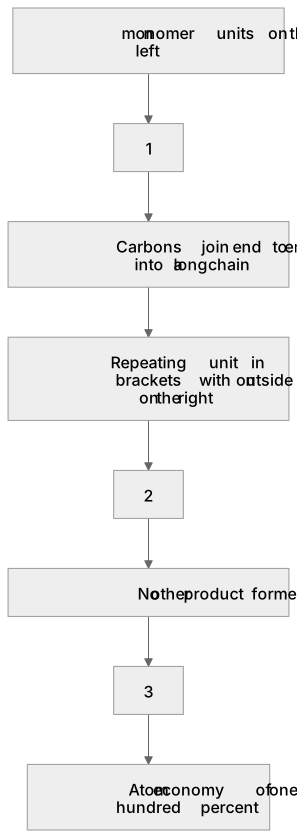
1Box 1
2Box 2
3Box 3
There is more to this lesson
The full lesson goes on to check your understanding and help you earn the marks. Create a free account to carry on, with your progress saved.
A week of Premium from your first lesson · Then the free plan continues · No card, no charge
Test your understanding of Addition polymers: Addition polymers are formed from alkenes and substituted alkenes.
Active recall beats re-reading. Take an instant quiz now to test what you’ve learned and lock it into long-term memory.
A week of Premium from your first lesson · Then the free plan continues · No card, no charge