AQA · A-Level · Chemistry
Course version: 7405 · Version from Sept 2016
Addition polymers: The repeating unit of addition polymers.
The repeating unit is the smallest section of chain that, repeated end to end, builds the whole polymer.
Checked against the AQA 7405 specification (opens in a new tab) on .
- Point 2 of 6
- 4 key terms
Study notes
From the checked teaching notes for this specification point.
The idea
The repeating unit is the smallest section of chain that, repeated end to end, builds the whole polymer. For an addition polymer it contains exactly the same atoms as the monomer, with the former double bond now a single bond and two bonds drawn out through the brackets to show where the next unit joins. Going forwards, take the monomer, open the double bond, and enclose the two carbons. Going backwards from a section of chain, find the shortest length that repeats, cut the backbone at equivalent points, and then put the double bond back between the two backbone carbons to recover the monomer. Keep any substituent on the same carbon it occupied in the monomer, or the repeat will not match the drawn chain.
What earns the marks
- A repeating unit containing the same atoms as the monomer.
- The two continuation bonds drawn through the brackets.
- A single carbon–carbon bond in the backbone with n outside the bracket.
- Restoring the C=C in the correct position when deducing a monomer from a section of chain.
Common mistakes and how to put them right
Drawing the monomer, complete with its double bond, when the repeating unit was asked for.
Leaving out the continuation bonds so the unit looks like an isolated molecule.
Choosing two monomer lengths as the repeating unit when one would do.
Moving a substituent onto the wrong backbone carbon so the repeat does not reproduce the chain.
Exam tips
- Test your answer by drawing the unit twice side by side; it should reproduce the chain in the question.
- Repeating unit and monomer are different answers, so read which one the question wants.
- Extend the bonds clearly past the brackets; a bond that stops short loses the mark.
Try the lesson
The start of the Addition polymers: The repeating unit of addition polymers. lesson, made from checked teaching notes for this specification point.
Have a go first
Which structure correctly represents the repeating unit of the addition polymer formed from propene, CH₂=CHCH₃?
Listen
The repeating unit is the smallest section of chain that, repeated end to end, builds the whole polymer. For an addition polymer it contains exactly the same atoms as the monomer, with the former double bond now a single bond and two bonds drawn out through the brackets to show where the next unit joins. Going forwards, take the monomer, open the double bond, and enclose the two carbons. Going backwards from a section of chain, find the shortest length that repeats, cut the backbone at equivalent points, and then put the double bond back between the two backbone carbons to recover the monomer. Keep any substituent on the same carbon it occupied in the monomer, or the repeat will not match the drawn chain. A strong answer earns marks for these points. a repeating unit containing the same atoms as the monomer. the two continuation bonds drawn through the brackets. a single carbon–carbon bond in the backbone with n outside the bracket. restoring the C=C in the correct position when deducing a monomer from a section of chain. Exam tip: Test your answer by drawing the unit twice side by side; it should reproduce the chain in the question.
See it
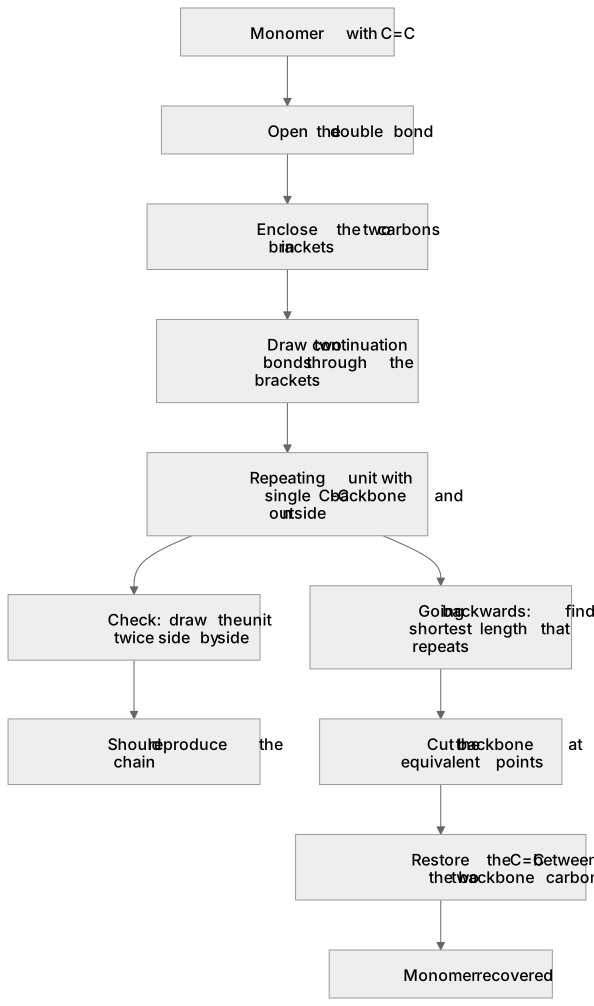
Key words
Say what each word means before you turn the card.
repeating unit
Try answering aloud or in your head before turning the card.
continuation bonds
Try answering aloud or in your head before turning the card.
monomer to polymer
Try answering aloud or in your head before turning the card.
polymer to monomer
Try answering aloud or in your head before turning the card.
See every definition
- repeating unit
- The smallest section of chain that, repeated end to end, builds the whole polymer.
- continuation bonds
- Two bonds drawn out through the brackets to show where the next unit joins.
- monomer to polymer
- Take the monomer, open the double bond, and enclose the two carbons.
- polymer to monomer
- Find the shortest length that repeats, cut the backbone at equivalent points, and put the double bond back between the two backbone carbons.
Label the diagram
Some boxes have lost their names. Pick the right name for each number.
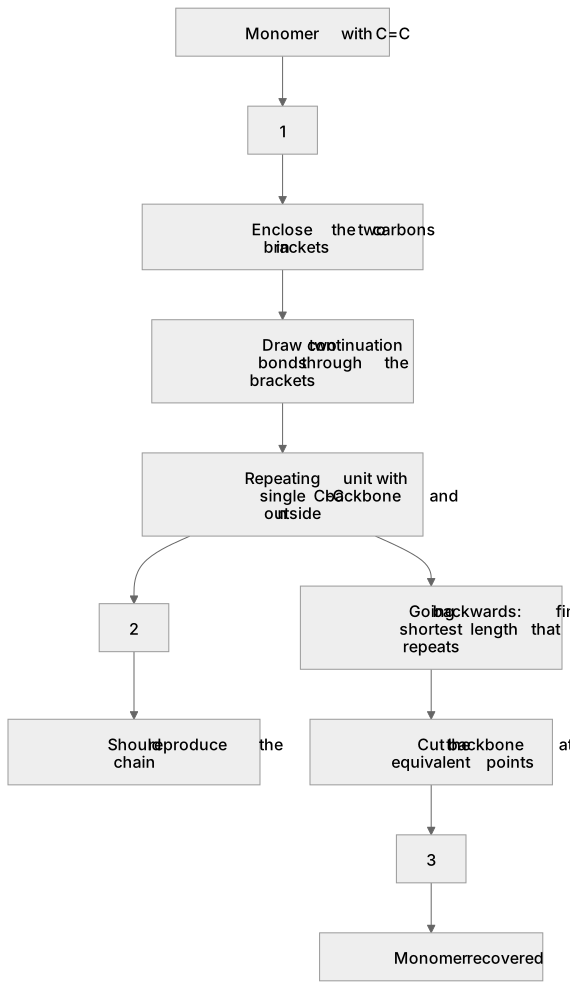
1Box 1
2Box 2
3Box 3
There is more to this lesson
The full lesson goes on to check your understanding and help you earn the marks. Create a free account to carry on, with your progress saved.
A week of Premium from your first lesson · Then the free plan continues · No card, no charge
Test your understanding of Addition polymers: The repeating unit of addition polymers.
Active recall beats re-reading. Take an instant quiz now to test what you’ve learned and lock it into long-term memory.
A week of Premium from your first lesson · Then the free plan continues · No card, no charge