AQA · A-Level · Chemistry
Course version: 7405 · Version from Sept 2016
Students should be able to: outline the mechanisms for these reactions…
Full specification wording
Addition reactions of alkenes: Students should be able to: outline the mechanisms for these reactions explain the formation of major and minor products by reference to the relative stabilities of primary, secondary and tertiary carbocation intermediates.
The mechanism is electrophilic addition and it runs in two steps.
Checked against the AQA 7405 specification (opens in a new tab) on .
- Point 2 of 2
Study notes
From the checked teaching notes for this specification point.
The idea
The mechanism is electrophilic addition and it runs in two steps. First, the π electrons of the C=C attack the δ⁺ hydrogen of H–Br, or of an O–H bond in sulfuric acid; the arrow starts at the double bond and ends at that hydrogen atom, while a second arrow shows the H–Br or H–O bond breaking, its electrons going to the halogen or oxygen. That gives a carbocation and a negative ion. In the second step an arrow runs from a lone pair on the negative ion to the positively charged carbon, forming the new bond. With bromine the same pattern applies once the non-polar Br–Br bond is polarised by the approaching electron-rich double bond. Choosing where to put the positive charge decides the major product.
What earns the marks
- Naming the mechanism electrophilic addition.
- The arrow from the C=C to the hydrogen atom of the H–Br or H–O bond.
- The arrow showing that H–Br or H–O bond breaking.
- The correct carbocation structure with the positive charge on the right carbon.
- The arrow from a lone pair on the negative ion to the positively charged carbon.
Common mistakes and how to put them right
Starting the first arrow at a carbon atom instead of at the double bond, which AQA does not credit.
Drawing the arrow from H–Br towards the double bond, which reverses the electron flow.
Placing the positive charge on the carbon that gained the hydrogen.
Showing the negative ion attacking with no lone pair drawn on the attacking atom.
Exam tips
- Check every curly arrow starts on a bond or a lone pair; that single rule protects several marks.
- Draw the intermediate large and clear, with the charge next to the correct carbon.
- The arrow forming a bond may stop at the atom, beside it, or more than half way to it, so aim it unmistakably.
Try the lesson
The start of the Addition reactions of alkenes: Students should be able to: outline the mechanisms for these reactions explain the formation of major and minor products by reference to the relative stabilities of primary, secondary and tertiary carbocation intermediates. lesson, made from checked teaching notes for this specification point.
Have a go first
Propene reacts with hydrogen bromide via an electrophilic addition mechanism. In the first step, the H⁺ ion adds to the carbon atom of the C=C double bond that already holds more hydrogen atoms. Which type of carbocation intermediate is formed?
Listen
The mechanism is electrophilic addition and it runs in two steps. First, the π electrons of the C=C attack the δ⁺ hydrogen of H–Br, or of an O–H bond in sulfuric acid; the arrow starts at the double bond and ends at that hydrogen atom, while a second arrow shows the H–Br or H–O bond breaking, its electrons going to the halogen or oxygen. That gives a carbocation and a negative ion. In the second step an arrow runs from a lone pair on the negative ion to the positively charged carbon, forming the new bond. With bromine the same pattern applies once the non-polar Br–Br bond is polarised by the approaching electron-rich double bond. Choosing where to put the positive charge decides the major product. A strong answer earns marks for these points. naming the mechanism electrophilic addition. the arrow from the C=C to the hydrogen atom of the H–Br or H–O bond. the arrow showing that H–Br or H–O bond breaking. the correct carbocation structure with the positive charge on the right carbon. Exam tip: Check every curly arrow starts on a bond or a lone pair; that single rule protects several marks.
See it
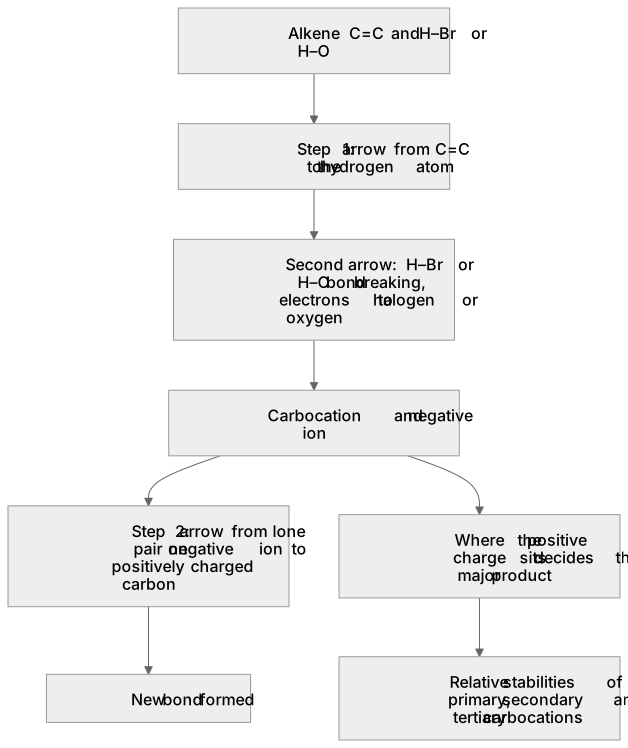
Label the diagram
Some boxes have lost their names. Pick the right name for each number.
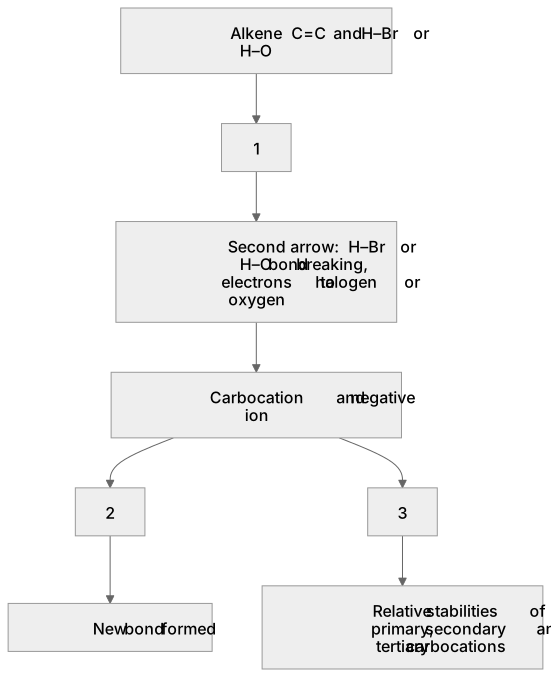
1Box 1
2Box 2
3Box 3
There is more to this lesson
The full lesson goes on to check your understanding and help you earn the marks. Create a free account to carry on, with your progress saved.
A week of Premium from your first lesson · Then the free plan continues · No card, no charge
Test your understanding of Addition reactions of alkenes: Students should be able to: outline the mechanisms for these reactions explain the formation of major and minor products by reference to the relative stabilities of primary, secondary and tertiary carbocation intermediates.
Active recall beats re-reading. Take an instant quiz now to test what you’ve learned and lock it into long-term memory.
A week of Premium from your first lesson · Then the free plan continues · No card, no charge