AQA · A-Level · Chemistry
Course version: 7405 · Version from Sept 2016
The formation of major and minor products in addition reactions of…
Full specification wording
Addition reactions of alkenes: The formation of major and minor products in addition reactions of unsymmetrical alkenes.
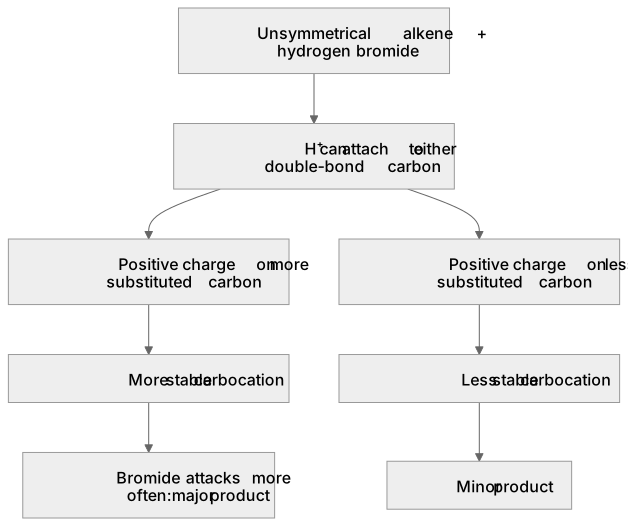
When a reagent such as hydrogen bromide adds to an unsymmetrical alkene, two products are possible because H⁺ can attach to either double-bond carbon.
Checked against the AQA 7405 specification (opens in a new tab) on .
- Point 1 of 2
- 4 key terms
Study notes
From the checked teaching notes for this specification point.
The idea
When a reagent such as hydrogen bromide adds to an unsymmetrical alkene, two products are possible because H⁺ can attach to either double-bond carbon. Which one dominates is decided by the intermediate, not by the product. The H⁺ adds so as to leave the positive charge on the more substituted carbon, because alkyl groups are electron-releasing: their positive inductive effect pushes electron density towards the carbon and spreads the charge, so a tertiary carbocation is more stable than a secondary one, which is more stable than a primary one. The more stable carbocation forms faster, so the bromide attacks it more often and its product is the major one. The minor product comes from the less stable carbocation.
What earns the marks
- The structure of the minor product drawn unambiguously.
- Saying the major product is formed via the more stable carbocation.
- Stating that a tertiary carbocation is more stable than a primary one.
- The electron-releasing character, or positive inductive effect, of the alkyl groups spreading the positive charge.
Common mistakes and how to put them right
Comparing the stabilities of the two products rather than of the two carbocation intermediates.
Describing alkyl groups as electron-withdrawing, which would reverse the order of stability.
Saying "three alkyl groups push electrons" without saying this stabilises the positive charge.
Adding the H⁺ to the carbon that already carries fewer hydrogen atoms.
Exam tips
- Draw both carbocations before choosing a major product; the classification, primary or tertiary, is the argument.
- Say "more stable carbocation" explicitly, then give the inductive effect as the reason; both are separate marks.
- Count alkyl groups on the positive carbon, as AQA credits the comparison of three against one.
Try the lesson
The start of the Addition reactions of alkenes: The formation of major and minor products in addition reactions of unsymmetrical alkenes. lesson, made from checked teaching notes for this specification point.
Have a go first
Propene reacts with hydrogen bromide. Which product is formed as the major product?
Listen
When a reagent such as hydrogen bromide adds to an unsymmetrical alkene, two products are possible because H⁺ can attach to either double-bond carbon. Which one dominates is decided by the intermediate, not by the product. The H⁺ adds so as to leave the positive charge on the more substituted carbon, because alkyl groups are electron-releasing: their positive inductive effect pushes electron density towards the carbon and spreads the charge, so a tertiary carbocation is more stable than a secondary one, which is more stable than a primary one. The more stable carbocation forms faster, so the bromide attacks it more often and its product is the major one. The minor product comes from the less stable carbocation. A strong answer earns marks for these points. the structure of the minor product drawn unambiguously. saying the major product is formed via the more stable carbocation. stating that a tertiary carbocation is more stable than a primary one. the electron-releasing character, or positive inductive effect, of the alkyl groups spreading the positive charge. Exam tip: Draw both carbocations before choosing a major product; the classification, primary or tertiary, is the argument.
See it
Key words
Say what each word means before you turn the card.
unsymmetrical alkenes
Try answering aloud or in your head before turning the card.
carbocation stability
Try answering aloud or in your head before turning the card.
positive inductive effect
Try answering aloud or in your head before turning the card.
major and minor products
Try answering aloud or in your head before turning the card.
See every definition
- unsymmetrical alkenes
- Alkenes in which H⁺ can attach to either double-bond carbon, so that two products are possible in addition reactions.
- carbocation stability
- A tertiary carbocation is more stable than a secondary one, which is more stable than a primary one, because the charge is spread.
- positive inductive effect
- The electron-releasing character of alkyl groups, which pushes electron density towards the carbon and spreads the positive charge.
- major and minor products
- The major product is formed via the more stable carbocation, which forms faster, while the minor product comes from the less stable carbocation.
Label the diagram
Some boxes have lost their names. Pick the right name for each number.
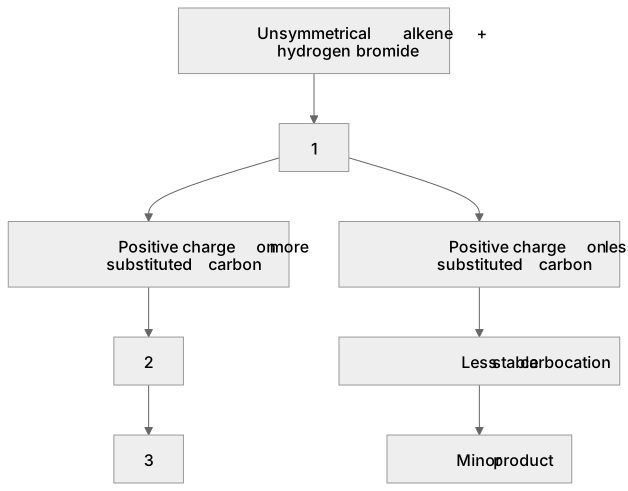
1Box 1
2Box 2
3Box 3
There is more to this lesson
The full lesson goes on to check your understanding and help you earn the marks. Create a free account to carry on, with your progress saved.
A week of Premium from your first lesson · Then the free plan continues · No card, no charge
Test your understanding of Addition reactions of alkenes: The formation of major and minor products in addition reactions of unsymmetrical alkenes.
Active recall beats re-reading. Take an instant quiz now to test what you’ve learned and lock it into long-term memory.
A week of Premium from your first lesson · Then the free plan continues · No card, no charge