AQA · A-Level · Chemistry
Course version: 7405 · Version from Sept 2016
Ethanol is produced industrially by fermentation of glucose. The…
Full specification wording
Alcohol production: Ethanol is produced industrially by fermentation of glucose. The conditions for this process.
Fermentation uses enzymes in yeast to convert glucose to ethanol in the absence of air: C₆H₁₂O₆ → 2C₂H₅OH + 2CO₂.
Checked against the AQA 7405 specification (opens in a new tab) on .
- Point 2 of 4
- 4 key terms
Study notes
From the checked teaching notes for this specification point.
The idea
Fermentation uses enzymes in yeast to convert glucose to ethanol in the absence of air: C₆H₁₂O₆ → 2C₂H₅OH + 2CO₂. Every condition can be justified. The temperature is held near 30 to 40 °C because below this the enzymes work too slowly, and much above it they are denatured and stop working altogether. Air is excluded because oxygen would allow the ethanol to be oxidised to ethanoic acid, turning the mixture to vinegar. The mixture is aqueous, since the enzymes need solution to act. It is a batch process, run at atmospheric pressure with simple equipment, and it stops when the ethanol concentration reaches roughly 15 per cent because the yeast can no longer survive.
What earns the marks
- The equation C₆H₁₂O₆ → 2C₂H₅OH + 2CO₂.
- Naming yeast, or the enzymes in yeast, as the catalyst.
- A temperature in the range 30 to 40 °C justified on both sides, too slow below and enzymes denatured above.
- The absence of air, to prevent oxidation of ethanol to ethanoic acid.
Common mistakes and how to put them right
Writing oxygen into the equation, when fermentation is anaerobic.
Choosing a high temperature to speed the reaction up, ignoring enzyme denaturation.
Saying the yeast is a catalyst and then describing it as used up.
Calling fermentation a continuous process, when it is a batch process.
Exam tips
- Justify a temperature by saying what goes wrong at both a lower and a higher value; one side alone is half an answer.
- Balance the fermentation equation by checking carbon first, then hydrogen.
- Use the word anaerobic, or "in the absence of air", explicitly.
Try the lesson
The start of the Alcohol production: Ethanol is produced industrially by fermentation of glucose. The conditions for this process. lesson, made from checked teaching notes for this specification point.
Have a go first
Which microorganism is used in the industrial fermentation of glucose to produce ethanol?
Listen
Fermentation uses enzymes in yeast to convert glucose to ethanol in the absence of air: C₆H₁₂O₆ → 2C₂H₅OH + 2CO₂. Every condition can be justified. The temperature is held near 30 to 40 °C because below this the enzymes work too slowly, and much above it they are denatured and stop working altogether. Air is excluded because oxygen would allow the ethanol to be oxidised to ethanoic acid, turning the mixture to vinegar. The mixture is aqueous, since the enzymes need solution to act. It is a batch process, run at atmospheric pressure with simple equipment, and it stops when the ethanol concentration reaches roughly 15 per cent because the yeast can no longer survive. A strong answer earns marks for these points. the equation C₆H₁₂O₆ → 2C₂H₅OH + 2CO₂. naming yeast, or the enzymes in yeast, as the catalyst. a temperature in the range 30 to 40 °C justified on both sides, too slow below and enzymes denatured above. the absence of air, to prevent oxidation of ethanol to ethanoic acid. Exam tip: Justify a temperature by saying what goes wrong at both a lower and a higher value; one side alone is half an answer.
See it

Key words
Say what each word means before you turn the card.
fermentation of glucose
Try answering aloud or in your head before turning the card.
yeast enzymes
Try answering aloud or in your head before turning the card.
optimum temperature
Try answering aloud or in your head before turning the card.
anaerobic conditions
Try answering aloud or in your head before turning the card.
See every definition
- fermentation of glucose
- Ethanol is produced industrially by this process, in which enzymes in yeast convert glucose to ethanol in the absence of air.
- yeast enzymes
- These act as the catalyst that converts glucose to ethanol, and they work too slowly below the temperature range and are denatured much above it.
- optimum temperature
- Held near 30 to 40 °C because below this the enzymes work too slowly, and much above it they are denatured and stop working altogether.
- anaerobic conditions
- Air is excluded because oxygen would allow the ethanol to be oxidised to ethanoic acid, turning the mixture to vinegar.
Label the diagram
Some boxes have lost their names. Pick the right name for each number.
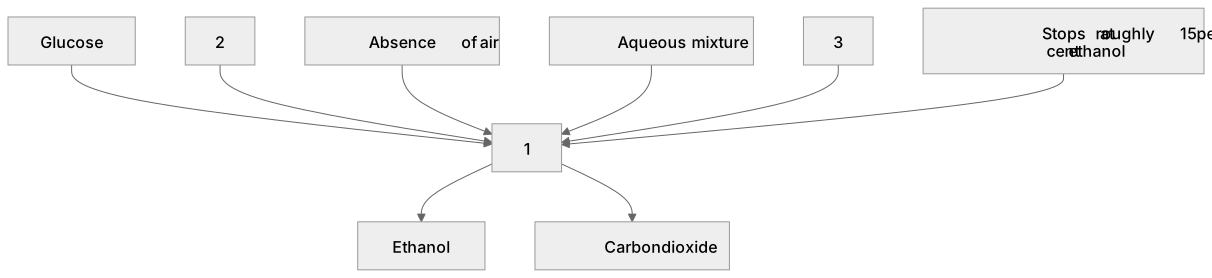
1Box 1
2Box 2
3Box 3
There is more to this lesson
The full lesson goes on to check your understanding and help you earn the marks. Create a free account to carry on, with your progress saved.
A week of Premium from your first lesson · Then the free plan continues · No card, no charge
Test your understanding of Alcohol production: Ethanol is produced industrially by fermentation of glucose. The conditions for this process.
Active recall beats re-reading. Take an instant quiz now to test what you’ve learned and lock it into long-term memory.
A week of Premium from your first lesson · Then the free plan continues · No card, no charge