AQA · A-Level · Chemistry
Course version: 7405 · Version from Sept 2016
Ethanol produced industrially by fermentation is separated by fractional…
Full specification wording
Alcohol production: Ethanol produced industrially by fermentation is separated by fractional distillation and can then be used as a biofuel.
Fermentation gives a dilute aqueous ethanol, so the ethanol has to be separated.
Checked against the AQA 7405 specification (opens in a new tab) on .
- Point 3 of 4
- 4 key terms
Study notes
From the checked teaching notes for this specification point.
The idea
Fermentation gives a dilute aqueous ethanol, so the ethanol has to be separated. Fractional distillation works because ethanol boils at 78 °C and water at 100 °C, so the vapour above the heated mixture is richer in ethanol. In the fractionating column that vapour repeatedly condenses and re-evaporates, each cycle enriching it further, and the distillate collected at about 78 °C is far purer than a single distillation would give. In the condenser, cooling water enters at the lower end and leaves at the upper end so the jacket stays full. The ethanol can then be burned as a biofuel, a fuel made from biomass, that is plant material grown recently rather than from fossil carbon.
What earns the marks
- Naming fractional distillation and the fractionating column.
- Stating that cooling water enters the condenser at the lower end and leaves at the upper end.
- Collecting the fraction at the boiling point of ethanol, about 78 °C.
- Defining a biofuel as a fuel produced from biomass or recently living material.
Common mistakes and how to put them right
Labelling the condenser with water entering at the top, so the jacket does not fill.
Saying ethanol boils higher than water because its molecules are larger, ignoring hydrogen bonding in water.
Expecting pure ethanol from one simple distillation of the fermented mixture.
Calling the separation filtration or evaporation rather than fractional distillation.
Exam tips
- When labelling apparatus, mark water in at the bottom and water out at the top of the condenser every time.
- Justify a fractionating column by saying the components have close boiling points.
- Quote the collection temperature as a range around 78 °C rather than a single exact figure.
Try the lesson
The start of the Alcohol production: Ethanol produced industrially by fermentation is separated by fractional distillation and can then be used as a biofuel. lesson, made from checked teaching notes for this specification point.
Have a go first
Which separation technique is used to separate ethanol from the fermentation mixture?
Listen
Fermentation gives a dilute aqueous ethanol, so the ethanol has to be separated. Fractional distillation works because ethanol boils at 78 °C and water at 100 °C, so the vapour above the heated mixture is richer in ethanol. In the fractionating column that vapour repeatedly condenses and re-evaporates, each cycle enriching it further, and the distillate collected at about 78 °C is far purer than a single distillation would give. In the condenser, cooling water enters at the lower end and leaves at the upper end so the jacket stays full. The ethanol can then be burned as a biofuel, a fuel made from biomass, that is plant material grown recently rather than from fossil carbon. A strong answer earns marks for these points. naming fractional distillation and the fractionating column. stating that cooling water enters the condenser at the lower end and leaves at the upper end. collecting the fraction at the boiling point of ethanol, about 78 °C. defining a biofuel as a fuel produced from biomass or recently living material. Exam tip: When labelling apparatus, mark water in at the bottom and water out at the top of the condenser every time.
See it
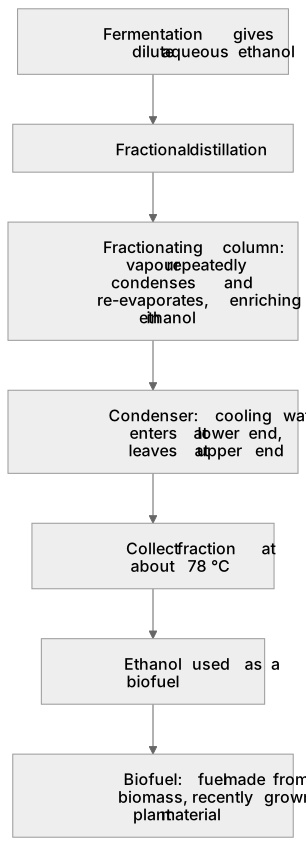
Put it in order
Put these steps in the order they happen.
- 1. Biofuel: fuel made from biomass, recently grown plant material
- 2. Ethanol used as a biofuel
- 3. Fractionating column: vapour repeatedly condenses and re-evaporates, enriching in ethanol
- 4. Collect fraction at about 78 °C
- 5. Fermentation gives dilute aqueous ethanol
- 6. Fractional distillation
- 7. Condenser: cooling water enters at lower end, leaves at upper end
Key words
Say what each word means before you turn the card.
fractional distillation
Try answering aloud or in your head before turning the card.
fractionating column
Try answering aloud or in your head before turning the card.
condenser water direction
Try answering aloud or in your head before turning the card.
biofuel from biomass
Try answering aloud or in your head before turning the card.
See every definition
- fractional distillation
- A separation method that works because ethanol boils at 78 °C and water at 100 °C, so the vapour above the heated mixture is richer in ethanol.
- fractionating column
- A column in which the vapour repeatedly condenses and re-evaporates, each cycle enriching it further.
- condenser water direction
- Cooling water enters at the lower end and leaves at the upper end so the jacket stays full.
- biofuel from biomass
- A fuel made from biomass, that is plant material grown recently rather than from fossil carbon.
Label the diagram
Some boxes have lost their names. Pick the right name for each number.
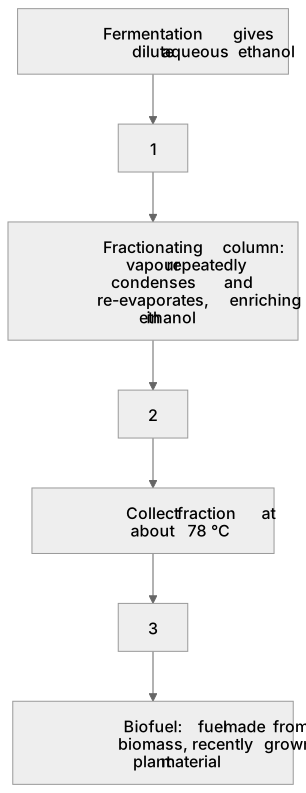
1Box 1
2Box 2
3Box 3
There is more to this lesson
The full lesson goes on to check your understanding and help you earn the marks. Create a free account to carry on, with your progress saved.
A week of Premium from your first lesson · Then the free plan continues · No card, no charge
Test your understanding of Alcohol production: Ethanol produced industrially by fermentation is separated by fractional distillation and can then be used as a biofuel.
Active recall beats re-reading. Take an instant quiz now to test what you’ve learned and lock it into long-term memory.
A week of Premium from your first lesson · Then the free plan continues · No card, no charge