AQA · A-Level · Chemistry
Course version: 7405 · Version from Sept 2016
Students should be able to: explain the meaning of the term biofuel…
Full specification wording
Alcohol production: Students should be able to: explain the meaning of the term biofuel justify the conditions used in the production of ethanol by fermentation of glucose write equations to support the statement that ethanol produced by fermentation is a carbon neutral fuel and give reasons why this statement is not valid outline the mechanism for the formation of an alcohol by the reaction of an alkene with steam in the presence of an acid catalyst discuss the environmental (including ethical) issues linked to decision making about biofuel use.
A biofuel is a fuel derived from renewable biological sources.
Checked against the AQA 7405 specification (opens in a new tab) on .
- Point 4 of 4
- 4 key terms
Study notes
From the checked teaching notes for this specification point.
The idea
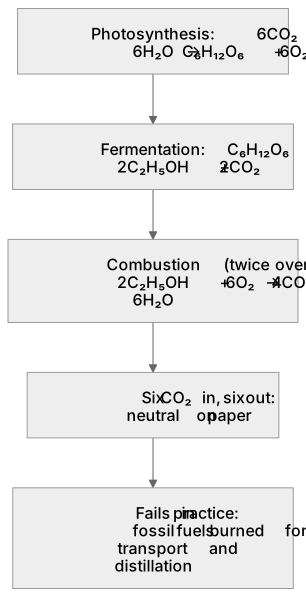
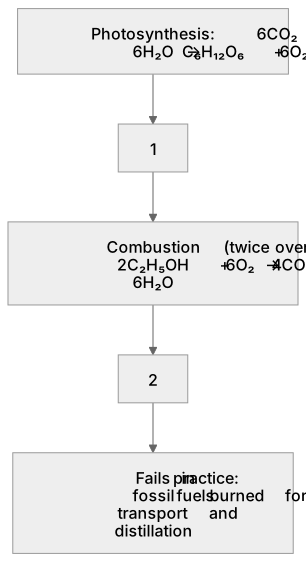
A biofuel is a fuel derived from renewable biological sources. Ethanol is produced by fermentation of glucose using yeast under anaerobic conditions at ~35°C. The carbon neutral claim is tested with three equations: Photosynthesis (6CO₂ + 6H₂O → C₆H₁₂O₆ + 6O₂), Fermentation (C₆H₁₂O₆ → 2C₂H₅OH + 2CO₂), and Combustion (C₂H₅OH + 3O₂ → 2CO₂ + 3H₂O, twice over). Six CO₂ in, six out, so on paper it is neutral. It fails in practice because fossil fuels are burned for transport and distillation. The hydration mechanism involves C=C attacking H⁺, forming a carbocation, water attacking with a lone pair, and H⁺ loss. Environmental and ethical issues must be discussed: land used for biofuel crops can cause deforestation, habitat loss, and raise food prices by displacing food crops.
What earns the marks
- Define a biofuel as a fuel derived from renewable biological sources.
- Justify fermentation conditions, such as anaerobic to prevent oxidation or ~35°C to prevent enzyme denaturation.
- Write correctly balanced equations for photosynthesis, fermentation, and combustion to show the carbon dioxide absorbed equals the carbon dioxide released.
- Outline the three curly arrows of the hydration mechanism, ending with the loss of H⁺ to regenerate the catalyst.
- Discuss environmental and ethical issues of biofuels, such as deforestation or the 'food vs fuel' debate raising food prices.
Common mistakes and how to put them right
Stating that carbon neutral means no carbon dioxide is produced at all.
Put it right by explaining that CO2 absorbed equals CO2 released.
Unbalancing the combustion equation by forgetting that ethanol already contains an oxygen atom.
Put it right by counting the oxygen in ethanol.
Leaving the final loss of H⁺ out of the hydration mechanism.
Put it right by showing the O-H bond breaking to regenerate the catalyst.
Exam tips
- Multiply the combustion equation by two before comparing totals, since fermentation gives two ethanol molecules.
- Give a specific energy input when arguing the claim fails; stating that machines are used is too vague to score.
Try the lesson
The start of the Alcohol production: Students should be able to: explain the meaning of the term biofuel justify the conditions used in the production of ethanol by fermentation of glucose write equations to support the statement that ethanol produced by fermentation is a carbon neutral fuel and give reasons why this statement is not valid outline the mechanism for the formation of an alcohol by the reaction of an alkene with steam in the presence of an acid catalyst discuss the environmental (including ethical) issues linked to decision making about biofuel use. lesson, made from checked teaching notes for this specification point.
Have a go first
Which statement defines a biofuel?
Listen
A biofuel is a fuel derived from renewable biological sources. Ethanol is produced by fermentation of glucose using yeast under anaerobic conditions at ~35°C. The carbon neutral claim is tested with three equations: Photosynthesis (6CO₂ + 6H₂O → C₆H₁₂O₆ + 6O₂), Fermentation (C₆H₁₂O₆ → 2C₂H₅OH + 2CO₂), and Combustion (C₂H₅OH + 3O₂ → 2CO₂ + 3H₂O, twice over). Six CO₂ in, six out, so on paper it is neutral. It fails in practice because fossil fuels are burned for transport and distillation. The hydration mechanism involves C=C attacking H⁺, forming a carbocation, water attacking with a lone pair, and H⁺ loss. Environmental and ethical issues must be discussed: land used for biofuel crops can cause deforestation, habitat loss, and raise food prices by displacing food crops. A strong answer earns marks for these points. Define a biofuel as a fuel derived from renewable biological sources. Justify fermentation conditions, such as anaerobic to prevent oxidation or ~35°C to prevent enzyme denaturation. Write correctly balanced equations for photosynthesis, fermentation, and combustion to show the carbon dioxide absorbed equals the carbon dioxide released. Outline the three curly arrows of the hydration mechanism, ending with the loss of H⁺ to regenerate the catalyst. A common slip: Stating that carbon neutral means no carbon dioxide is produced at all. Instead, explaining that CO2 absorbed equals CO2 released. Exam tip: Multiply the combustion equation by two before comparing totals, since fermentation gives two ethanol molecules.
See it
Put it in order
Put these steps in the order they happen.
- 1. Fermentation: C₆H₁₂O₆ → 2C₂H₅OH + 2CO₂
- 2. Combustion (twice over): 2C₂H₅OH + 6O₂ → 4CO₂ + 6H₂O
- 3. Photosynthesis: 6CO₂ + 6H₂O → C₆H₁₂O₆ + 6O₂
- 4. Fails in practice: fossil fuels burned for transport and distillation
- 5. Six CO₂ in, six out: neutral on paper
Key words
Say what each word means before you turn the card.
Biofuel
Try answering aloud or in your head before turning the card.
Carbon neutral fuel
Try answering aloud or in your head before turning the card.
Hydration mechanism
Try answering aloud or in your head before turning the card.
Environmental and ethical issues
Try answering aloud or in your head before turning the card.
See every definition
- Biofuel
- A fuel derived from renewable biological sources.
- Carbon neutral fuel
- A fuel where the carbon dioxide absorbed equals the carbon dioxide released, as shown by the photosynthesis, fermentation and combustion equations.
- Hydration mechanism
- The mechanism for the formation of an alcohol by the reaction of an alkene with steam in the presence of an acid catalyst, ending with the loss of H⁺ to regenerate the catalyst.
- Environmental and ethical issues
- Issues linked to decision making about biofuel use, such as land used for biofuel crops causing deforestation, habitat loss, and raising food prices by displacing food crops.
Label the diagram
Some boxes have lost their names. Pick the right name for each number.
1Box 1
2Box 2
There is more to this lesson
The full lesson goes on to check your understanding and help you earn the marks. Create a free account to carry on, with your progress saved.
A week of Premium from your first lesson · Then the free plan continues · No card, no charge
Test your understanding of Alcohol production: Students should be able to: explain the meaning of the term biofuel justify the conditions used in the production of ethanol by fermentation of glucose write equations to support the statement that ethanol produced by fermentation is a carbon neutral fuel and give reasons why this statement is not valid outline the mechanism for the formation of an alcohol by the reaction of an alkene with steam in the presence of an acid catalyst discuss the environmental (including ethical) issues linked to decision making about biofuel use.
Active recall beats re-reading. Take an instant quiz now to test what you’ve learned and lock it into long-term memory.
A week of Premium from your first lesson · Then the free plan continues · No card, no charge