AQA · A-Level · Chemistry
Course version: 7405 · Version from Sept 2016
Born–Haber cycles are used to calculate lattice enthalpies using the…
Full specification wording
Born–Haber cycles (A-level only): Born–Haber cycles are used to calculate lattice enthalpies using the following data: enthalpy of formation ionisation energy enthalpy of atomisation bond enthalpy electron affinity.
Lattice enthalpy cannot be measured directly, so a Born–Haber cycle reaches it indirectly from values that can be measured.
Checked against the AQA 7405 specification (opens in a new tab) on .
- Point 2 of 4
- 4 key terms
Study notes
From the checked teaching notes for this specification point.
The idea
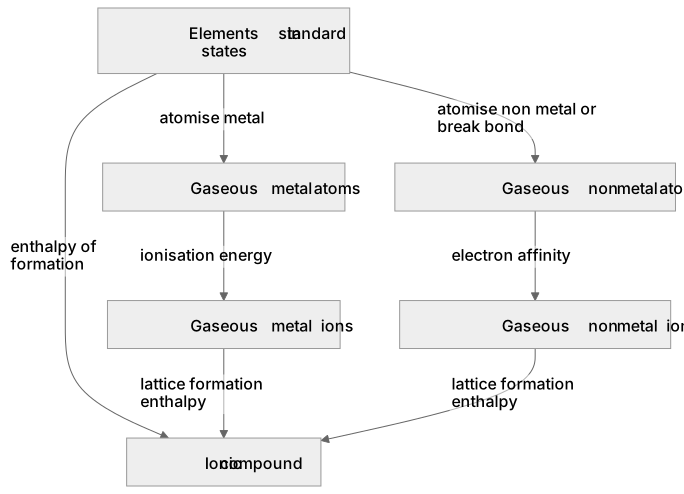
Lattice enthalpy cannot be measured directly, so a Born–Haber cycle reaches it indirectly from values that can be measured. The route runs from the elements in their standard states down to the compound by two paths. One path is the enthalpy of formation. The other builds gaseous ions step by step: atomise the metal, atomise the non metal or break its bond, remove electrons from the metal atoms as successive ionisation energies, add electrons to the non metal atoms as electron affinities, then bring the gaseous ions together by the lattice formation enthalpy. Because both paths start and finish at the same places, ∆fH equals the sum of the steps, and any one unknown can be found by rearrangement.
What earns the marks
- Each enthalpy term placed on the correct level of the cycle with the correct direction of arrow.
- Using two ionisation energies for a 2⁺ ion, or two electron affinities where a 2⁻ ion is formed.
- Doubling the atomisation or the electron affinity where two moles of the non metal atoms are needed.
- The correct arithmetic with signs, giving the lattice enthalpy with units kJ mol⁻¹.
Common mistakes and how to put them right
Using the bond enthalpy of Cl₂ where the cycle needs the atomisation enthalpy, which is half that value per mole of atoms.
Forgetting to double the electron affinity when two halide ions are formed.
Using only the first ionisation energy for a Group 2 metal.
Treating the second electron affinity of oxygen as negative, when it is positive.
Adding all the values without regard to the direction of the arrows.
Exam tips
- Write the state symbols and charges on every level of the cycle; most sign errors are really level errors.
- Check the number of moles at each step against the formula of the compound before you substitute.
- Set the arithmetic out as one line of substitution so process marks survive an error in a single term.
Try the lesson
The start of the Born–Haber cycles (A-level only): Born–Haber cycles are used to calculate lattice enthalpies using the following data: enthalpy of formation ionisation energy enthalpy of atomisation bond enthalpy electron affinity. lesson, made from checked teaching notes for this specification point.
Have a go first
Which quantity in a Born–Haber cycle represents the energy needed to remove one electron from each atom in one mole of gaseous atoms?
Listen
Lattice enthalpy cannot be measured directly, so a Born–Haber cycle reaches it indirectly from values that can be measured. The route runs from the elements in their standard states down to the compound by two paths. One path is the enthalpy of formation. The other builds gaseous ions step by step: atomise the metal, atomise the non metal or break its bond, remove electrons from the metal atoms as successive ionisation energies, add electrons to the non metal atoms as electron affinities, then bring the gaseous ions together by the lattice formation enthalpy. Because both paths start and finish at the same places, ∆fH equals the sum of the steps, and any one unknown can be found by rearrangement. A strong answer earns marks for these points. each enthalpy term placed on the correct level of the cycle with the correct direction of arrow. using two ionisation energies for a 2⁺ ion, or two electron affinities where a 2⁻ ion is formed. doubling the atomisation or the electron affinity where two moles of the non metal atoms are needed. the correct arithmetic with signs, giving the lattice enthalpy with units kJ mol⁻¹. Exam tip: Write the state symbols and charges on every level of the cycle; most sign errors are really level errors.
See it
Key words
Say what each word means before you turn the card.
Born–Haber cycle
Try answering aloud or in your head before turning the card.
enthalpy of formation
Try answering aloud or in your head before turning the card.
ionisation energy
Try answering aloud or in your head before turning the card.
electron affinity
Try answering aloud or in your head before turning the card.
See every definition
- Born–Haber cycle
- A cycle used to calculate lattice enthalpies indirectly from values that can be measured, running from the elements in their standard states to the compound by two paths.
- enthalpy of formation
- One path of the cycle, from the elements in their standard states down to the compound.
- ionisation energy
- The removal of electrons from the metal atoms as successive steps in building gaseous ions.
- electron affinity
- The addition of electrons to the non metal atoms as a step in building gaseous ions.
Label the diagram
Some boxes have lost their names. Pick the right name for each number.
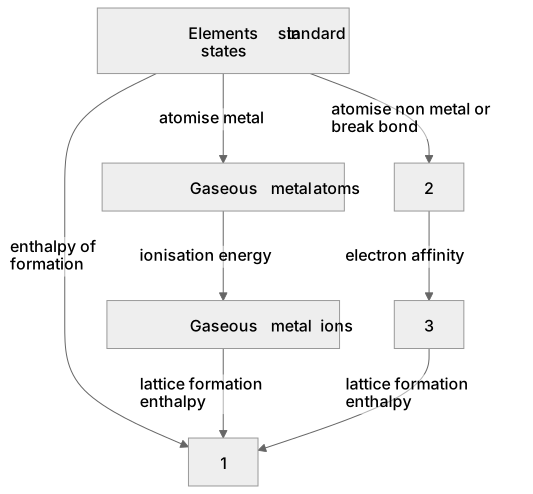
1Box 1
2Box 2
3Box 3
There is more to this lesson
The full lesson goes on to check your understanding and help you earn the marks. Create a free account to carry on, with your progress saved.
A week of Premium from your first lesson · Then the free plan continues · No card, no charge
Test your understanding of Born–Haber cycles (A-level only): Born–Haber cycles are used to calculate lattice enthalpies using the following data: enthalpy of formation ionisation energy enthalpy of atomisation bond enthalpy electron affinity.
Active recall beats re-reading. Take an instant quiz now to test what you’ve learned and lock it into long-term memory.
A week of Premium from your first lesson · Then the free plan continues · No card, no charge