AQA · A-Level · Chemistry
Course version: 7405 · Version from Sept 2016
Lattice enthalpy can be defined as either enthalpy of lattice dissociation…
Full specification wording
Born–Haber cycles (A-level only): Lattice enthalpy can be defined as either enthalpy of lattice dissociation or enthalpy of lattice formation.
Lattice enthalpy can be quoted in either direction, and the sign follows from the direction chosen.
Checked against the AQA 7405 specification (opens in a new tab) on .
- Point 1 of 4
- 2 key terms
Study notes
From the checked teaching notes for this specification point.
The idea
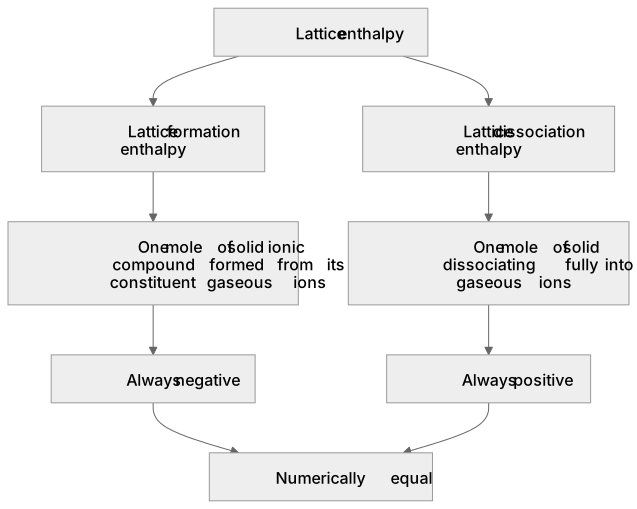
Lattice enthalpy can be quoted in either direction, and the sign follows from the direction chosen. Lattice formation enthalpy is the enthalpy change when one mole of a solid ionic compound is formed from its constituent gaseous ions, for example Ca²⁺(g) + 2Cl⁻(g) → CaCl₂(s), ∆H = −2237 kJ mol⁻¹; it is always negative, because strong electrostatic attractions are being made. Lattice dissociation enthalpy is the exact reverse, one mole of the solid dissociating fully into gaseous ions, and is always positive and numerically equal. The one mole refers to the compound, not to the ions, so a definition that says one mole of gaseous ions is refused. Gaseous state symbols on the ions are essential.
What earns the marks
- One mole of a solid ionic compound, formed from or dissociating into its constituent ions.
- Specifying that the ions are gaseous.
- The sign that matches the direction defined, negative for formation and positive for dissociation.
- A supporting equation with state symbols, such as Na⁺(g) + Cl⁻(g) → NaCl(s).
Common mistakes and how to put them right
Defining it as one mole of gaseous ions rather than one mole of the compound.
Omitting the gaseous state of the ions, which leaves the definition ambiguous.
Quoting a lattice formation enthalpy as positive.
Writing the ions as aqueous, which describes hydration instead.
Using the same sign for both the formation and the dissociation value.
Exam tips
- Read the question for which direction is wanted; formation and dissociation differ only in sign.
- Write the equation with state symbols beneath your definition; it often carries a mark and settles the direction.
- For a compound such as CaCl₂, put two chloride ions in the equation so it makes exactly one mole of compound.
Try the lesson
The start of the Born–Haber cycles (A-level only): Lattice enthalpy can be defined as either enthalpy of lattice dissociation or enthalpy of lattice formation. lesson, made from checked teaching notes for this specification point.
Have a go first
Which statement correctly describes the enthalpy of lattice formation of an ionic compound?
Listen
Lattice enthalpy can be quoted in either direction, and the sign follows from the direction chosen. Lattice formation enthalpy is the enthalpy change when one mole of a solid ionic compound is formed from its constituent gaseous ions, for example Ca²⁺(g) + 2Cl⁻(g) → CaCl₂(s), ∆H = −2237 kJ mol⁻¹; it is always negative, because strong electrostatic attractions are being made. Lattice dissociation enthalpy is the exact reverse, one mole of the solid dissociating fully into gaseous ions, and is always positive and numerically equal. The one mole refers to the compound, not to the ions, so a definition that says one mole of gaseous ions is refused. Gaseous state symbols on the ions are essential. A strong answer earns marks for these points. one mole of a solid ionic compound, formed from or dissociating into its constituent ions. specifying that the ions are gaseous. the sign that matches the direction defined, negative for formation and positive for dissociation. a supporting equation with state symbols, such as Na⁺(g) + Cl⁻(g) → NaCl(s). Exam tip: Read the question for which direction is wanted; formation and dissociation differ only in sign.
See it
Key words
Say what each word means before you turn the card.
lattice formation enthalpy
Try answering aloud or in your head before turning the card.
lattice dissociation enthalpy
Try answering aloud or in your head before turning the card.
See every definition
- lattice formation enthalpy
- The enthalpy change when one mole of a solid ionic compound is formed from its constituent gaseous ions; it is always negative, because strong electrostatic attractions are being made.
- lattice dissociation enthalpy
- The exact reverse of lattice formation enthalpy, where one mole of the solid dissociates fully into gaseous ions; it is always positive and numerically equal.
Label the diagram
Some boxes have lost their names. Pick the right name for each number.
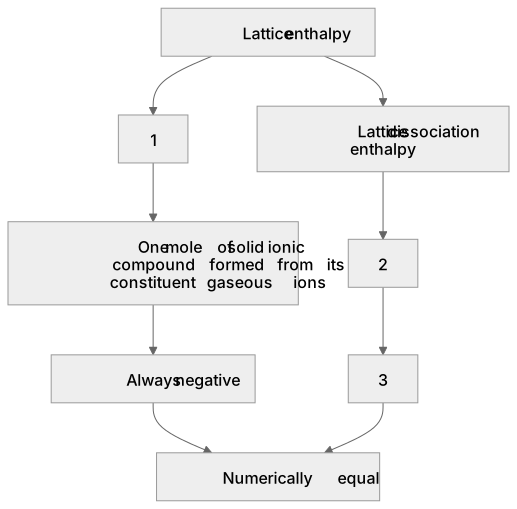
1Box 1
2Box 2
3Box 3
There is more to this lesson
The full lesson goes on to check your understanding and help you earn the marks. Create a free account to carry on, with your progress saved.
A week of Premium from your first lesson · Then the free plan continues · No card, no charge
Test your understanding of Born–Haber cycles (A-level only): Lattice enthalpy can be defined as either enthalpy of lattice dissociation or enthalpy of lattice formation.
Active recall beats re-reading. Take an instant quiz now to test what you’ve learned and lock it into long-term memory.
A week of Premium from your first lesson · Then the free plan continues · No card, no charge