AQA · A-Level · Chemistry
Course version: 7405 · Version from Sept 2016
Acid–base equilibria involve the transfer of protons.
Full specification wording
Brønsted–Lowry acid–base equilibria in aqueous solution (A-level only): Acid–base equilibria involve the transfer of protons.
Every acid and base reaction is a proton changing owner, so every one contains two conjugate pairs whose members differ by exactly one H⁺.
Checked against the AQA 7405 specification (opens in a new tab) on .
- Point 3 of 3
- 4 key terms
Study notes
From the checked teaching notes for this specification point.
The idea
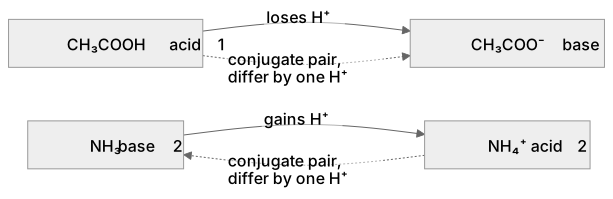
Every acid and base reaction is a proton changing owner, so every one contains two conjugate pairs whose members differ by exactly one H⁺. In CH₃COOH + NH₃ ⇌ CH₃COO⁻ + NH₄⁺ the pairs are CH₃COOH with CH₃COO⁻ and NH₄⁺ with NH₃. Each acid is paired with the base that came from it by losing the proton, not with the base it reacted with. Because these are equilibria, the reaction need not go to completion, and the position tells you about relative strengths: the equilibrium always lies away from the stronger acid and towards the weaker one. That is why the conjugate base of a strong acid, such as Cl⁻, is an extremely poor base; it has almost no tendency to take the proton back.
What earns the marks
- Identifying both conjugate acid and base pairs in a given equation.
- Showing the proton being transferred from the acid to the base.
- Stating that the members of a pair differ by one H⁺.
- Deducing which side the equilibrium lies on from the relative strengths of the two acids.
Common mistakes and how to put them right
Pairing an acid with the base on the opposite side of the equation rather than with its own conjugate.
Saying the members of a conjugate pair differ by a hydrogen atom instead of a proton.
Using a single arrow, so the reaction is treated as going to completion.
Treating water as a spectator when it is in fact one member of a conjugate pair.
Exam tips
- Label the pairs as acid 1 / base 1 and acid 2 / base 2 across the equation; the numbering makes the pairing obvious.
- The stronger acid is always on the side the equilibrium lies away from.
Try the lesson
The start of the Brønsted–Lowry acid–base equilibria in aqueous solution (A-level only): Acid–base equilibria involve the transfer of protons. lesson, made from checked teaching notes for this specification point.
Have a go first
In the Brønsted–Lowry model, which particle is transferred when an acid reacts with a base?
Listen
Every acid and base reaction is a proton changing owner, so every one contains two conjugate pairs whose members differ by exactly one H⁺. In CH₃COOH + NH₃ ⇌ CH₃COO⁻ + NH₄⁺ the pairs are CH₃COOH with CH₃COO⁻ and NH₄⁺ with NH₃. Each acid is paired with the base that came from it by losing the proton, not with the base it reacted with. Because these are equilibria, the reaction need not go to completion, and the position tells you about relative strengths: the equilibrium always lies away from the stronger acid and towards the weaker one. That is why the conjugate base of a strong acid, such as Cl⁻, is an extremely poor base; it has almost no tendency to take the proton back. A strong answer earns marks for these points. identifying both conjugate acid and base pairs in a given equation. showing the proton being transferred from the acid to the base. stating that the members of a pair differ by one H⁺. deducing which side the equilibrium lies on from the relative strengths of the two acids. Exam tip: Label the pairs as acid 1 / base 1 and acid 2 / base 2 across the equation; the numbering makes the pairing obvious.
See it
Key words
Say what each word means before you turn the card.
proton transfer
Try answering aloud or in your head before turning the card.
conjugate pairs
Try answering aloud or in your head before turning the card.
position of equilibrium
Try answering aloud or in your head before turning the card.
relative acid strength
Try answering aloud or in your head before turning the card.
See every definition
- proton transfer
- Acid–base equilibria involve the transfer of protons from the acid to the base.
- conjugate pairs
- Each acid is paired with the base that came from it by losing the proton, and the members of a pair differ by one H⁺.
- position of equilibrium
- Because these are equilibria, the reaction need not go to completion, and the position tells you about relative strengths.
- relative acid strength
- The equilibrium always lies away from the stronger acid and towards the weaker one.
Label the diagram
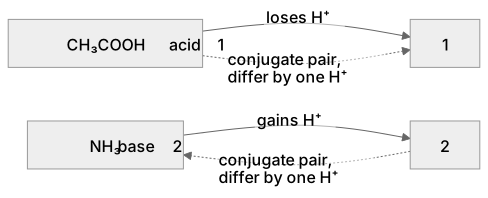
Some boxes have lost their names. Pick the right name for each number.
1Box 1
2Box 2
There is more to this lesson
The full lesson goes on to check your understanding and help you earn the marks. Create a free account to carry on, with your progress saved.
A week of Premium from your first lesson · Then the free plan continues · No card, no charge
Test your understanding of Brønsted–Lowry acid–base equilibria in aqueous solution (A-level only): Acid–base equilibria involve the transfer of protons.
Active recall beats re-reading. Take an instant quiz now to test what you’ve learned and lock it into long-term memory.
A week of Premium from your first lesson · Then the free plan continues · No card, no charge