AQA · A-Level · Chemistry
Course version: 7405 · Version from Sept 2016
A base is a proton acceptor.
Full specification wording
Brønsted–Lowry acid–base equilibria in aqueous solution (A-level only): A base is a proton acceptor.
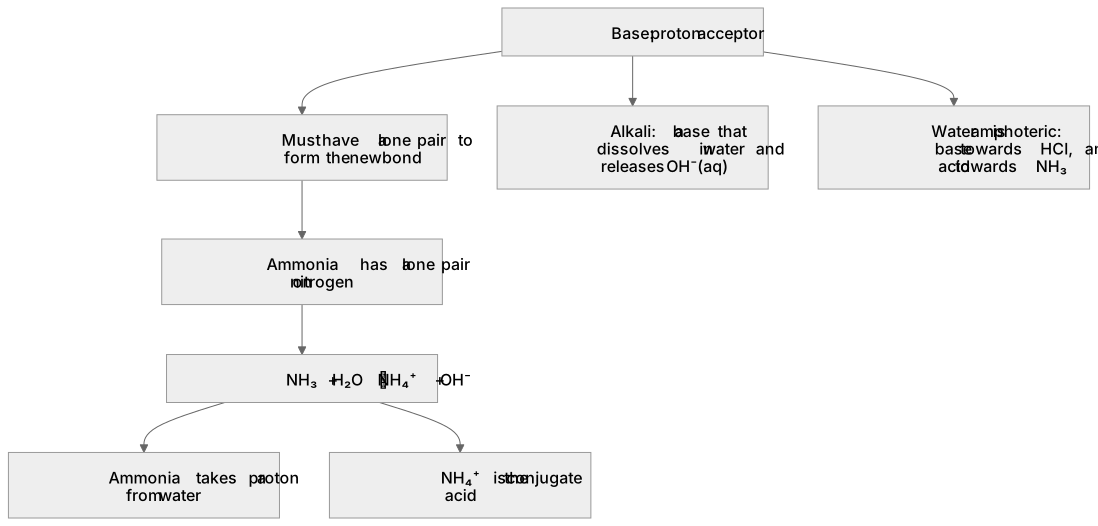
A base is a proton acceptor, and to accept a proton it must have a lone pair of electrons available to form the new bond.
Checked against the AQA 7405 specification (opens in a new tab) on .
- Point 2 of 3
- 3 key terms
Study notes
From the checked teaching notes for this specification point.
The idea
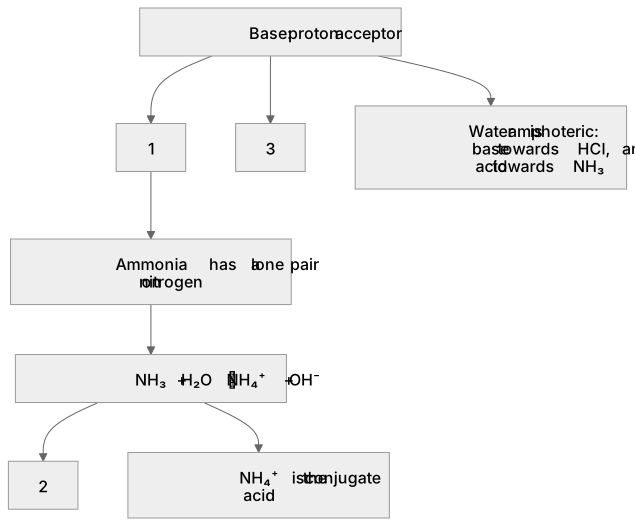
A base is a proton acceptor, and to accept a proton it must have a lone pair of electrons available to form the new bond. Ammonia has a lone pair on nitrogen, so NH₃ + H₂O ⇌ NH₄⁺ + OH⁻: the ammonia takes a proton from water, and NH₄⁺ is its conjugate acid. This definition is wider than 'a substance that produces hydroxide ions', which would exclude ammonia and the carbonate ion altogether. An alkali is the narrower idea: a base that dissolves in water and so releases OH⁻(aq). Water itself is amphoteric, acting as a base towards HCl and as an acid towards NH₃, which is why it turns up on both sides of this topic and why its own slight dissociation matters later.
What earns the marks
- Defining a base as a proton acceptor or H⁺ acceptor.
- Identifying the lone pair that accepts the proton.
- Naming the conjugate acid formed when the base gains the proton.
- Distinguishing an alkali as a base that dissolves to give OH⁻(aq).
Common mistakes and how to put them right
Defining a base as a substance that produces hydroxide ions, which excludes ammonia.
Using base and alkali as interchangeable words.
Giving the conjugate acid of NH₃ as NH₂⁻, which is its conjugate base.
Forgetting that water can act as a base towards HCl and as an acid towards NH₃.
Exam tips
- If asked why a species can act as a base, point to the lone pair, not to a negative charge alone.
- To write a conjugate acid, add one H⁺ and increase the charge by one.
Try the lesson
The start of the Brønsted–Lowry acid–base equilibria in aqueous solution (A-level only): A base is a proton acceptor. lesson, made from checked teaching notes for this specification point.
Have a go first
According to the Brønsted–Lowry definition, what does a base accept?
Listen
A base is a proton acceptor, and to accept a proton it must have a lone pair of electrons available to form the new bond. Ammonia has a lone pair on nitrogen, so NH₃ + H₂O ⇌ NH₄⁺ + OH⁻: the ammonia takes a proton from water, and NH₄⁺ is its conjugate acid. This definition is wider than 'a substance that produces hydroxide ions', which would exclude ammonia and the carbonate ion altogether. An alkali is the narrower idea: a base that dissolves in water and so releases OH⁻(aq). Water itself is amphoteric, acting as a base towards HCl and as an acid towards NH₃, which is why it turns up on both sides of this topic and why its own slight dissociation matters later. A strong answer earns marks for these points. defining a base as a proton acceptor or H⁺ acceptor. identifying the lone pair that accepts the proton. naming the conjugate acid formed when the base gains the proton. distinguishing an alkali as a base that dissolves to give OH⁻(aq). Exam tip: If asked why a species can act as a base, point to the lone pair, not to a negative charge alone.
See it
Key words
Say what each word means before you turn the card.
Brønsted–Lowry base
Try answering aloud or in your head before turning the card.
conjugate acid
Try answering aloud or in your head before turning the card.
amphoteric water
Try answering aloud or in your head before turning the card.
See every definition
- Brønsted–Lowry base
- A proton acceptor, which must have a lone pair of electrons available to form the new bond.
- conjugate acid
- The species formed when a base gains a proton, such as NH₄⁺ formed when ammonia takes a proton from water.
- amphoteric water
- Water can act as a base towards HCl and as an acid towards NH₃, so it turns up on both sides of this topic.
Label the diagram
Some boxes have lost their names. Pick the right name for each number.
1Box 1
2Box 2
3Box 3
There is more to this lesson
The full lesson goes on to check your understanding and help you earn the marks. Create a free account to carry on, with your progress saved.
A week of Premium from your first lesson · Then the free plan continues · No card, no charge
Test your understanding of Brønsted–Lowry acid–base equilibria in aqueous solution (A-level only): A base is a proton acceptor.
Active recall beats re-reading. Take an instant quiz now to test what you’ve learned and lock it into long-term memory.
A week of Premium from your first lesson · Then the free plan continues · No card, no charge