AQA · A-Level · Chemistry
Course version: 7405 · Version from Sept 2016
An acid is a proton donor.
Full specification wording
Brønsted–Lowry acid–base equilibria in aqueous solution (A-level only): An acid is a proton donor.
Brønsted and Lowry defined an acid as a proton donor.
Checked against the AQA 7405 specification (opens in a new tab) on .
- Point 1 of 3
- 3 key terms
Study notes
From the checked teaching notes for this specification point.
The idea
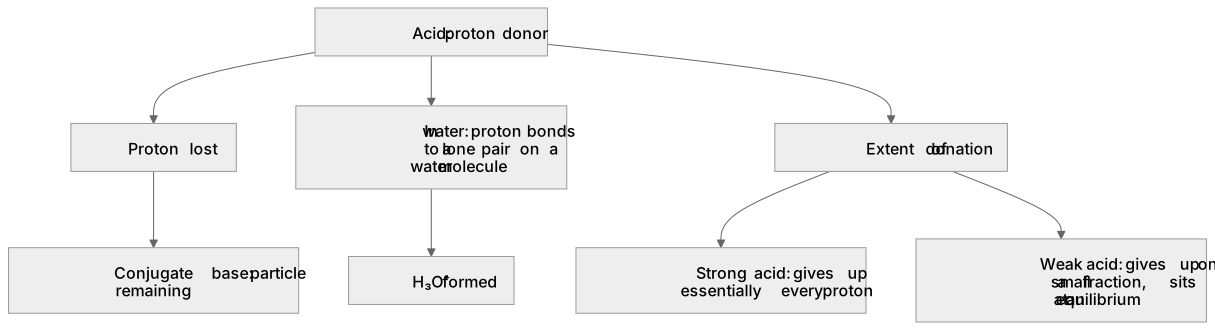
Brønsted and Lowry defined an acid as a proton donor. A proton here means H⁺, a hydrogen atom that has lost its only electron, so a bare nucleus. In water that proton is never free: it bonds to a lone pair on a water molecule, which is why HCl + H₂O → H₃O⁺ + Cl⁻ is the honest equation and [H⁺] is a shorthand for [H₃O⁺]. What remains after the proton has gone is the conjugate base, Cl⁻ here. The definition says nothing about how much of the acid donates. A strong acid such as HNO₃ gives up essentially every proton; a weak acid such as CH₃COOH gives up only a small fraction and sits at an equilibrium. Strength is about that fraction; concentration is about how many moles are in a cubic decimetre.
What earns the marks
- Defining an acid as a proton donor or H⁺ donor.
- Identifying the species that loses the proton in a given equation.
- Naming the conjugate base as the particle remaining after the proton has been donated.
- Writing H₃O⁺ rather than H⁺ when the acid reacts with water.
Common mistakes and how to put them right
Defining an acid as a substance that produces hydrogen ions in solution, which is the Arrhenius idea rather than Brønsted–Lowry.
Calling an acid a 'hydrogen donor', which is refused because a hydrogen atom carries an electron.
Confusing strength with concentration, so concentrated ethanoic acid is described as a strong acid.
Giving the conjugate base of H₂SO₄ as SO₄²⁻ rather than HSO₄⁻.
Exam tips
- Write the word 'proton' in the definition; 'hydrogen ion' is usually accepted but 'hydrogen' alone is not.
- To find a conjugate base, remove exactly one H⁺ from the acid and reduce the charge by one.
Try the lesson
The start of the Brønsted–Lowry acid–base equilibria in aqueous solution (A-level only): An acid is a proton donor. lesson, made from checked teaching notes for this specification point.
Have a go first
In the Brønsted–Lowry model, which particle is transferred when an acid acts as a proton donor?
Listen
Brønsted and Lowry defined an acid as a proton donor. A proton here means H⁺, a hydrogen atom that has lost its only electron, so a bare nucleus. In water that proton is never free: it bonds to a lone pair on a water molecule, which is why HCl + H₂O → H₃O⁺ + Cl⁻ is the honest equation and [H⁺] is a shorthand for [H₃O⁺]. What remains after the proton has gone is the conjugate base, Cl⁻ here. The definition says nothing about how much of the acid donates. A strong acid such as HNO₃ gives up essentially every proton; a weak acid such as CH₃COOH gives up only a small fraction and sits at an equilibrium. Strength is about that fraction; concentration is about how many moles are in a cubic decimetre. A strong answer earns marks for these points. defining an acid as a proton donor or H⁺ donor. identifying the species that loses the proton in a given equation. naming the conjugate base as the particle remaining after the proton has been donated. writing H₃O⁺ rather than H⁺ when the acid reacts with water. Exam tip: Write the word 'proton' in the definition; 'hydrogen ion' is usually accepted but 'hydrogen' alone is not.
See it
Key words
Say what each word means before you turn the card.
Brønsted–Lowry acid
Try answering aloud or in your head before turning the card.
conjugate base
Try answering aloud or in your head before turning the card.
strength versus concentration
Try answering aloud or in your head before turning the card.
See every definition
- Brønsted–Lowry acid
- A proton donor, where a proton means H⁺, a hydrogen atom that has lost its only electron.
- conjugate base
- The particle remaining after the proton has been donated.
- strength versus concentration
- Strength is about the fraction of protons given up, while concentration is about how many moles are in a cubic decimetre.
Label the diagram
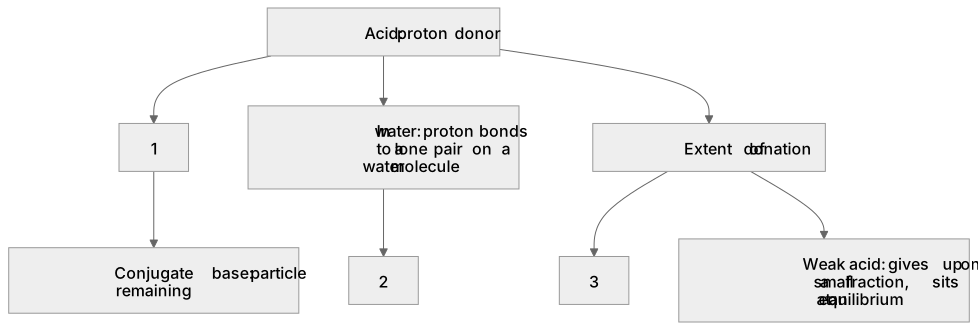
Some boxes have lost their names. Pick the right name for each number.
1Box 1
2Box 2
3Box 3
There is more to this lesson
The full lesson goes on to check your understanding and help you earn the marks. Create a free account to carry on, with your progress saved.
A week of Premium from your first lesson · Then the free plan continues · No card, no charge
Test your understanding of Brønsted–Lowry acid–base equilibria in aqueous solution (A-level only): An acid is a proton donor.
Active recall beats re-reading. Take an instant quiz now to test what you’ve learned and lock it into long-term memory.
A week of Premium from your first lesson · Then the free plan continues · No card, no charge