AQA · A-Level · Chemistry
Course version: 7405 · Version from Sept 2016
Students should be able to: use this equation to calculate the molar…
Full specification wording
Calorimetry: Students should be able to: use this equation to calculate the molar enthalpy change for a reaction use this equation in related calculations.
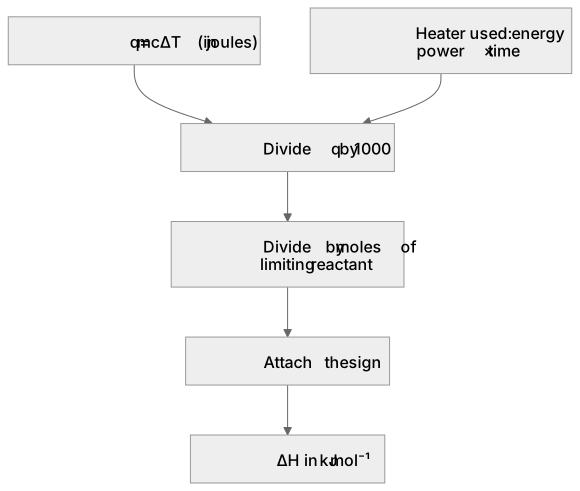
A molar enthalpy change needs two numbers: the heat, from q = mc∆T, and the amount in moles of the substance the question asks you to quote it for.
Checked against the AQA 7405 specification (opens in a new tab) on .
- Point 2 of 3
Study notes
From the checked teaching notes for this specification point.
The idea
A molar enthalpy change needs two numbers: the heat, from q = mc∆T, and the amount in moles of the substance the question asks you to quote it for. Work out q in joules, divide by 1000, then divide by the moles of the limiting reactant, and attach the sign. So dissolving 4.00 g of ammonium nitrate, 0.0500 mol, in 50.0 cm³ of water and recording a fall of 6.2 K gives q = 50.0 × 4.18 × 6.2 = 1296 J, so ∆H = +1.296 ÷ 0.0500 = +25.9 kJ mol⁻¹, positive because the solution cooled. The same equation runs backwards: given ∆H and a temperature change you can find the mass or the concentration, and given the power of a heater, energy is power × time instead of mc∆T.
What earns the marks
- The amount in moles of the substance the enthalpy change is to be quoted per mole of.
- q calculated correctly from q = mc∆T, or from power × time when a heater is used.
- Dividing the energy in kilojoules by the moles to reach kJ mol⁻¹.
- The final value with the correct sign and units, allowing error carried forward from an earlier slip.
Common mistakes and how to put them right
Dividing by the moles of the excess reagent instead of the limiting one.
Dividing joules by moles and then quoting the answer as kJ mol⁻¹ without the factor of 1000.
Losing the sign at the last step, so an exothermic result is written as positive.
Rounding the moles to one significant figure early, which moves the final answer outside the accepted range.
Using the mass of water only when the question tells you the total mass of the mixture changed temperature.
Exam tips
- Set the calculation out in three labelled lines, q, n, then ∆H = −q/n, so process marks survive an arithmetic slip.
- Quote the answer to the same number of significant figures as the least precise data, usually three.
- When a heater is specified in kW, energy in kJ is power in kW multiplied by time in seconds.
Try the lesson
The start of the Calorimetry: Students should be able to: use this equation to calculate the molar enthalpy change for a reaction use this equation in related calculations. lesson, made from checked teaching notes for this specification point.
Have a go first
Which expression gives the molar enthalpy change for a reaction when the heat change q and the number of moles n are known?
Listen
A molar enthalpy change needs two numbers: the heat, from q = mc∆T, and the amount in moles of the substance the question asks you to quote it for. Work out q in joules, divide by 1000, then divide by the moles of the limiting reactant, and attach the sign. So dissolving 4.00 g of ammonium nitrate, 0.0500 mol, in 50.0 cm³ of water and recording a fall of 6.2 K gives q = 50.0 × 4.18 × 6.2 = 1296 J, so ∆H = +1.296 ÷ 0.0500 = +25.9 kJ mol⁻¹, positive because the solution cooled. The same equation runs backwards: given ∆H and a temperature change you can find the mass or the concentration, and given the power of a heater, energy is power × time instead of mc∆T. A strong answer earns marks for these points. the amount in moles of the substance the enthalpy change is to be quoted per mole of. q calculated correctly from q = mc∆T, or from power × time when a heater is used. dividing the energy in kilojoules by the moles to reach kJ mol⁻¹. the final value with the correct sign and units, allowing error carried forward from an earlier slip. Exam tip: Set the calculation out in three labelled lines, q, n, then ∆H = −q/n, so process marks survive an arithmetic slip.
See it
Label the diagram
Some boxes have lost their names. Pick the right name for each number.
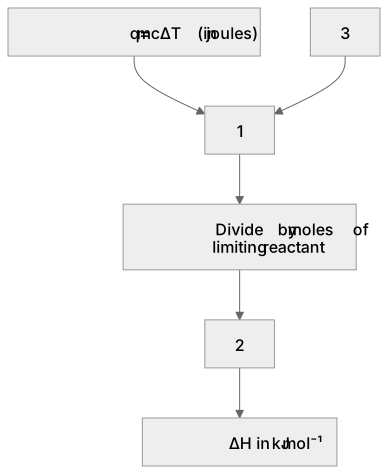
1Box 1
2Box 2
3Box 3
There is more to this lesson
The full lesson goes on to check your understanding and help you earn the marks. Create a free account to carry on, with your progress saved.
A week of Premium from your first lesson · Then the free plan continues · No card, no charge
Test your understanding of Calorimetry: Students should be able to: use this equation to calculate the molar enthalpy change for a reaction use this equation in related calculations.
Active recall beats re-reading. Take an instant quiz now to test what you’ve learned and lock it into long-term memory.
A week of Premium from your first lesson · Then the free plan continues · No card, no charge