AQA · A-Level · Chemistry
Course version: 7405 · Version from Sept 2016
Heterogeneous catalysts can become poisoned by impurities that block the…
Full specification wording
Catalysts (A-level only): Heterogeneous catalysts can become poisoned by impurities that block the active sites and consequently have reduced efficiency; this has a cost implication.
Poisoning is adsorption that does not reverse.
Checked against the AQA 7405 specification (opens in a new tab) on .
- Point 5 of 7
- 4 key terms
Study notes
From the checked teaching notes for this specification point.
The idea
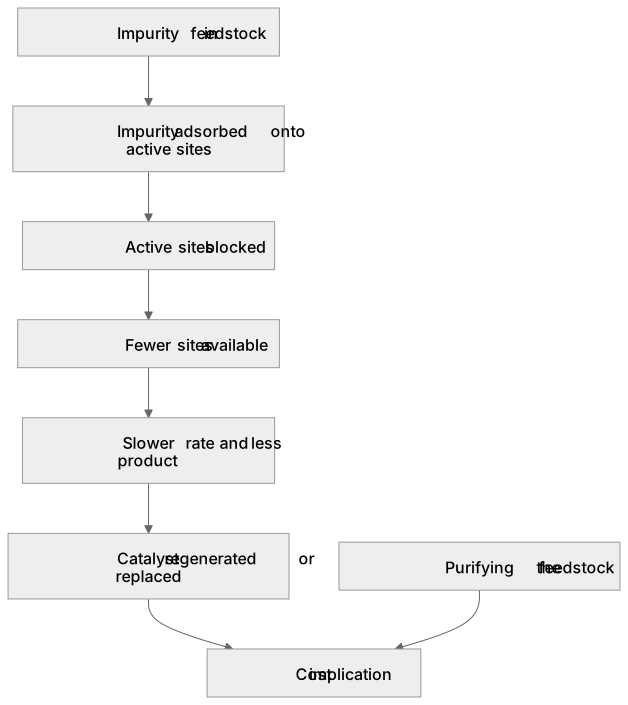
Poisoning is adsorption that does not reverse. An impurity binds to the active sites so strongly that it never desorbs, so those sites are permanently out of use. With fewer sites available the rate falls, less product is made per unit time, and eventually the catalyst has to be regenerated or replaced. Sulfur compounds poison the iron in the Haber process, which is why the nitrogen and hydrogen feed is purified first, and lead poisons the platinum and rhodium in a catalytic converter, which is why cars fitted with converters must run on unleaded petrol. The cost runs in both directions: purifying the feedstock costs money, and so does buying replacement catalyst and shutting the plant down while it is changed.
What earns the marks
- Stating that the impurity is adsorbed onto and blocks the active sites.
- The consequence, fewer sites available so a slower rate and less product.
- A named poison such as sulfur in the Haber process or lead in a catalytic converter.
- A cost consequence, such as purifying the feedstock or replacing the catalyst.
Common mistakes and how to put them right
Saying the poison reacts with and uses up the catalyst rather than blocking its surface.
Claiming poisoning raises the activation energy rather than reducing the number of usable sites.
Giving it stops working as the cost implication, without naming purification, replacement or downtime.
Suggesting the catalyst can simply be washed clean, when the adsorption is effectively irreversible.
Exam tips
- Use the phrase blocks the active sites, because that is the wording the mark scheme uses.
- Name a specific poison and the specific process it affects.
- Answer the cost part separately, since it usually carries its own mark.
Try the lesson
The start of the Catalysts (A-level only): Heterogeneous catalysts can become poisoned by impurities that block the active sites and consequently have reduced efficiency; this has a cost implication. lesson, made from checked teaching notes for this specification point.
Have a go first
A solid catalyst in an industrial reactor becomes poisoned by an impurity in the feedstock. What is the direct effect of this poisoning on the catalyst?
Listen
Poisoning is adsorption that does not reverse. An impurity binds to the active sites so strongly that it never desorbs, so those sites are permanently out of use. With fewer sites available the rate falls, less product is made per unit time, and eventually the catalyst has to be regenerated or replaced. Sulfur compounds poison the iron in the Haber process, which is why the nitrogen and hydrogen feed is purified first, and lead poisons the platinum and rhodium in a catalytic converter, which is why cars fitted with converters must run on unleaded petrol. The cost runs in both directions: purifying the feedstock costs money, and so does buying replacement catalyst and shutting the plant down while it is changed. A strong answer earns marks for these points. stating that the impurity is adsorbed onto and blocks the active sites. the consequence, fewer sites available so a slower rate and less product. a named poison such as sulfur in the Haber process or lead in a catalytic converter. a cost consequence, such as purifying the feedstock or replacing the catalyst. Exam tip: Use the phrase blocks the active sites, because that is the wording the mark scheme uses.
See it
Key words
Say what each word means before you turn the card.
catalyst poisoning
Try answering aloud or in your head before turning the card.
blocked active sites
Try answering aloud or in your head before turning the card.
irreversible adsorption
Try answering aloud or in your head before turning the card.
economic consequences
Try answering aloud or in your head before turning the card.
See every definition
- catalyst poisoning
- Impurities block the active sites so the catalyst has reduced efficiency, which has a cost implication.
- blocked active sites
- An impurity binds to the active sites so strongly that it never desorbs, so those sites are permanently out of use.
- irreversible adsorption
- Adsorption that does not reverse, so the impurity never desorbs and the sites are permanently out of use.
- economic consequences
- The cost runs in both directions: purifying the feedstock costs money, and so does buying replacement catalyst and shutting the plant down while it is changed.
Label the diagram
Some boxes have lost their names. Pick the right name for each number.
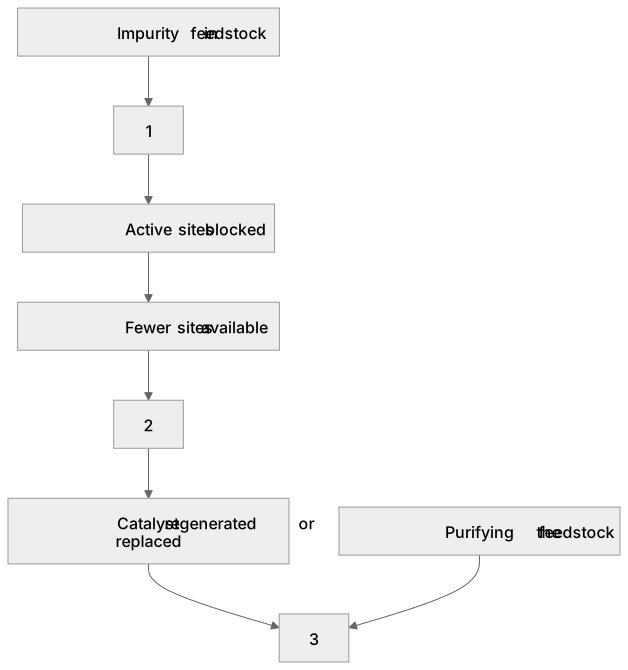
1Box 1
2Box 2
3Box 3
There is more to this lesson
The full lesson goes on to check your understanding and help you earn the marks. Create a free account to carry on, with your progress saved.
A week of Premium from your first lesson · Then the free plan continues · No card, no charge
Test your understanding of Catalysts (A-level only): Heterogeneous catalysts can become poisoned by impurities that block the active sites and consequently have reduced efficiency; this has a cost implication.
Active recall beats re-reading. Take an instant quiz now to test what you’ve learned and lock it into long-term memory.
A week of Premium from your first lesson · Then the free plan continues · No card, no charge