AQA · A-Level · Chemistry
Course version: 7405 · Version from Sept 2016
A homogeneous catalyst is in the same phase as the reactants.
Full specification wording
Catalysts (A-level only): A homogeneous catalyst is in the same phase as the reactants.
Homogeneous means one phase: catalyst and reactants mixed together, in practice almost always all in aqueous solution.
Checked against the AQA 7405 specification (opens in a new tab) on .
- Point 6 of 7
Study notes
From the checked teaching notes for this specification point.
The idea
Homogeneous means one phase: catalyst and reactants mixed together, in practice almost always all in aqueous solution. There is no surface and there are no active sites, so the mechanism is entirely different from heterogeneous catalysis. Instead the catalyst reacts with one of the reactants to form an intermediate species, which then reacts on to give the product and regenerate the catalyst. Two standard examples both involve transition metal ions in solution. Fe²⁺ catalyses the otherwise very slow reaction between peroxodisulfate, S₂O₈²⁻, and iodide, I⁻. Mn²⁺ catalyses the reaction between MnO₄⁻ and C₂O₄²⁻, and since Mn²⁺ is itself a product of that reaction it is an autocatalyst.
What earns the marks
- Stating that the catalyst is in the same phase as the reactants.
- Identifying the phase concerned, usually all species in aqueous solution.
- A named homogeneous example such as Fe²⁺ with S₂O₈²⁻ and I⁻.
- Defining an autocatalyst as a product of the reaction that catalyses that same reaction.
Common mistakes and how to put them right
Describing active sites or adsorption in a homogeneous mechanism, where no surface exists.
Defining an autocatalyst as a reactant that catalyses the reaction, which the mark scheme specifically rejects.
Calling a reaction homogeneous just because it takes place in a single vessel.
Saying the catalyst dissolves and is therefore used up.
Exam tips
- State the phase of every species when you classify, not just that of the catalyst.
- Use the word product in any definition of an autocatalyst.
- Keep adsorption language out of homogeneous answers entirely.
Try the lesson
The start of the Catalysts (A-level only): A homogeneous catalyst is in the same phase as the reactants. lesson, made from checked teaching notes for this specification point.
Have a go first
In a reaction between two aqueous solutions, a soluble catalyst is added. Which term describes this catalyst?
Listen
Homogeneous means one phase: catalyst and reactants mixed together, in practice almost always all in aqueous solution. There is no surface and there are no active sites, so the mechanism is entirely different from heterogeneous catalysis. Instead the catalyst reacts with one of the reactants to form an intermediate species, which then reacts on to give the product and regenerate the catalyst. Two standard examples both involve transition metal ions in solution. Fe²⁺ catalyses the otherwise very slow reaction between peroxodisulfate, S₂O₈²⁻, and iodide, I⁻. Mn²⁺ catalyses the reaction between MnO₄⁻ and C₂O₄²⁻, and since Mn²⁺ is itself a product of that reaction it is an autocatalyst. A strong answer earns marks for these points. stating that the catalyst is in the same phase as the reactants. identifying the phase concerned, usually all species in aqueous solution. a named homogeneous example such as Fe²⁺ with S₂O₈²⁻ and I⁻. defining an autocatalyst as a product of the reaction that catalyses that same reaction. Exam tip: State the phase of every species when you classify, not just that of the catalyst.
See it
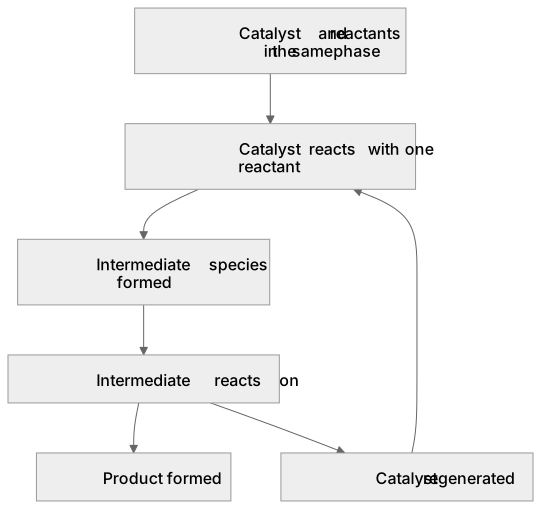
Label the diagram
Some boxes have lost their names. Pick the right name for each number.
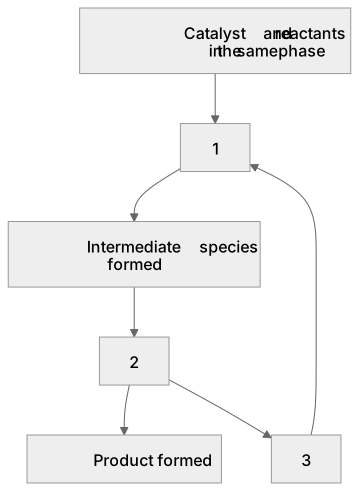
1Box 1
2Box 2
3Box 3
There is more to this lesson
The full lesson goes on to check your understanding and help you earn the marks. Create a free account to carry on, with your progress saved.
A week of Premium from your first lesson · Then the free plan continues · No card, no charge
Test your understanding of Catalysts (A-level only): A homogeneous catalyst is in the same phase as the reactants.
Active recall beats re-reading. Take an instant quiz now to test what you’ve learned and lock it into long-term memory.
A week of Premium from your first lesson · Then the free plan continues · No card, no charge