AQA · A-Level · Chemistry
Course version: 7405 · Version from Sept 2016
When catalysts and reactants are in the same phase, the reaction proceeds…
Full specification wording
Catalysts (A-level only): When catalysts and reactants are in the same phase, the reaction proceeds through an intermediate species.
In a homogeneous mechanism the catalyst is consumed in the first step and regenerated in the second, and the species it forms in between is the intermediate.
Checked against the AQA 7405 specification (opens in a new tab) on .
- Point 7 of 7
- 4 key terms
Study notes
From the checked teaching notes for this specification point.
The idea
In a homogeneous mechanism the catalyst is consumed in the first step and regenerated in the second, and the species it forms in between is the intermediate. The manganate(VII) and ethanedioate titration is the standard case. The uncatalysed reaction is slow because both reactants are negative ions, MnO₄⁻ and C₂O₄²⁻, which repel each other, so the activation energy is high. Once a little Mn²⁺ has formed it opens a new route: 4Mn²⁺ + MnO₄⁻ + 8H⁺ → 5Mn³⁺ + 4H₂O, then 2Mn³⁺ + C₂O₄²⁻ → 2Mn²⁺ + 2CO₂. Both steps now involve oppositely charged ions attracting, so both have lower activation energies, and the Mn²⁺ returns at the end. Since Mn²⁺ is a product, this is autocatalysis.
What earns the marks
- Defining an autocatalyst as a product of the reaction that catalyses that reaction.
- Explaining the slow start by repulsion between two negatively charged reactant ions and a high activation energy.
- Each correct step equation, 4Mn²⁺ + MnO₄⁻ + 8H⁺ → 5Mn³⁺ + 4H₂O and 2Mn³⁺ + C₂O₄²⁻ → 2Mn²⁺ + 2CO₂.
- Attraction between the negative reactant ion and the positive catalyst ion as the reason the new route is faster.
Common mistakes and how to put them right
Calling Mn²⁺ a reactant rather than a product when defining the autocatalyst, which the mark scheme rejects.
Offering the catalyst lowers the activation energy as the explanation for the faster intermediate route, when the mark is for attraction between oppositely charged ions.
Leaving the step equations unbalanced for charge, most often by omitting the H⁺ ions.
Writing one overall equation instead of the two separate steps that show the intermediate.
Exam tips
- Write both steps and check that the catalyst appears on the left of one and the right of the other.
- Use oppositely charged ions attract for the rate explanation and save lower activation energy for the general point.
- Balance each step for atoms and for charge separately.
Try the lesson
The start of the Catalysts (A-level only): When catalysts and reactants are in the same phase, the reaction proceeds through an intermediate species. lesson, made from checked teaching notes for this specification point.
Have a go first
When a catalyst and the reactants are in the same phase, the catalysed reaction proceeds through which type of species?
Listen
In a homogeneous mechanism the catalyst is consumed in the first step and regenerated in the second, and the species it forms in between is the intermediate. The manganate(VII) and ethanedioate titration is the standard case. The uncatalysed reaction is slow because both reactants are negative ions, MnO₄⁻ and C₂O₄²⁻, which repel each other, so the activation energy is high. Once a little Mn²⁺ has formed it opens a new route: 4Mn²⁺ + MnO₄⁻ + 8H⁺ → 5Mn³⁺ + 4H₂O, then 2Mn³⁺ + C₂O₄²⁻ → 2Mn²⁺ + 2CO₂. Both steps now involve oppositely charged ions attracting, so both have lower activation energies, and the Mn²⁺ returns at the end. Since Mn²⁺ is a product, this is autocatalysis. A strong answer earns marks for these points. defining an autocatalyst as a product of the reaction that catalyses that reaction. explaining the slow start by repulsion between two negatively charged reactant ions and a high activation energy. each correct step equation, 4Mn²⁺ + MnO₄⁻ + 8H⁺ → 5Mn³⁺ + 4H₂O and 2Mn³⁺ + C₂O₄²⁻ → 2Mn²⁺ + 2CO₂. attraction between the negative reactant ion and the positive catalyst ion as the reason the new route is faster. Exam tip: Write both steps and check that the catalyst appears on the left of one and the right of the other.
See it
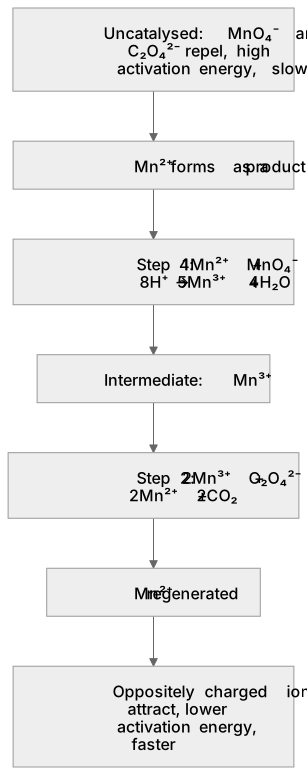
Put it in order
Put these steps in the order they happen.
- 1. Oppositely charged ions attract, lower activation energy, faster
- 2. Mn²⁺ regenerated
- 3. Step 1: 4Mn²⁺ + MnO₄⁻ + 8H⁺ → 5Mn³⁺ + 4H₂O
- 4. Step 2: 2Mn³⁺ + C₂O₄²⁻ → 2Mn²⁺ + 2CO₂
- 5. Uncatalysed: MnO₄⁻ and C₂O₄²⁻ repel, high activation energy, slow
- 6. Mn²⁺ forms as a product
- 7. Intermediate: Mn³⁺
Key words
Say what each word means before you turn the card.
intermediate species
Try answering aloud or in your head before turning the card.
autocatalysis
Try answering aloud or in your head before turning the card.
ion repulsion and high activation energy
Try answering aloud or in your head before turning the card.
two step mechanism
Try answering aloud or in your head before turning the card.
See every definition
- intermediate species
- The species formed between the first and second steps, when the catalyst is consumed in the first step and regenerated in the second.
- autocatalysis
- A product of the reaction catalyses that reaction, as when Mn²⁺ returns at the end.
- ion repulsion and high activation energy
- Both reactants are negative ions that repel each other, so the uncatalysed reaction is slow because the activation energy is high.
- two step mechanism
- The catalyst is consumed in the first step and regenerated in the second, and the species it forms in between is the intermediate.
Label the diagram
Some boxes have lost their names. Pick the right name for each number.
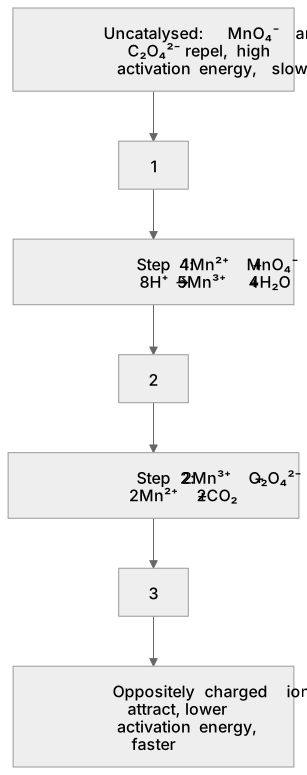
1Box 1
2Box 2
3Box 3
There is more to this lesson
The full lesson goes on to check your understanding and help you earn the marks. Create a free account to carry on, with your progress saved.
A week of Premium from your first lesson · Then the free plan continues · No card, no charge
Test your understanding of Catalysts (A-level only): When catalysts and reactants are in the same phase, the reaction proceeds through an intermediate species.
Active recall beats re-reading. Take an instant quiz now to test what you’ve learned and lock it into long-term memory.
A week of Premium from your first lesson · Then the free plan continues · No card, no charge