AQA · A-Level · Chemistry
Course version: 7405 · Version from Sept 2016
Catalysts work by providing an alternative reaction route of lower…
Full specification wording
Catalysts: Catalysts work by providing an alternative reaction route of lower activation energy.
A catalyst does not push the existing reaction harder; it opens a different one.
Checked against the AQA 7405 specification (opens in a new tab) on .
- Point 2 of 3
- 4 key terms
Study notes
From the checked teaching notes for this specification point.
The idea
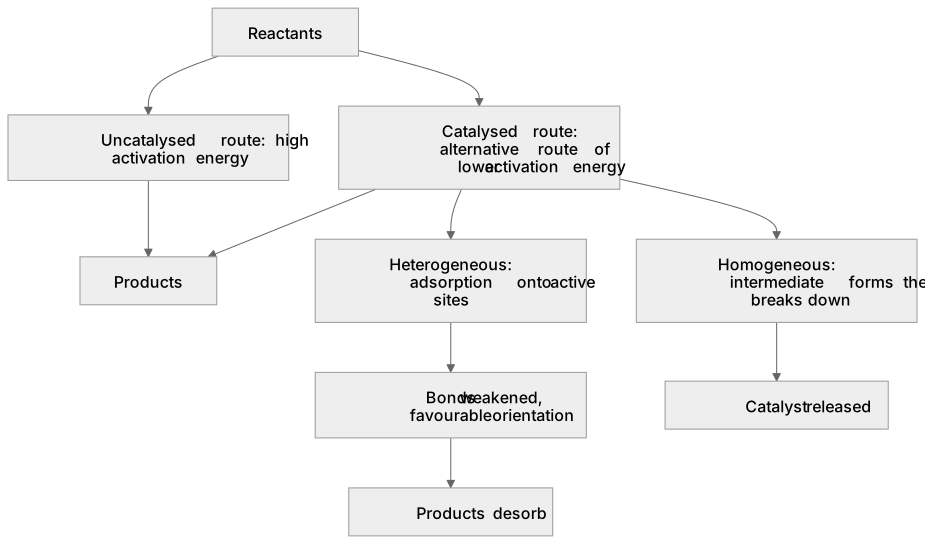
A catalyst does not push the existing reaction harder; it opens a different one. The catalysed route passes through different intermediates and has a lower activation energy, so at the same temperature a much larger proportion of colliding particles now has enough energy to react, and the frequency of successful collisions rises. In heterogeneous catalysis the reactants adsorb onto active sites, which weakens their bonds and holds them in a favourable orientation before the products desorb. In homogeneous catalysis an intermediate forms and then breaks down to release the catalyst. The manganate(VII) and ethanedioate reaction shows why the route matters: two negative ions repel each other, giving a high Eₐ, whereas the positive manganese ions of the catalysed path attract the ethanedioate ions.
What earns the marks
- Stating that the catalyst provides an alternative route or mechanism.
- That route having a lower activation energy.
- Concluding that a greater proportion of collisions is successful at the same temperature.
- Describing the catalysed route in a named example, such as adsorption onto active sites or formation of an intermediate.
- Explaining a high uncatalysed Eₐ by repulsion between ions of like charge, where relevant.
Common mistakes and how to put them right
Saying the catalyst lowers the activation energy of the reaction, rather than providing a route with a lower one.
Claiming the catalyst increases the collision frequency or the energy of the particles.
Stating that the catalyst makes the reaction more exothermic, when ∆H is unaffected.
Drawing a catalysed profile with a different product energy level.
Attributing the effect to the catalyst being a reactant that is consumed.
Exam tips
- Use the exact phrase alternative route of lower activation energy; both halves are credited.
- On a profile diagram draw a second, lower hump between the same reactant and product levels, and label both barriers.
- For an ionic example, explain the high uncatalysed barrier in terms of repulsion between ions of the same charge.
Try the lesson
The start of the Catalysts: Catalysts work by providing an alternative reaction route of lower activation energy. lesson, made from checked teaching notes for this specification point.
Have a go first
Which statement describes how a catalyst increases the rate of a reaction?
Listen
A catalyst does not push the existing reaction harder; it opens a different one. The catalysed route passes through different intermediates and has a lower activation energy, so at the same temperature a much larger proportion of colliding particles now has enough energy to react, and the frequency of successful collisions rises. In heterogeneous catalysis the reactants adsorb onto active sites, which weakens their bonds and holds them in a favourable orientation before the products desorb. In homogeneous catalysis an intermediate forms and then breaks down to release the catalyst. The manganate(VII) and ethanedioate reaction shows why the route matters: two negative ions repel each other, giving a high Eₐ, whereas the positive manganese ions of the catalysed path attract the ethanedioate ions. A strong answer earns marks for these points. stating that the catalyst provides an alternative route or mechanism. that route having a lower activation energy. concluding that a greater proportion of collisions is successful at the same temperature. describing the catalysed route in a named example, such as adsorption onto active sites or formation of an intermediate. Exam tip: Use the exact phrase alternative route of lower activation energy; both halves are credited.
See it
Key words
Say what each word means before you turn the card.
alternative reaction route
Try answering aloud or in your head before turning the card.
lower activation energy
Try answering aloud or in your head before turning the card.
proportion of successful collisions
Try answering aloud or in your head before turning the card.
adsorption on active sites
Try answering aloud or in your head before turning the card.
See every definition
- alternative reaction route
- A different path through different intermediates that a catalyst provides for a reaction.
- lower activation energy
- The catalysed route has a smaller energy barrier than the uncatalysed route, so more colliding particles have enough energy to react.
- proportion of successful collisions
- At the same temperature a much larger share of colliding particles has enough energy to react, so the frequency of successful collisions rises.
- adsorption on active sites
- In heterogeneous catalysis the reactants adsorb onto active sites, which weakens their bonds and holds them in a favourable orientation before the products desorb.
Label the diagram
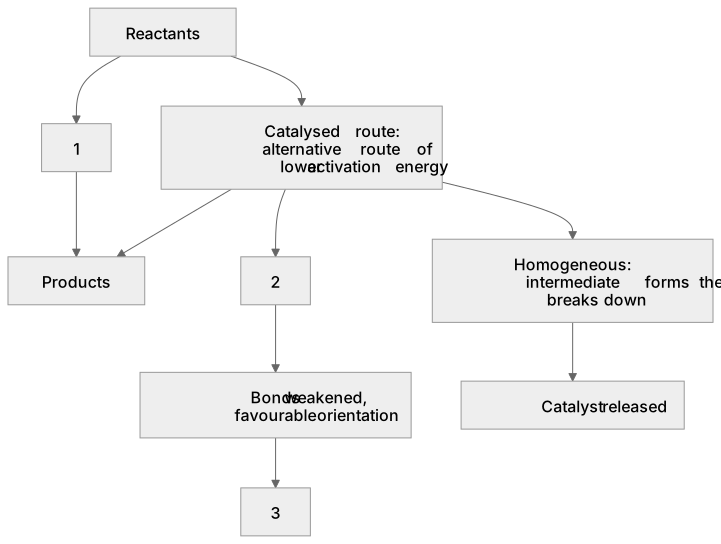
Some boxes have lost their names. Pick the right name for each number.
1Box 1
2Box 2
3Box 3
There is more to this lesson
The full lesson goes on to check your understanding and help you earn the marks. Create a free account to carry on, with your progress saved.
A week of Premium from your first lesson · Then the free plan continues · No card, no charge
Test your understanding of Catalysts: Catalysts work by providing an alternative reaction route of lower activation energy.
Active recall beats re-reading. Take an instant quiz now to test what you’ve learned and lock it into long-term memory.
A week of Premium from your first lesson · Then the free plan continues · No card, no charge